
How to Define Brand Values That Guide Every Business Decision
Brand values are the principles that guide company decisions, define what a brand stands for, and shape how it treats customers, employees, and partners.
Updated November 26, 2025

Every audience is unique, and where they stand on AI vs. real photos could significantly impact their trust and conversion. So, where does your audience stand?
AI visuals are no longer a novelty. Some teams are swapping photo shoots for AI prompts, leaning on generative fill to extend frames, and commissioning "concept" imagery when time or logistics are tight.
Audiences, meanwhile, are noticing. In a recent Clutch survey, 95% of consumers reported at least some concern with brand use of AI images. For anyone responsible for brand trust, conversion, or long-term loyalty, this number is alarming.
Looking for a Public Relations agency?
Compare our list of top Public Relations companies near you
This article maps the top consumer concerns, where customers tend to accept AI visuals (and where they don't), and why explicit AI disclaimers matter. You'll also get a ready-to-use survey template to calibrate your policy against your own audience.
Most brands don't dispute the productivity upside of AI use. However, the friction starts when synthetic imagery breaches customer trust. Here are the four key patterns that show up across our survey datasets.
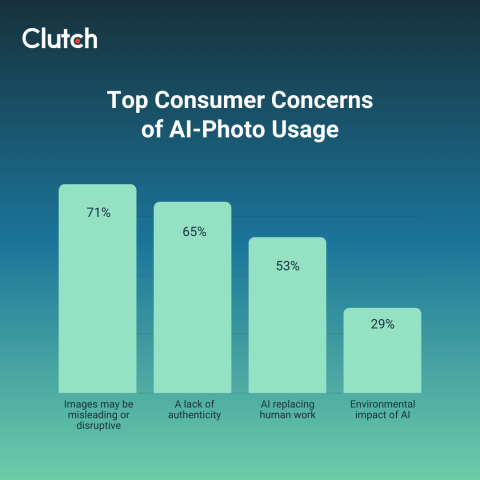
The sharpest anxiety is simple: people don't want to be fooled. According to the Clutch survey, 71% of consumers worry about being misled by the use of artificial intelligence for photography, which aligns with high-profile PR blowups where disclosure lagged or context felt ambiguous. Not to mention, 57% of consumers can't correctly identify AI images.
Recent media incidents reinforce the point. Sports Illustrated faced a reputational storm after reports that AI-generated headshots of journalists and content appeared without clear provenance. Even with clarifications about third-party vendors, the episode became shorthand for "you hid the ball." Reputational damage came less from the presence of AI than from perceived opacity.
What this means operationally: Disclose AI photos, keep internal logs on where/when AI touched an image, and align claims to what the photo actually represents. When teams skip these basics, audiences assume intent to deceive.
In the survey, 65% of consumers said they prefer "real" visuals because they fear AI photos don't represent reality. In categories where proof matters (clothing fit, texture, quality, etc.), AI stand-ins may create hesitation that decreases conversions.
If an AI image appears low-quality or lazy, your audience may deem it "AI slop," a term that reflects growing fatigue with the flood of generic, over-processed visuals that erase brand distinctiveness. When your imagery feels templated instead of tangible, your brand voice starts to fade. Authenticity is built with real-world texture, small imperfections, and personality that make something feel human.
What a brand may see as efficient content operations, many customers interpret as corner-cutting. That's how "AI slop" becomes more than a meme. It turns into a judgment that says, "This brand prioritizes cheap over real."
A 53% majority in the survey expressed ethical concerns, which can include the displacement of photographers, exploitation of creative labor, and simulated diversity that sidesteps genuine inclusion.
The Levi's/Lalaland.ai pilot is a great example here. The company framed AI-generated models as a supplement to expand representation. However, backlash mounted fast, with critics arguing that simulated diversity can't replace hiring real models. Levi's clarified its intent, but the debate shows how quickly "efficiency" can be read as "erasure."
For B2B leaders, the takeaway isn't to avoid experimentation. It's to pair AI usage with real investment in the creative ecosystem, such as on-set crews, photographers, stylists, and models, so your program expands, rather than replaces, human work.
Environmental impact is not the top headline, but it's no longer a fringe issue either. In fact, 29% of consumers in the Clutch survey flagged environmental concerns, which are mostly related to AI's compute-intensive workflows.
As sustainability disclosures become part of enterprise procurement, expect this to creep into Request for Proposal (RFP) language and vendor questionnaires. If your team is going to lean heavily on AI generation runs, consider tracking and communicating the footprint and the steps you're taking to mitigate it (for example, optimizing inference pipelines or using greener regions).
Most customers don't think in strictly black-and-white terms. That's why AI acceptance rises or falls based on use case and intention.
While a minority, a meaningful 18% of consumers say that brands should never use AI photos. You won't convince this cohort with disclaimers or clever copy. If your brand's audience skews toward this minority, adopt a conservative policy and reserve AI for internal ideation, not public-facing imagery, or forego it altogether.
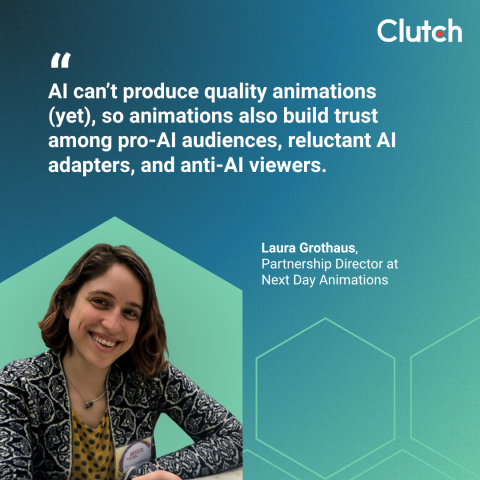
One alternative to using AI is through the use of illustration and animation. Laura Grothaus, Partnership Director at Next Day Animations, reports, "We’ve found that illustration and animation are excellent tools for navigating these complex issues of representation. Through animation, artists can manipulate time, space, and perspective. This allows for innovative and sensitive portrayals of challenging situations." Grothaus adds, "AI can’t produce quality animations (yet), so animations also build trust among pro-AI audiences, reluctant AI adapters, and anti-AI viewers."
Acceptance rises when everyone understands the visual isn't claiming to be real:
Done well, these uses can be effective. Heinz's "A.I. Ketchup" played with the question "What is ketchup?" using text-to-image prompts. The brand earned broad attention without pretending the images were real-world product photos. This proves how AI imagery can also amplify brand prominence without undermining trust.
Approval collapses when AI gets close to mimicking reality:
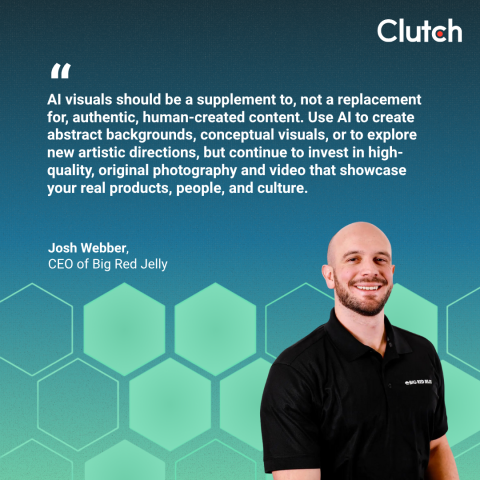
In short, the closer AI gets to representing reality, the more skeptical audiences become. Or, as Josh Webber, CEO of Big Red Jelly, puts it, "AI visuals should be a supplement to, not a replacement for, authentic, human-created content. Use AI to create abstract backgrounds, conceptual visuals, or to explore new artistic directions, but continue to invest in high-quality, original photography and video that showcase your real products, people, and culture."
That framing aligns with the previous Levi's example and with the reception to concept-heavy campaigns such as Heinz's. Keep the conceptual ideas synthetic, but the actual promise or product real.
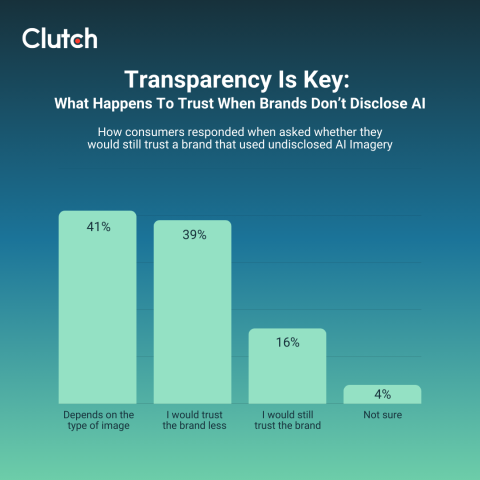
Treat AI disclosure as a brand-safety instrument, not a mere legal afterthought, because 84% of consumers say it's important to them.
When brands don't disclose AI:
Regulators are also monitoring the broader space. The U.S. Federal Trade Commission (FTC) has flagged deceptive AI claims and content as an enforcement priority. If your image communicates (or implies) product attributes, and those attributes aren't real or are only true under narrow conditions, you're in the strike zone. So it's advisable not to anchor your policy to blog chatter; instead, anchor it to the simple rule the FTC repeats: ads must be truthful and not misleading—period.
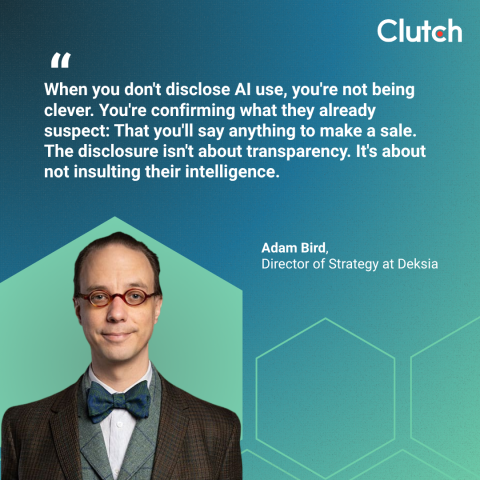
The strategic case for clear labeling is even stronger than the compliance case. As Adam Bird, Director of Strategy at Deksia, puts it, "When you don't disclose AI use, you're not being clever. You're confirming what they already suspect: That you'll say anything to make a sale. The disclosure isn't about transparency. It's about not insulting their intelligence."
In other words, AI labeling is a sign of respect. It tells experienced buyers that your team understands context, has nothing to hide, and treats audience cognition as an asset. In B2B cycles where lengthy consideration and multiple stakeholders amplify risk, a single unlabeled AI product shot can erode years of credibility-building.
Practical guidance you can put on a one-pager:
Of course, AI imagery can play an essential role in conceptual storytelling. However, the moment it pretends to be a real scene or object, scrutiny climbs. So calibrate your policy to industry norms and buyer expectations, not just internal efficiency targets.
Practical steps you can take:
Ready to pressure-test your AI policy against your audience? Use our free Ready-To-Use Survey Template to collect structured feedback across acceptance thresholds, disclosure preferences, and use-case boundaries.
If you find your audience is accepting of AI usage, be sure to work with a top-rated branding agency to ensure you use AI photos responsibly and in a brand-aligned way.
If your audience prefers that you avoid AI images, connect with a talented graphic design agency or animation company to bring your concepts to life.
Ready to pressure-test your AI policy against your audience? Use our free survey template to collect structured feedback across acceptance thresholds, disclosure preferences, and use-case boundaries.