![How to Make a Budget for Print Design [With Template]](https://img.shgstatic.com/clutch-static-prod/image/resize/715x400/s3fs-public/article/d593c4d0f16292c1f26270424626b50f.png)
How to Make a Budget for Print Design [With Template]
Discover how to prepare an effective budget for your print design needs through this piece.
Updated May 26, 2026

As AI continues to dominate the digital design landscape, hand-drawn designs bring brand identities to life by offering a refreshing, authentic touch that brings personality and warmth.
Ever since Midjourney and Dall-E started making waves in the online space, one thing has become clear: the future of graphic design is about to change. Then, Canva introduced its artificial intelligence (AI) design features. Now, we have full-fledged graphic design companies like Napkin AI, which are creating AI agents that can do everything from brand design to illustrations and more.
However, increasing AI involvement in graphic design has also led to a longing for the human touch. Hand-drawn elements fulfill this desire by providing a design with an authentic and personal feel.
Looking for a Graphic Design agency?
Compare our list of top Graphic Design companies near you
Recent survey data from Clutch shows that 95% of consumers express some level of concern about AI imagery, citing issues like deception, lack of authenticity, and ethics. Even as AI becomes a common tool, the demand for human-centered design has never been stronger.
Discover how to transform your brand to be more human-centered with hand-drawn designs.
While it can be tempting to incorporate hand-drawn design elements in all areas of your branding, it's best to be selective on where they will be the most effective. Hand-drawn designs have the highest impact in areas where consumers interact most with your brand, such as packaging and social media.
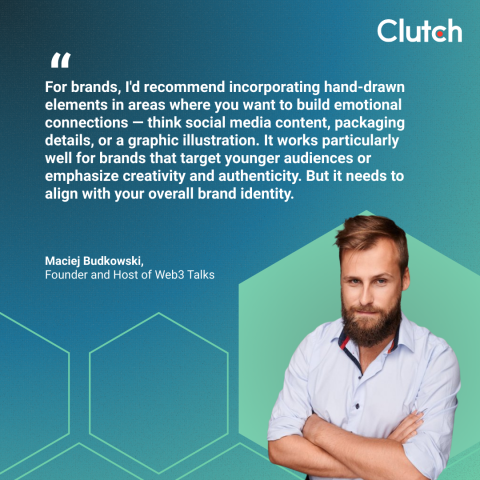
As Budkowski recommends, "For brands, I'd recommend incorporating hand-drawn elements in areas where you want to build emotional connections — think social media content, packaging details, or a graphic illustration. It works particularly well for brands that target younger audiences or emphasize creativity and authenticity. But it needs to align with your overall brand identity."
Keeping this advice in mind, you can include hand-drawn elements in the following areas:
In addition to the deprivation of the human touch in this virtual age, several other factors contribute to the rising popularity of hand-drawn elements. These factors have a lot to do with the psychological impact of visuals and the sense of nostalgia that hand-drawn elements evoke.
According to an EY Pulse survey, nearly 50% of the respondents (business leaders and senior executives) reported their organization's enthusiasm for AI adoption and integration has declined. The trend is prevalent across industries as more people find AI too ingrained in their daily lives.
AI fatigue has led to a renewed appreciation for the human touch, even in design. The demand for authenticity has increased, especially since AI-generated designs tend to look quite similar.
Many AI-generated designs, especially logos and branding, seem eerie. Rafal Blecharz, Vice President of Animwood, also notes this: "AI-generated results tend to be quite homogenous — both in their final appearance and in their polished, almost-too-perfect aesthetic. I believe this has made people more skeptical of creative outputs, leading to a shift toward a more human-centric approach."
This skepticism is reflected in consumer data as well. In a recent survey, Clutch found that 66% said they were confident they could spot AI-generated images, but when tested, 57% failed. This gap between confidence and accuracy highlights how easily AI can undermine trust and why human-centered, hand-drawn design feels more authentic and reassuring to audiences.
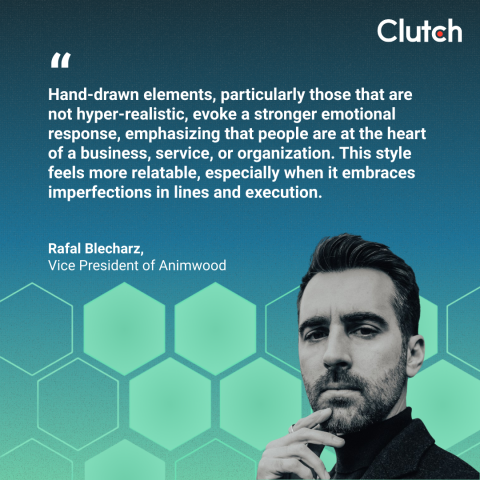
As a result, there's a gravitation towards hand-drawn elements, as they add a personal touch that AI can't replicate. Blecharz further explains, "Hand-drawn elements, particularly those that are not hyper-realistic, evoke a stronger emotional response, emphasizing that people are at the heart of a business, service, or organization. This style feels more relatable, especially when it embraces imperfections in lines and execution."
There's no denying that relatability has become the thread connecting businesses to their customers, whether in marketing or branding. The same holds true for design.
Consumers feel connected to brands with personalities, so it's no surprise they buy from them. In fact, 57.5% report buying from brands with strong personalities, while 51.2% base their decisions on how brands speak online.
AI-generated designs often fail to differentiate brands due to the "sameness" we've come to associate with AI outputs. In contrast, personalized hand-drawn elements make a brand feel more approachable.
As Maciej Budkowski, the Founder and Host of Web3 Talks, puts it, "Hand-drawn elements bring warmth and personality that consumers find refreshing." They also make brands feel more authentic, as they haven't been created by a machine but by a human with individual creative choices and imperfections.
Hand-drawn elements can evoke nostalgia, which can be a powerful marketing tool. Nostalgia core has become a popular aesthetic these days, and for good reason.
People crave the old-school aesthetic of a time when things were less digital. By using hand-drawn elements, businesses can tap into this longing for the past and create a sense of familiarity and comfort in their branding.
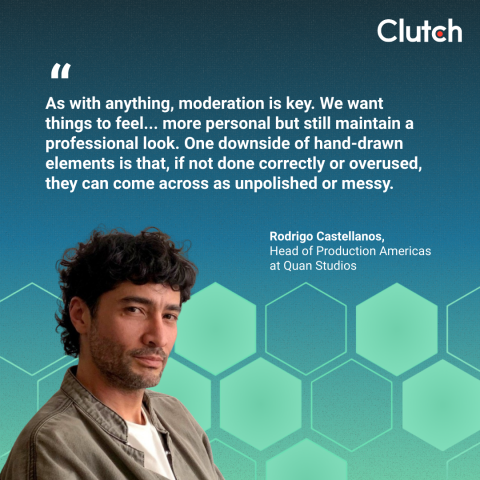
A blend of traditional graphic design and hand-drawn elements usually works better than relying solely on one or the other. As Rodrigo Castellanos, Head of Production Americas at Quan Studios, explains, "As with anything, moderation is key. We want things to feel closer and more personal but still maintain a professional look. One downside of hand-drawn elements is that, if not done correctly or overused, they can come across as unpolished or messy."
So, when using hand-drawn elements, make sure they add the personality you're looking for, but not at the cost of overwhelming the overall brand aesthetic. Only use as much as is needed without sacrificing the professional look.
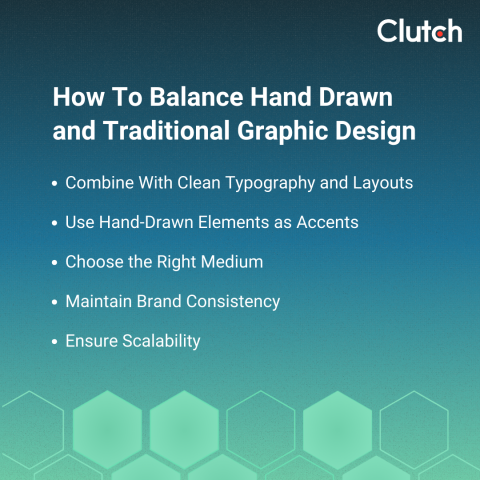
When hand-drawn visuals are combined with modern typography and clean layouts, a striking contrast can be created that catches the viewer's attention while maintaining a professional feel. As Blecharz suggests, "On websites, for example, graphical elements and visuals are valuable additions, but the overall layout should be designed traditionally, using standard fonts to ensure proper SEO, easy navigation, and scalability across mobile and tablet screens."
This way, you mix hand-drawn and digital fonts to create a stellar visual experience while keeping the website user-friendly.
Hand-drawn elements don't necessarily have to take all the attention. They could just be used as accents to emphasize certain parts of the design.
Budkowski recommends, "Use hand-drawn elements as accents rather than the foundation — perhaps in illustrations or secondary typography — while keeping your primary navigation and key information in cleaner, more traditional designs. The key is creating a contrast that feels intentional rather than chaotic." Since the hand-drawn elements are sprinkled in as accents, they won't overpower the overall design and still add that personal touch.
Select the medium that best suits your design and message. Hand-drawn elements can be created using pen and paper or digitally on a tablet or graphics software. Each medium creates a different style and effect, so choose the one that best suits where you want to display your design.
For example, graphics software is better for web design, while pen and paper may be more suitable for packaging or print designs.
Hand-drawn elements should not appear as an afterthought in your design. Instead, they should seamlessly complement your brand's overall aesthetic.
Decide on one style or color palette and then stick to it. Make sure these elements are consistent across all your designs for easy brand recognition and cohesion.
Blecharz points out, "The limitations of hand-drawn elements are most apparent in responsive design, and this needs to be carefully considered before implementing anything in a digital format." The hand-drawn elements you create should be adaptable to different sizes and formats so they can be used in various mediums without losing their quality or impact.
You can create vectors or use scalable fonts to easily resize your hand-drawn elements without losing clarity. This keeps them legible in different sizes.
As effective as hand-drawn elements are, AI shouldn't be shunned entirely. AI remains a useful design tool when used responsibly. Survey data show that consumers are most receptive to AI visuals in imaginative or conceptual contexts, such as fictional scenarios, illustrations, or unsafe-to-photograph situations. There are many ways that AI can assist design processes, including:
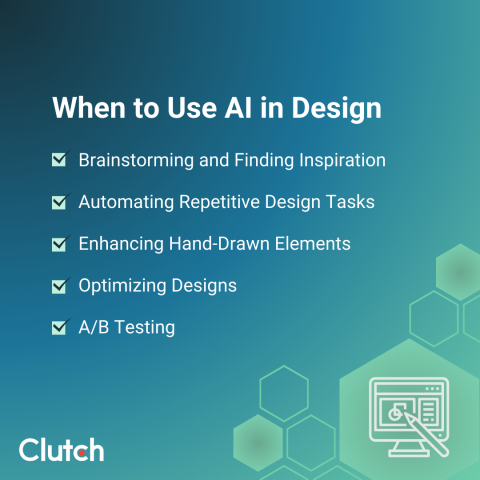
AI's primary use case is for brainstorming ideas. Budkowski says, "We see it as a powerful tool for ideation and rapid prototyping. It's great for generating initial concepts or variations that designers can then refine and personalize."
Castellanos also says, "Personally, I use it as a playground to find inspiration." Once you get that initial idea with AI's assistance, you can run with it and add your own touch.
The most common use of AI in any field is likely the automation of repetitive tasks. You can do the same in design. For example, AI can be used to generate color palettes or create variations of a logo. It saves you time and speeds up workflows to get more done in less time.
AI can also help clean up and enhance hand-drawn elements. Designers can use AI-powered software to refine their sketches and create vectors, making resizing and adapting them for different mediums easier.
Once you've created a design, you can optimize it using AI for different platforms and devices. Even better, AI can assist in making improvements to your design based on user behavior and preferences for each platform.
In the past, you had to create multiple design variations and manually test them to determine which worked best. AI saves you all this time and effort.
You can use it to test variations of hand-drawn designs, color schemes, or website layouts. The AI will gather data and insights on which design elements perform best. Go ahead with the most effective design and continue to iterate until you reach the desired results.
Hand-drawn design brings nostalgia, personality, and a human touch to your visuals, while AI adds efficiency and precision. By combining the two thoughtfully, designers can create work that is both authentic and highly effective, resonating with audiences and standing out in a crowded market.
To ensure your brand captures this balance, consider working with a top-rated graphic designer. Browse the Clutch directory of graphic design companies to find experts who can help you incorporate hand-drawn elements, leverage AI responsibly, and elevate your visual identity.