
What 25 Years of Design Projects Taught Us About What Clients Actually Need
That moment changed the way we ask questions at the start of a project. Twenty-five years in, the work has touched organizations of every kind: enterprise...
Updated April 9, 2026

Test your ability to tell truth from fiction with our AI photo quiz. 57% of people can’t spot all the fakes, a recent Clutch survey found. How high will you score?
Early AI pictures weren’t exactly subtle. They almost always botched human hands, for one. Physics-defying architecture and nonsensical letters were other telltale signs that you weren’t looking at real photos.
But as image generators improve, it’s not as easy to tell the difference between AI versus real photos. That’s a problem, because according to Clutch data, more than half of people can’t currently identify them. And if you don’t know how to spot them, you might get duped by fake product photos or ads.
Ready to test your skills? Try our quick AI photo quiz for yourself, then scroll down for the results.
If you got a perfect score, you've got an elite AI spidey-sense. But if you didn’t answer every question correctly, you’re not alone. Before taking this test, 66% of customers said they were confident they could spot AI imagery. But that dropped to 56% after completing the quiz.
Here’s why it’s so tricky to distinguish AI versus real photos.
Everyone loves jaw-dropping nature photography, but sometimes those epic shots are too good to be true.
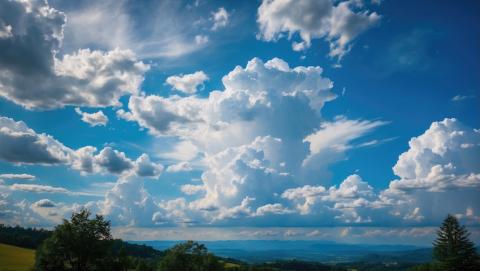
With its fluffy clouds and realistic colors, this image almost looks like something you’d see outside your own window. Maybe that’s why the responses were evenly divided:
Takeaway: Even simple scenery creates confusion.
Look closely, though, and you’ll see that the lower clouds have suspiciously flat bottoms, with more clouds crammed beneath them. And the trees in the bottom left corner look oddly blob-like. Definitely AI.
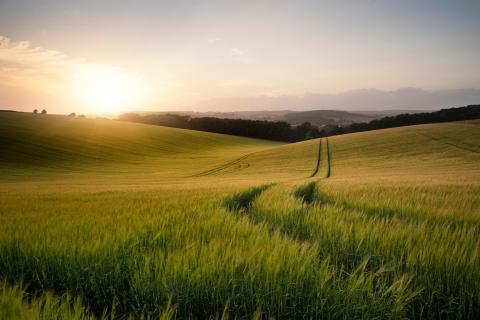
Maybe people were more wary when they got to Image Two, or those gently rolling hills looked a little too perfect. Either way, this question duped more test takers:
Takeaway: Natural details like fields are surprisingly deceptive.
This is definitely a tricky one, but there are a few clues that it’s real. The most obvious hint is the wheat plants closest to the camera, which are incredibly detailed and consistent. AI image generators often struggle to mimic natural textures.
Zoom in on the horizon, too. The trees and rolling hills have irregular shapes, just like you’d see if you were strolling around the farm in person. AI tends to make those sorts of background details unnaturally uniform or blurry.
When it comes to sizing up photos of humans, our test-takers were more accurate. That makes sense. You look at other people all the time, so it’s easier to instinctively spot those slightly uncanny, AI-generated details.

If you spend a lot of time on LinkedIn, you may be tempted to spruce up your profile with an AI headshot. However, there's a good chance your connections will spot that it isn't real. Many of our test-takers correctly identified the origins of this headshot:
Takeaway: AI image generators still struggle with human anatomy.
Pay attention to how far away the man’s right wrist is from his hand. He’s either setting a world record for the longest wrist, or, more accurately, it’s AI-generated.
Unlike real photos, AI headshots also tend to be flawless, as though they’ve been overly edited. The man’s hair looks perfectly smooth, with none of the flyaways you’d see in an actual outdoor photo. Plus, his beard and hair are oddly multi-colored, with random patches of white and gray.
The biggest giveaway, though, is the wrinkles. If you zoom in, you’ll quickly notice that they don’t look like they’ve been shaped by natural facial expressions. After all, most people don’t have deep creases running from under their eyes all the way down the side of their face.

On the other hand, Image Four looks much more natural. Here’s how quiz takers voted on it:
Takeaway: Real photos of human faces are filled with natural flaws and quirks.
This woman’s hair is frizzy and full of movement, as though she’s been hiking all day in the wind. It’s a stark contrast to the perfectly smooth hair in the previous photo. Another green flag is her teeth, which aren’t perfectly even and straight like AI-generated smiles. And her skin has plenty of natural texture around the mouth and eyes. So far, AI can’t convincingly recreate these kinds of authentic details.
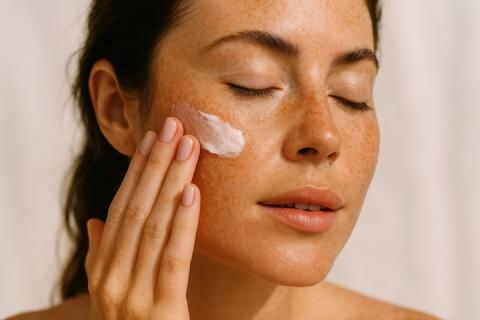
We get another close-up of a woman’s face in Image Five, but this one isn’t real. Despite this, it tripped up more people than the previous question:
Takeaway: This is a strong example of how lifestyle AI pictures slip under the radar.
At first glance, this photo looks totally convincing. There are no surreal hand distortions, and her lips are textured like a real woman’s. But those fingernails might be too uniform, and those eyebrows are impeccably brushed. Most people also don’t have such perfectly spaced freckles across their entire face. The verdict: AI.
Comparing AI vs real images can help you train your brain to pick up on sneaky differences.

Okay, so you already know that hands are AI’s kryptonite. Here’s how people guessed which close-up image was AI:
Takeaway: Hands remain one of the hardest features for AI-generated images to get right, yet people still struggle to tell the difference.
It mostly comes down to texture. The woman’s hands have realistic wrinkles around the knuckles, where the fingers naturally bend. On the other hand, the back of the man’s nearer hand is weirdly scaly, as though the AI generator confused alligator and human skin. And why would anyone be wearing two watches?
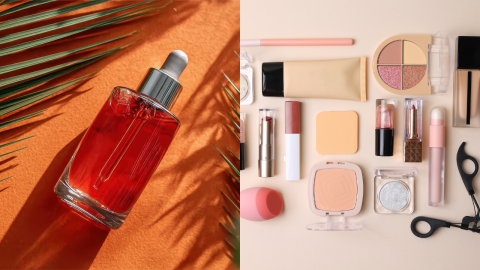
While comparing images of humans can be tricky, AI-generated product photos are less challenging. The majority of people correctly identified the AI image:
Takeaway: Artificial product photos are often easier to detect.
The second image has many different textures and colors that all look realistic. On the other hand, the shadows in the first visual don’t make sense, especially for the fronds on the right side. The liquid inside the bottle is also a clue. Wouldn’t any air bubbles show up in the center of the bottle, not on the side?
AI-generated pictures are becoming more convincing, but sharp-eyed viewers can still spot subtle tells. Odd textures, shadows, and natural features are just a few red flags to look for.
Of course, AI imagery isn’t inherently bad. Over four out of five (82%) customers are open to seeing AI photos, but context matters. Want to show a dragon perched on your building? AI away. For images of humans or products, though, many people still prefer the real thing.
For marketers and business owners, transparency is key. Always disclose when you’ve used AI-generated imagery and why. For example, you might use AI photos for products that don’t exist yet to help your audience see your vision. By explaining your rationale, customers are less likely to feel like you’re trying to dupe or manipulate them.
Can your friends and co-workers spot AI visuals? Share your results, and challenge them to take the quiz themselves.