What Are AI Influencers? A Guide to Virtual Creators
AI influencers abound on social media. Clutch explains what they are, why brands partner with them, and whether people can tell them apart from human...
Updated August 5, 2026

From reviewing resumes to ensuring compliance, AI interview software can help small businesses hire more efficiently and effectively. Finding the right tools for you depends on the volume of applications you receive, your existing tech stack, and your recruiting budget. Read on to learn more about AI interview software available and how to make the right choice for your business.
Hiring has always been a challenge for small businesses, and AI is making it even harder to keep up with the growing volume of applications. You don't want to waste time on applicants who aren't qualified, but you also don't want to screen out a unicorn candidate accidentally.
Thankfully, AI also offers small businesses more ways to streamline candidate screening without adding to their hiring team.
Looking for a Artificial Intelligence agency?
Compare our list of top Artificial Intelligence companies near you
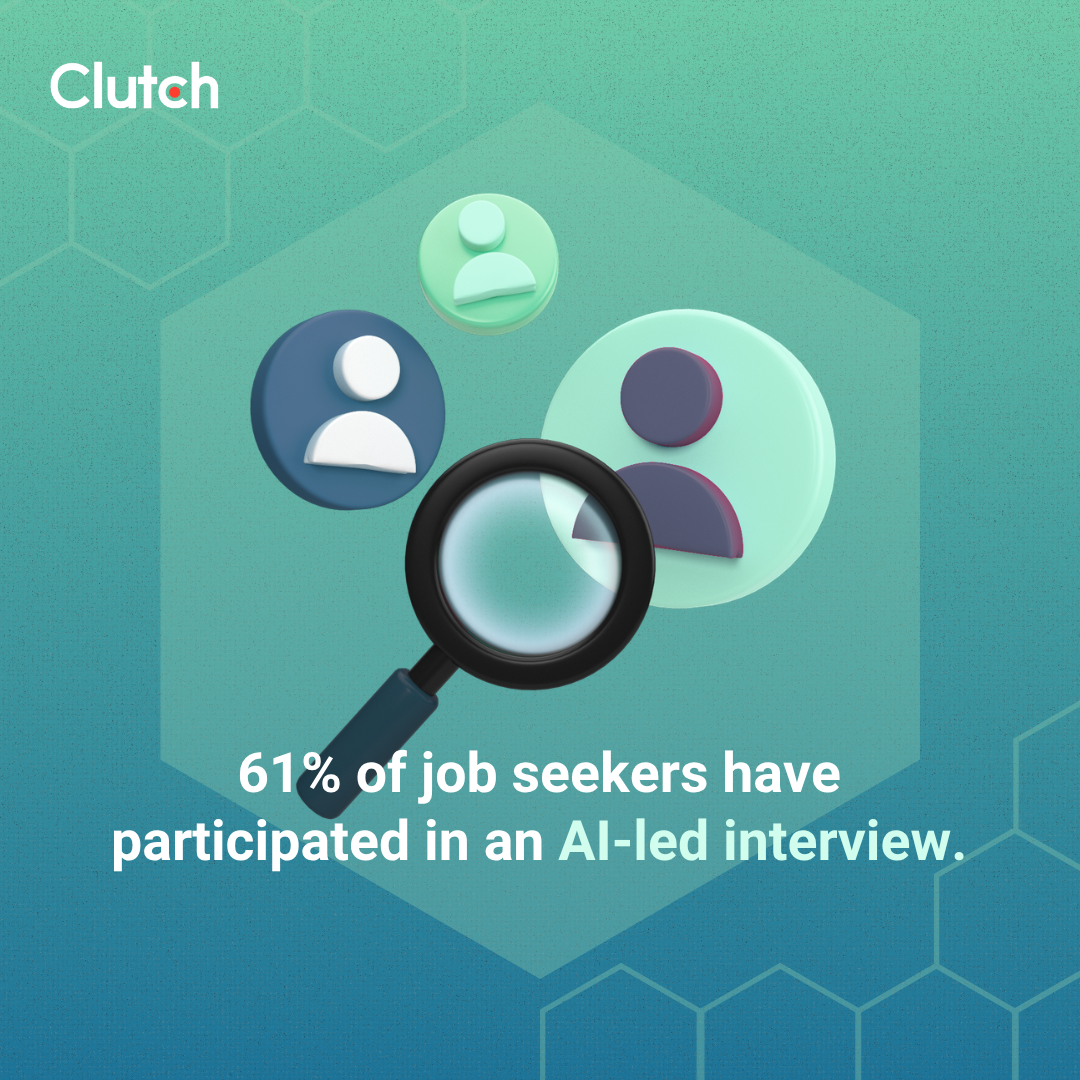
The hiring landscape is changing rapidly. In a recent Clutch survey, 61% of job seekers have already participated in an AI-led interview.
Candidates increasingly expect AI as part of their job search, and when implemented thoughtfully, it can save businesses significant time and reduce hiring costs. But poorly designed AI experiences can frustrate candidates and cause them to abandon the application process altogether.
In this article, you'll learn the best AI interview software options for small businesses, as well as how to use AI ethically and effectively to find the right candidates.
AI interview tools are not all the same. Lean, scalable software that works for tech startups may not be suitable for larger organizations with significant compliance exposure. Here’s what you should consider when evaluating AI interview software:
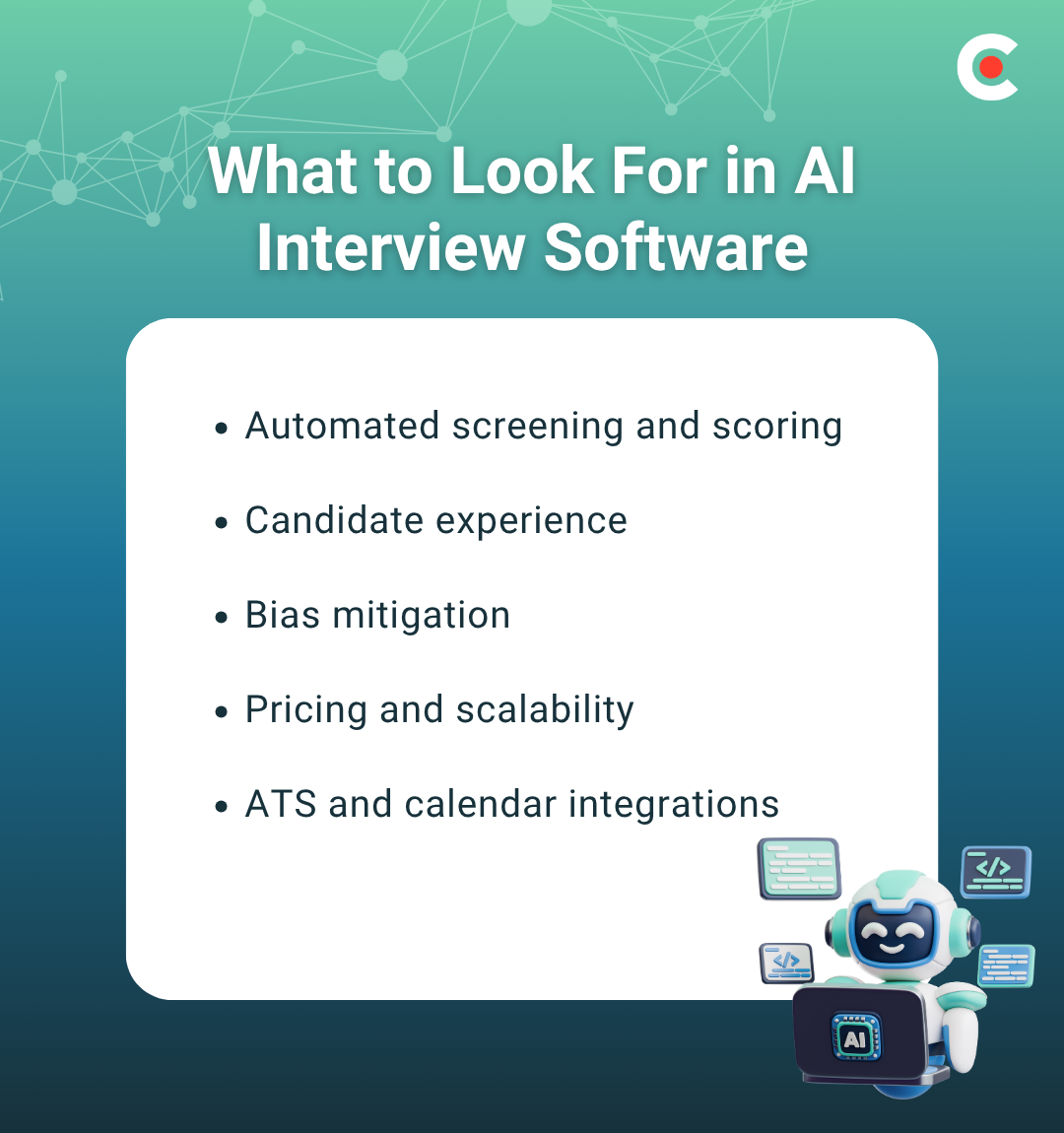
AI tools can help small HR teams sharply cut the time they spend conducting screening interviews. Look for tools that either conduct agent-based interviews or provide AI evaluation on asynchronous videos. These evaluations should score candidate responses against role-specific criteria and produce a ranked shortlist for HR to follow up on.
The way your AI tool scores and ranks your applicants matters. Ask potential vendors whether they use keyword matching, semantic analysis, behavior indicators, or other techniques. Their answer will tell you a lot about how sophisticated the software is, and if there's any potential for bias.
The job application process can be frustrating for candidates. Many have either had a poor experience with an AI-led interview or heard a horror story from someone else. Data from Greenhouse shows that 38% of job seekers have abandoned a hiring process because it included an AI interview. Poor user experience costs you applicants, and the best candidates tend to be the first to leave.
Look for AI interview software that your candidates won't hate using. A mobile-friendly interface and clear instructions are vital. Reasonable time limits, as well as prompt follow-up, help candidates feel assessed instead of processed.
If your AI-assisted hiring process screens out one particular demographic group, you're on the hook, not your vendor. Employers are responsible for any disparate impact in hiring, regardless of whether they use AI. Some states, including Colorado, Illinois, California, and Texas, as well as New York City, have already implemented additional laws around AI in hiring.
AI can also complicate ADA compliance. If a disabled candidate cannot complete an AI assessment, you must provide an accessible alternative.
Most importantly, all of these laws apply no matter the size of the company. A 10-person business has the same obligations as a Fortune 500 firm. With so much at stake, businesses shouldn't take a vendor's word about bias at face value.
Make sure your interview tool comes with an independent third-party bias audit, transparent scoring methodology, and documentation you can provide should there be a challenge.
Pricing models for AI interview software present additional challenges for small and medium-sized businesses. An enterprise annual contract may make sense for a large firm with more than 500 employees, but smaller organizations should consider pay-per-use, pay-per-seat, or freemium models. These allow you to get the most from your software without breaking the bank.
However, you should also look for a platform that can grow with your business. As you scale in size, there shouldn't be a surprise change to a higher pricing tier when you go from hiring five employees a month to hiring 50. Flag any pricing that isn't transparent and easy to understand, and push vendors for a real quote that includes all fees.
Any AI interview software you choose should fit seamlessly into your existing hiring workflow, including your applicant tracking system (ATS) and calendar scheduling tools.
If recruiters have to manually export interview results, update candidate records, or send scheduling emails, the software isn't saving time—it's creating extra administrative work. The best platforms automatically sync candidate information, interview recordings, evaluation scores, and interviewer feedback with your ATS, while integrating with calendars like Google Calendar and Microsoft Outlook to coordinate interviews without back-and-forth emails.
These integrations are especially important for small businesses with lean HR teams. Rather than juggling multiple systems, recruiters can manage the entire hiring process from a single workflow, reducing manual tasks, minimizing errors, and ensuring every interviewer has access to the latest candidate information.
The diversity of AI interview tools means that each SMB can find one that's right for them. Here are a few of the top AI interview tools:
If your team needs to hire fast and fuss-free, check out Breezy HR. It's quick to set up, easy to integrate, and simple to use for both recruiters and candidates. Breezy offers a free intro tier, and credits for AI services are only $30 per month
The platform includes both ATS and video interviewing, along with light AI screening capabilities, and drag-and-drop pipeline management. However, the AI screening features are less sophisticated than other tools on the market, so it may not be the best fit for companies with large candidate pools.
Purpose-built for small businesses hiring without a dedicated HR team, Truffle offers an all-in-one interviewing solution. It combines resume screening, one-way video interviews, and talent assessments in an easy-to-manage workflow. There's no enterprise complexity, and no implementation team required.
Truffle's multiple assessment tools can help small teams quickly conquer a mountain of applications. As a newer tool, though, Truffle has less brand recognition among candidates, which could affect your recruiting process.
Manatal provides AI-powered candidate scoring for easier screening. It also offers strong resume parsing across multiple sources, including LinkedIn, email, and job boards. It's a great tool for small businesses that want an ATS system and a variety of AI capabilities without paying for a full recruiting suite.
Starting at $15 a month, Manatal deploys quickly. However, that nimbleness comes with less robust video interview features than other tools.
If your business is just starting to hire new employees, budgeting for and picking the right interview tool may feel overwhelming. With a free plan available and a premium tier starting at only $30 a month, Zoho Recruit is ideal for really small businesses, especially if they're already set up in the Zoho ecosystem. It offers AI-powered resume parsing that turns information from PDFs, LinkedIn, and Gmail into structured profiles.
However, Zoho Recruit's AI interview features are more basic than those of dedicated platforms. Teams with a larger budget or those managing a large number of candidates may prefer another tool.
JuggleHire costs more than other services, with a $79 monthly flat rate. However, that price includes job posting, candidate tracking, a career page, team collaboration, and asynchronous video interviews. And with no increase in costs as you ramp up hiring, it's great for businesses looking to scale while managing recruiting costs.
While the predictable pricing and suite of features are great for small businesses, JuggleHire doesn't have the name recognition of other tools, and there are fewer third-party reviews.
| Best for | Starting Price | Interview Type | Bias Audit Available? | ATS Included? | |
| Breezy HR | Recruiter and candidate experience | Free, $30/month for optional AI credits | Asynchronous video | No | Yes |
| Truffle | Teams without a recruiter | $49/month | Asynchronous video with AI Ranking | Yes | Yes |
| Manatal | Low-cost AI features | $15/month | AI Agent | No | Yes |
| Zoho Recruit | Freemium model | Free, $30/month for premium | Asynchronous video | No | Yes |
| JuggleHire | All-inclusive value | $79/month flat rate | Asynchronous video with AI transcription | No | Yes |
Think through what your business needs to find the software program that works best for you.
Each small business is a little different, so choosing the right one depends on your specific needs. To begin the selection process, start by understanding your hiring volume, your compliance needs, and your existing HR software. Then, if possible, trial it with a new hire.
A company that hires a few people a year has very different needs than one that averages a few hires a month. Businesses that hire fewer people should prioritize tools that are easy to use, especially for the interviewee. Candidates often apply to small businesses seeking a less formal and anonymous work environment, so a difficult-to-use AI tool may be off-putting.
On the other hand, businesses hiring 30+ employees per year may receive thousands of applications. Look for features that prioritize automation, ensure consistent scoring and ranking, and integrate well with your other software. That way, you can focus on the candidates who will really add value to your organization.
Even small businesses have to comply with federal and state anti-discrimination laws. Ask your vendor directly if their tool has an independent bias audit. If they say they are hesitant to provide information on it, that's a sign to slow down and do more research.
Even if your state hasn't passed AI hiring regulations yet, that doesn't mean it won't. Choosing a platform with strong compliance features now can help you stay ahead of evolving requirements.
Most AI interview tools offer a free trial, and your team should consider taking your favorite prospective tool for a spin before paying a monthly fee. Try it out with a low-stakes role and keep an eye on who completes the process. A high dropout rate means the tool could be making it harder, not easier, for you to hire.
A tool that doesn't integrate with your existing tech stack will only make your life more frustrating. Confirm that your prospective interview software integrates with your calendar and any existing ATS and HR tools.
AI interview software introduces several ethical considerations, so hiring teams should use these tools carefully to minimize bias and maintain a positive candidate experience.
The most important principle: AI can help evaluate candidates, but humans should always make the final hiring decisions.
You can start by being transparent about how and where AI is used in your hiring process. While many job seekers see AI as less biased than human reviewers, some remain hesitant about AI interviews. Clearly explaining how the technology works and providing a human point of contact for questions can build trust and reduce candidate drop-off.
You should also strive to keep AI interviews short. One-way interviews that run longer than 20–25 minutes can have higher abandonment rates. Longer interviews may make candidates feel disrespected, especially since they're conducted in a way designed to minimize inconvenience to the employer.
Most importantly, regularly audit your AI-interview results quarterly and analyze the demographic patterns. If you see one group that disproportionately advances—or doesn't advance—investigate right away. You could be at risk of a disparate impact claim, and if your process excludes certain groups, you may not be finding the best candidates either.
AI interview software can help small business owners get a leg up on hiring, even when they have specific compliance, workflow, or technical requirements. By automating time-consuming screening tasks, these tools allow lean recruiting teams to evaluate more candidates, reduce administrative work, and focus on top applicants.
However, choosing the right AI interview software and implementing it effectively requires careful thought and consideration. The best solution should align with your hiring goals, integrate with your existing tools, protect candidate data, and provide a transparent experience for applicants.