
How Consumers Feel About AI in Social Media: What They Welcome (and Don't)
New Clutch data shows how consumers feel about AI in social media marketing, where they welcome it and where they draw a hard line.
Updated August 27, 2026

Social media marketing is an essential business tool, but its direct impact can be hard to measure. Learn how to avoid these 4 common mistakes from popular examples to see results.
Business social media fails come in two flavors: the famous ones (a viral brand blunder that trends for days), and the quiet ones (an account that never gains traction, generates no leads, and eventually gets abandoned). Both share the same underlying causes — unclear goals, wrong platform, random content, and no plan for the customer buying journey — plus one new addition: AI-generated content that audiences detect and punish. This article covers five famous business social media fails and what they teach, the four reasons brands consistently stumble, and how to avoid both.
Pepsi released a commercial showing Kendall Jenner joining a street protest and defusing tensions by handing a police officer a Pepsi. The ad drew immediate backlash for trivializing real protest movements — particularly Black Lives Matter — and Pepsi pulled it within 24 hours.
Looking for a Social Media Marketing agency?
Compare our list of top Social Media Marketing companies near you
The lesson: don't co-opt serious social movements to sell soda. If your brand doesn't have real credibility on an issue, don't build a campaign around it. Tone-deaf campaigns spread faster on social than any planned messaging does.
Balenciaga released a November 2022 holiday campaign featuring child models with teddy bear accessories that many viewers found disturbing. A separate simultaneous partnership shoot compounded the crisis — court documents from a Supreme Court child protection case were visible as background props. The two campaigns landing at the same time made the "coincidence" defense difficult to sustain.
Backlash was immediate and severe: brand ambassadors distanced themselves, Balenciaga pulled the campaigns and issued public apologies, and the fallout continued for months.
The lesson: creative vetting has to be layered, especially when children appear anywhere in campaign imagery. When even a single element clears review that shouldn't have, the campaign becomes the story — and no clarifying statement fully undoes the initial reaction. Multi-layer human review of every asset before publication is now standard practice at brands operating at this scale.
The "Willy's Chocolate Experience" in Glasgow used AI-generated marketing imagery to promote what turned out to be a bare warehouse with a few decorations, a bouncy castle, and small paper-cup portions of jelly beans.
The AI images set expectations the physical event couldn't come close to meeting. Families demanded refunds, police were called, and the event became a global social-media punchline within hours.
The lesson: AI-generated marketing imagery creates a promise. If the physical experience can't back it up, the gap between promise and reality becomes the story. This is a specific case of a broader 2020s fail category — using AI to raise expectations you can't meet.
Coca-Cola released an AI-generated recreation of its classic 1995 "Holidays Are Coming" holiday advertising campaign.
The ad drew criticism from artists, ad-industry figures, and consumers who saw it as devaluing human craft in favor of AI shortcuts. Even viewers who supported Coca-Cola's underlying strategy noted that the AI aesthetics — subtle uncanny movements, physically incorrect details — undermined the nostalgia the ad was meant to evoke.
The lesson: nostalgia is one of the categories where audiences are least tolerant of AI-generated content. If the brand's history and craft are the value, using AI to recreate them signals the opposite of what you're trying to communicate.
Duolingo announced that its owl mascot, Duo, had "died," with follow-up content covering the funeral and Duo's eventual resurrection. The campaign drew both viral engagement and criticism — some audiences saw it as a clever brand moment, while others found it in poor taste and confusing (the announcement came after a period of real news about layoffs at brand accounts across the tech industry).
The lesson: shock-driven brand-account tactics are increasingly high-risk. Even well-executed brand-account moments now compete with real news for attention and interpretation. A moment that feels clever internally can land differently in a saturated feed.
These five fails cover the recognizable patterns — but the day-to-day version of business social media failure looks less dramatic. It's the branded account that never gains traction, the campaign that spends budget without generating leads, the strategy that keeps getting rebuilt because nobody remembers why the last version stopped working. The four reasons below cover why.
Social media can serve many different goals: exposure, traffic, loyal fans, marketplace insights, lead generation, thought leadership, business partnership growth, and improved sales. The Social Media Examiner Social Media Marketing Industry Report catalogs each, with the mix shifting slightly each year.
You have to determine which goals matter most in your plan and align your efforts with them. To increase exposure, you need to grow your follower base, impressions, and mentions — meaning it would be wrong to post sales pages upfront and expect people who don't know you to buy. To measure success, track the right KPIs: for awareness campaigns, profile visits, post impressions, and the number of likes, followers, shares, and mentions. For engagement, lead generation, and sales, track clicks, sign-ups, downloads, and downstream conversion.
If you're not sure which goals and KPIs to pursue, an expert consultant can help calibrate the plan to your business stage.
It might be a bad idea to be present on all social media networks.
For one thing, keeping up with each network and producing content for each is hard work; for another, content standards on each network differ, and the audiences on each one might have different expectations.
To have a general understanding of what content performs well on each social media platform, check out the following suggestions:
Get to know the demographics and interests of users on each platform, then create content designed for that platform's audience. Skip the platforms where your target customers aren't. For a deeper look, see Clutch's guides on building a social media presence from zero and on why Reddit and Quora are reshaping B2B marketing.
Another misconception about social media is that you can post random content and get results.
You should post different kinds of content depending on the goals of your campaigns.
Hubspot identified content types based on the concept of the sales funnel.
Depending on what stages your customers are in or what goals you want to achieve (awareness, evaluation, purchase), you should post different kinds of content.
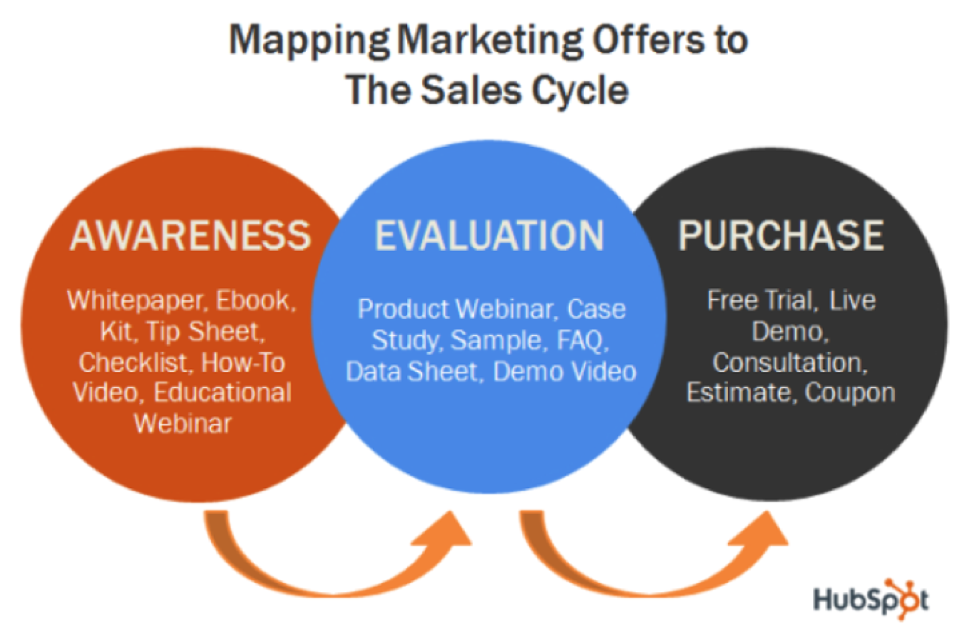
There is typically a distance between the awareness phase and the purchase phase of the customer buying journey, and you need to fill that distance by providing suitable content and engaging people.
You can’t assume people will buy from you in their first interaction.
In order to fill this gap, you need to know your audience and their buying journey (i.e. how they move from the awareness phase to the purchase phase).
Your customers’ demographic features such as gender, age, and work are a goldmine here. You need to have a good understanding of their behavioral features as well. Their lifestyle, habits, interests, pain points, and micro-moments are more important than you could guess – you want to connect with your customers and appeal to them in the buying journey.
Here are some questions to determine your customers’ preferences and their buying journey:
The greatest source for finding the answers to these questions is your customers.
Make professional surveys using SurveyMonkey or Google Forms, send them to your customers (through your email list or social media), and use the information to provide a great customer experience throughout their journey.
Once you determine how your customers use social media (for example, whether they use it to find products or to validate their product choices), what types of content they prefer to see, and when and on what devices they use social media, you can more easily provide support throughout their journey.
The newest addition to the business social media fails category: AI-generated content that audiences detect.
What started as an experimental format in 2022 became a common brand-fail category by 2024 (see the Willy Wonka Experience and the Coca-Cola AI Christmas Ad above). The pattern: brands use AI to save time or scale; audiences detect the AI; and the discovery — not the AI itself — becomes the failure.
Clutch's July 2026 survey of 408 consumers shows the size of the risk: 55% view a brand less favorably once they can tell AI created the work, and 93% say it matters that a brand's communications feel like they came from a real person.
Two practical implications:
AI content isn't inherently the fail — the discovery is. Structural transparency about where AI is and isn't in your content pipeline lets you use the tools without inheriting the backlash.
Clutch's June 2026 brand loyalty survey — the same 408-consumer panel — adds the flip side of the finding: 36% of consumers cite seeing real people visibly behind a brand as the strongest single driver of their loyalty, and 49% rank real-customer-story campaigns as the most memorable format of all — outperforming polished, high-production creative.
What audiences penalize (undisclosed AI content) and what audiences reward (visible human presence and real customer stories) are two sides of the same social dynamic.
Brands that lean into the "reward" side don't just avoid the AI-content fail category — they build the durable loyalty signal that competitors leaning on AI shortcuts can't replicate.
It doesn’t make any sense to keep repeating the same social media marketing mistakes again and again.
Social media analytics tools enable you to monitor your success or failure in social media marketing and choose the right actions for the future.
To have the right social media marketing strategy, you need to avoid some misconceptions and wrong practices.
The fails everyone remembers — Pepsi's protest ad, Balenciaga's holiday campaign, Willy Wonka's Glasgow warehouse — all trace back to some combination of these missing. Get them right, and you're playing a different game.
Five widely covered business social media fails from the past decade: Pepsi's 2017 Kendall Jenner protest ad (pulled within 24 hours after backlash for trivializing real protest movements), Balenciaga's 2022 holiday campaign controversy (child models paired with disturbing imagery led to campaign withdrawals, public apologies, and lost brand ambassadors), the Willy Wonka Chocolate Experience in Glasgow in 2024 (AI-generated marketing imagery created expectations the physical event couldn't meet), Coca-Cola's 2024 AI-generated Christmas ad (criticism from artists and consumers for using AI to recreate craft-heavy nostalgic content), and Duolingo's 2025 mascot "death" campaign (mixed reception; some found the shock-driven tactic clever, others found it confusing given real news about tech-industry brand-account layoffs).
Businesses fail on social media for four consistent reasons plus one modern addition. First, no clear goals or KPIs — the strategy doesn't align to specific business outcomes. Second, wrong platform — investing in platforms your customers don't use, or spreading effort across too many. Third, random content — posting without a clear content strategy tied to the customer's journey stage. Fourth, no plan for the customer buying journey — expecting people to buy on first interaction rather than nurturing them through awareness, evaluation, and decision. Fifth (new in 2024–2026), AI-generated content backlash — using AI in ways audiences detect and penalize. Clutch's July 2026 AI disclosure survey found 55% of consumers view a brand less favorably once they can tell AI created its work; Clutch's June 2026 brand loyalty survey adds the flip side, with 36% citing real people behind a brand as their strongest loyalty driver. Brands using detectable AI where audiences expect visible humans lose twice.
Start by matching your platform mix to where your customers actually are — TikTok and YouTube for reach, LinkedIn for B2B, Reddit and Quora for community-driven B2B categories, Instagram for consumer brands. Build content around each stage of the buying journey: educational content for awareness, product deep-dives for evaluation, and purchase-enabling formats (demos, trials, personalized video) for decision. Disclose AI use where a reasonable audience member would want to know, and keep humans visibly in charge of anything attributed to a person. Test campaigns against three questions before publishing: does the goal align with a business outcome? Does the content fit the platform's audience? And would a reasonable customer feel informed and respected by this? If the answer to any is no, revise before you post.
Mostafa Dastras has written for important companies such as HubSpot, WordStream, SmartInsights, and MarketingProfs. What keeps him up at night is how he can help his clients increase sales with content marketing (or how people can grow an email list). Visit his blog, Live a Business Life, or connect with him on LinkedIn to get him to write for you.
See full profile