
How Consumers Feel About AI in Social Media: What They Welcome (and Don't)
New Clutch data shows how consumers feel about AI in social media marketing, where they welcome it and where they draw a hard line.
Updated July 22, 2026

For many small business owners, developing a strong social media presence from scratch can feel overwhelming. Learn more about how you can build your social media strategy from scratch.
Facebook, Instagram, TikTok, YouTube — where do you even begin?
Which platforms should you focus on? How often should you post? And what’s the right amount of effort and content for your budget and audience?
Looking for a Social Media Marketing agency?
Compare our list of top Social Media Marketing companies near you
With so many questions, it’s easy for your social media strategy to slip through the cracks when you’re juggling the other demands of running a business.
However, with a clear strategy and execution plan, you can successfully leverage the popular platforms to attract followers and build real relationships with potential customers.
Here is how you can build your social media presence completely from scratch.
Before you create a single profile, you need to know who your audience is. The more specific, the better, because your audience should shape what you say, how you say it, and which platforms you create and maintain.
Deesha Laxsav, Clutch's Director of Brand Marketing, puts it this way: "Before you post anything, it’s very important to understand your audience. Demographics matter, but behavior matters more . . . . It’s important to do a historical view of everything you’ve posted and what your top-performing posts are that are actually resonating with your audience."
By historical review, Laxsav doesn't just mean checking which posts got the most likes. You should also examine the type of engagement each post drove.
For example, a carousel post on Instagram might get saved, meaning people want to revisit it later. On the other hand, if people are sharing a testimonial post, it indicates it resonated with your audience and that they want others to see it, too. A behind-the-scenes YouTube video might spark detailed comments, signaling that viewers are seeking not just information but also a connection with your business.
Different types of engagement highlight different audience needs, and recognizing the differences turns simple posting into a real strategy.
Laxsav points out that a "holistic, informed content strategy [...] will help you even further when you think about content diversification." Diversifying isn’t about churning out more content or joining more platforms for its own sake, but about intentionally creating content that addresses the range of problems you’ve identified in your target demographics.
Saves, shares, and comments reflect the different needs and challenges that your potential customers or clients face. By making your audience the foundation of your strategy, you make sure your overall content mix addresses what matters most to them.
Once you know your audience, share your content where your customers spend most of their time.
If you're selling products or services that can easily be visualized in photos or short videos, TikTok and Instagram are strong choices. If you're running a B2B or professional services company that frequently publishes thought leadership, LinkedIn is likely the better pick.
It’s tempting to be on every platform to boost conversions, but it’s smarter to start with one or two so you can consistently produce focused, high-quality content. Think of it this way: If you start out by spreading yourself across five platforms, you might only be able to post once every two weeks on each, which won't be enough to build momentum on any particular site. If you stick to two platforms, you could post three to four times a week on each, keeping you regularly in people’s feeds and top of mind.
Along with choosing the right platforms, you need to establish the pillars your content is built on.
"Content pillars are essentially three to five recurring themes that help represent your brand," says Laxsav. Content pillars are the core topics your brand consistently creates content around to educate, engage, and attract your target audience.
For example, a financial services company might build its content around the pillars of reliability, transparency, and integrity, publishing customer stories, educational resources, and expert insights that reinforce those values across every channel.
Identifying your content pillars starts with understanding where your brand's identity aligns with your audience's interests. The strongest pillars are rooted in what your company stands for while addressing the topics your audience genuinely cares about.
"You have to find the overlap in terms of what does your brand stand for and what does your audience care about," Laxsav explains. "...That will help you define this holistic content strategy and all of the types of content that bucket into these pillars."
For example, consider a B2B software company whose brand centers on efficiency. If their audience is always asking how to save time on repetitive tasks, that’s where the brand’s promise and the audience’s needs align. This could mean creating content that highlights time saved per feature, per integration, or per workflow. Hitting that sweet spot with specific data, rather than a vague “We care about quality” claim, should guide the content calendar.
Getting this right matters. Clearly established content pillars keep your posts feeling consistent and intentional, even when the specific topics change week to week.
Once you've identified your content pillars, you can start turning them into posts. Each post you put up should do one of three things: educate, solve a pain point, or entertain.
An educational post shares something new with your audience, like a tip, a process, or an industry insight they didn’t know before. A pain-point post taps into a frustration they already feel and offers a solution, often turning casual followers into people who trust your brand enough to connect. An entertaining post, on the other hand, aims to be enjoyable and engaging so people want to interact with it and your brand.
If you run a vendor marketplace or a service-based business, here’s how these posts might look. An educational post could show viewers how to assess a portfolio before hiring, while a pain-point post addresses the common frustration of recognizing an overpriced proposal.
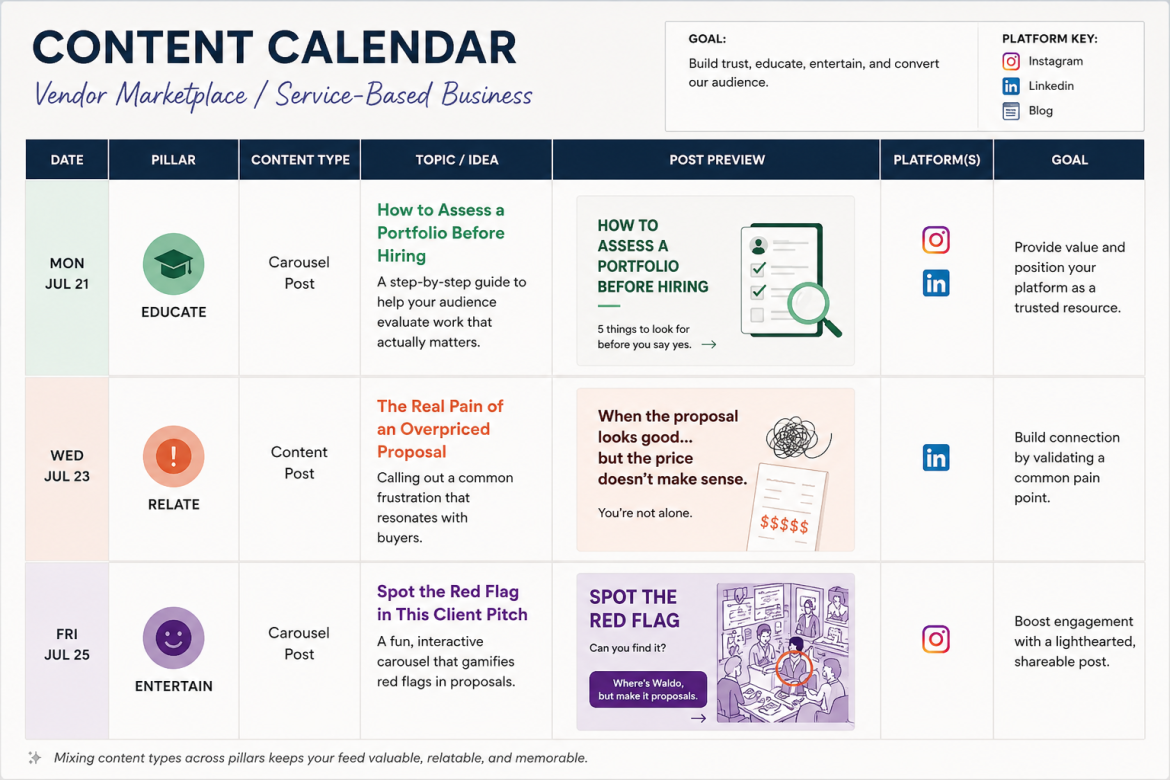
For something entertaining, a lighthearted “red flags in a client pitch” carousel could gamify elements, such as asking the audience to spot the red flag like a “Where's Waldo” challenge.
To keep viewers engaged, rotate the types of content you post. Start with one post that teaches something, then for the next showcase a result or testimonial. Then post something that gives a behind-the-scenes look at your business.
Overall, consistency beats perfection. A steady stream of good posts — for example, two videos every week on YouTube and TikTok — outperforms occasional posts, even if they’re nearly perfect.
Putting posts online is only the beginning. You now need to track what's actually working and use these insights to adjust your content plan.
Track reach, saves, shares, and engagement. Reach tells you how many people saw the post, which is useful for gauging awareness, while the rates of saves and shares can indicate whether people found your content relatable or useful.
To measure engagement, look at the number and quality of comments: the more in-depth the comments, the more your content has sparked a clear reaction.
When monitoring these metrics, watch for overall patterns. If, say, your educational posts consistently get more saves than your testimonial posts, that's worth acting on.
Once you have a clear idea of what post types lead to certain reactions, double down on what lands, and tweak or drop what doesn't. This will improve your return on investment and make your content strategy feel less effortful and more natural.
Ultimately, the takeaway for content teams regarding tracking what works is to treat your social media strategy as a living document, not a fixed plan. Keep testing, keep learning, and keep refining based on real data.
For example, if you notice your audience saves educational posts but rarely engages with behind-the-scenes content, you don't have to stop posting the latter entirely.
Instead, try testing a different format for your behind-the-scenes posts, like a short Q&A rather than a day-in-the-life video.
Building a social media presence can be daunting, especially when you're not sure where to start. That's why you should break each step down into chunks.
Start by understanding your audience: How have your previous posts performed? How do people react to your posts, based on what factors? Then, focus on one or two platforms where your audience spends most of their time.
From there, build content pillars that reflect both your brand and your audience's interests, and turn those pillars into a simple, repeatable rotation of posts. Consistency matters more than volume or perfection. A steady, sustainable posting rhythm, even a modest one, can build more trust and recognition over time than an ambitious plan you can't keep up with.
Once your social media strategy is live, don't treat it as finished. Track what resonates, look for patterns in the data, and let that inform what you create next. Always keep refining your plan as you learn more about your audience.