
How to Delegate: A Step-by-Step Guide for Agency Owners
Learn how to delegate effectively as an agency owner — what to delegate first, how to hand off work without losing quality, and the hiring sequence that...
Updated May 29, 2026

Economic uncertainties pose a massive asterisk for small and mid-sized businesses in the United States. In a survey of 500 SMB business leaders, almost half (48%) of small businesses cited economic uncertainty as a prime challenge in the coming year.
Between rising costs and shifting consumer behaviors, small businesses are in a crunch. For small businesses who may not be as well-equipped to handle rising prices, recent news about rising tariffs and fluctuations in the stock market can be particularly concerning.
Growing apprehensions of a potential recession call for smarter spending and investing, and outsourcing shows it can be a serious solution in order to ride out the storm. Navigating through a multitude of economic challenges such as inflation, supply chain disruptions, and strained trade policies will push SMBs to pivot to stay competitive — and many are turning to outsource service providers.
Of those who participated in our study, 84% of SMBs said they already outsource some of their activities, and 70% of respondents say they intend to boost their outsourcing initiatives in 2025.
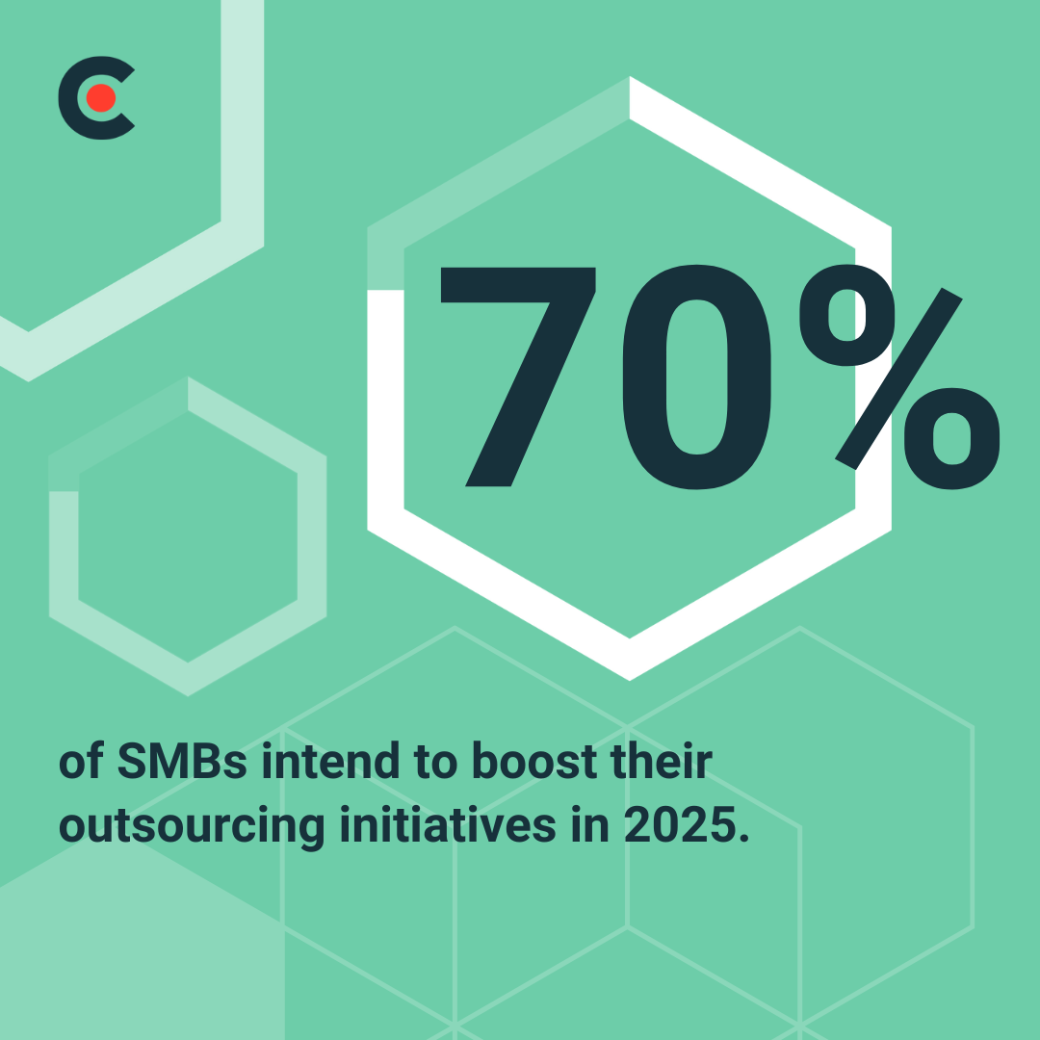
For many small businesses, one of the biggest challenges is expanding operations with limited resources. Outsourcing can feel intimidating at first but the numbers don’t lie — the demand reveals how SMBs see its advantages.
Many SMBs leverage outsourcing to gain access to external expertise that can help boost productivity and efficiency. However, outsourcing isn’t just about that — it also provides businesses with additional flexibility and scalability necessary for weathering economic unpredictability.
Read more about the survey in ‘The Small Business Growth Playbook for 2025.’
Saying that outsourcing unlocks efficiency may not paint a clear picture of how it brings much-needed stability. Particularly when the market is volatile, outsourcing allows companies to adapt quickly. Instead of investing heavily in permanent staff, equipment, or infrastructure, businesses that outsource specific services can scale those services up or down based on demand.
This not only makes outsourcing more cost-effective, but it’s also helps companies avoid long-term commitments, enabling them to shift strategy if their plans no longer align with their goals.
Here are outsourcing’s main strategic advantages:
While it’s always a great idea to establish internal teams and systems, outsourcing is also an exceptional solution to achieving continued growth.
Nowadays, businesses can outsource almost any function from service providers, but some are more popular than others. According to our report, the primary business function that SMBs anticipate outsourcing the most in 2025 are:
Let’s dissect why SMBs have these three functions on their outsourcing priority list:
Marketing is always a big talking point for SMBs, especially when financial turbulence hits.
Manpower can be a roadblock for SMBs. Since they often have smaller in-house teams, and marketing has evolved into a multi-disciplinary duty, it’ll be a tough task to run full-scale marketing campaigns internally.
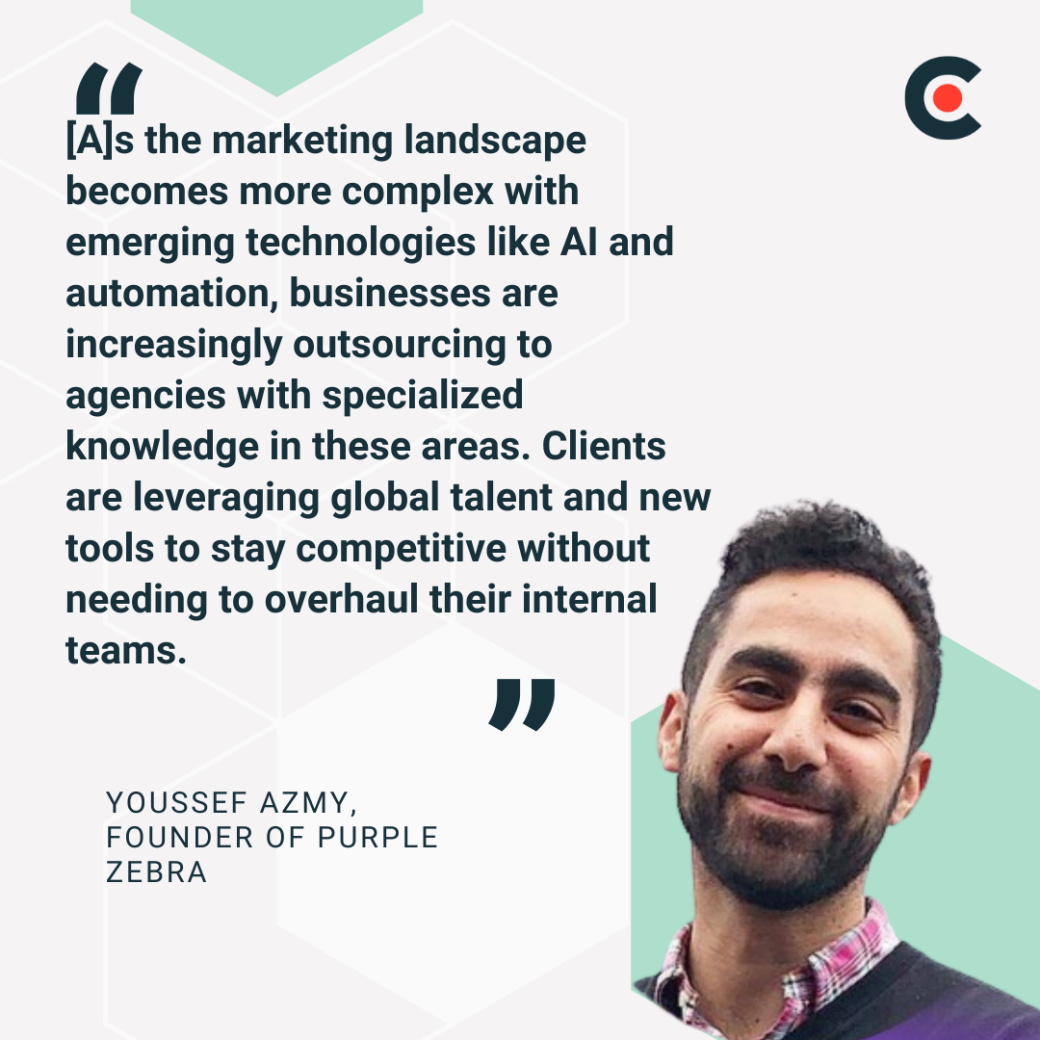
“[A]s the marketing landscape becomes more complex with emerging technologies like AI and automation, businesses are increasingly outsourcing to agencies with specialized knowledge in these areas,” says Youssef Azmy, the founder and CEO of the boutique performance marketing company, Purple Zebra. “Clients are leveraging global talent and new tools to stay competitive without needing to overhaul their internal teams.”
Even highly experienced teams can struggle to keep up with every marketing task, especially when working with a limited budget. Outsourcing allows them to choose what marketing services they want to invest in and adjust their budgets as they need.
What SMBs gain from outsourcing marketing services:
Uncertain times call for flexibility and resiliency. Outsourcing professional marketing services gives them room to execute cost-friendly campaigns without over-investing.
Additional reading, ‘How to Successfully Outsource Your Marketing Efforts in 2025.’
Information technology serves as the backbone of businesses, enabling them to facilitate communication and seamless collaboration between different teams.
Establishing an internal IT system and department costs a pretty penny, and not every SMB has the bandwidth or the budget to build an internal team. Since IT constantly advances, it's not ideal for SMBs to be spending on new technologies unless they're financially capable.
Here's why they should consider outsourcing their IT needs:
Economic uncertainty impacts many aspects of the tech landscape — cybersecurity concerns spike and demand for better scalability rises. IT partners provide heightened security, proactively helping SMBs handle unpredictable chapters.
At first glance, software development feels like an expensive investment for small businesses. However, bespoke software can open priceless doors of opportunities for SMBs, especially considering how processes have been impacted by technology.
Essentially, modern market demands expect businesses to adopt digitalization to keep up with the competition. Outsourcing software development introduces benefits such as:
Digital enablement shouldn’t be left on the backburner despite cut backs during times of economic uncertainty; doing so may only cause your growth momentum to slow down. Software development companies allow SMBs to build modern solutions like automation tools and internal platforms to help solve crucial problems.
Additional reading, ‘Leveraging Outsourced Talent for Competitive Edge in Development and Cybersecurity.’
While it may not be a guaranteed solution, outsourcing is all about finding the most efficient and productive way to advance your business, even during tough times. Outsourcing functions such as marketing, IT, and software development allow SMBs to stay competitive, agile, and flexible — key attributes needed for continued growth.
Clutch is here to help you match with the right service provider for your project. Find the right professionals that work for your budget and needs.