
How to Choose a 3PL: 5 Mistakes E-Commerce Brands Make
Learn how to choose a 3PL that fits your channel mix, avoids hidden costs, and scales with your brand. Real selection criteria, and top providers compared.
Updated June 19, 2026

Consultants provide much-needed expertise and an external perspective for small businesses. Leaders should budget for consulting support if they anticipate needing outside expertise for a specific business challenge. Our latest survey of 500 small business decision-makers finds that in 2025, marketing, technology, and AI are the top areas where SMBs plan to increase outsourcing, which is driving demand for consultants with expertise in these fields.
It can be hard to know when to ask for help, and even harder when you know that help comes with a price tag.
That’s the decision many small business leaders and decision-makers face this year as they establish a budget for 2021: Is it time to hire a consultant?
Looking for a BPO agency?
Compare our list of top BPO companies near you
That’s the decision many small business leaders face as they plan their budgets and weigh whether it’s the right time to bring in outside expertise.
Business consulting encompasses a range of specialties and organizations, from large consulting firms to individuals with knowledge and experience to share.
As small businesses work to balance growth and profitability in 2025, consultants remain a smart investment for leaders looking to bring in targeted expertise and stay competitive.
We surveyed 500 small business decision-makers to understand their top priorities and growth strategies for 2025. This year, 3 in 5 small businesses will rely on outsourcing to support growing business demands — a trend that’s fueling demand for consultants in areas like marketing, technology, and AI to fill critical skill gaps.

There are many different types of consultants small businesses can choose from. Below, we examine five of the most in-demand consultant types for SMBs in 2025.
A consultant is an experienced professional who helps businesses solve problems. Consultants can work for clients as part of a consulting firm or work individually.
Many consultants have experience working with small businesses themselves, which gives them insight into the challenges SMBs face, like tight budgets and changing goals. Leaders often turn to consultants when they need skills or perspectives that aren’t available in-house.
In 2025, consultants are playing a bigger role than ever in helping small businesses adapt to a fast-changing landscape. According to our latest research, the most in-demand consulting areas include AI and automation (47%), marketing and brand strategy (45%), technology and IT support (43%), customer experience (38%), and operations and internal processes (34%).
These trends reflect the top priorities for small businesses today — and they also map closely to the five core types of consulting specialties explored below
As small businesses face growing cybersecurity risks and rapid advancements in technology, many are turning to IT consultants for support.
In 2025, digital transformation remains a top priority — and now includes everything from cloud migration to AI integration.
According to Clutch’s 2025 research, 43% of small businesses plan to outsource technology services, with many looking to strengthen cybersecurity and modernize internal systems. AI consulting is also on the rise, with 47% of SMBs prioritizing automation and data-driven decision-making.

Startups and small businesses are often small and agile enterprises quick to adopt new technology. Still, as business needs grow and change, IT and AI consultants can help small businesses through:
Like other types of consultants, IT and AI consultants can work independently or under a larger corporation to provide custom solutions on the ground for small businesses.
Big consulting firms have teams of experts that businesses hire to help migrate their websites or systems or install important software and train employees to manage it.
Smaller IT firms or even individual IT professionals can be just as effective at providing high-quality technology solutions. Small business leaders may have an easier time working with an individual IT expert with whom they can build a working relationship and assess their specific IT needs.
Dan Bailey is president of WikiLawn, a lawn care business in Los Angeles. His business hired an IT expert to help the company resolve a security breach issue.
“The consultants were able to address our backdoor security issues, recover data lost in the breach, and give us resources to help make sure we don't make the same mistakes twice,” Bailey said. “For that, I'd say they were invaluable.”
“The consultants were able to address our backdoor security issues, recover data lost in the breach, and give us resources to help make sure we don't make the same mistakes twice. For that, I'd say they were invaluable.”
WikiLawn hired a small firm that focused on network security. The consultants not only secured the network but also equipped the team to tackle network security on their own, demonstrating the value of IT consulting for this small business.
Even small businesses with the most robust operating strategies need help with brand strategy, digital visibility, or customer engagement. That’s why more leaders are turning to outside marketing experts for support.
According to Clutch’s 2025 research, 45% of small businesses plan to outsource their marketing efforts this year. From content creation to paid advertising, consultants help teams stay current, scale quickly, and respond to market trends without overextending internal resources.
Today’s marketing landscape is more complex than ever. Businesses today are managing multiple channels, navigating emerging platforms, and learning how to use AI-driven tools. For many companies, hiring a consultant is the fastest way to fill skills gaps and unlock new growth opportunities.

Marketing consulting is a broad field that encompasses work such as:
Some small businesses will only hire a marketing consultant specializing in social media marketing, for example, to launch a new Facebook account or social media advertising campaign.
Other small businesses, however, may need a marketing generalist to assist with establishing and promoting a brand, particularly if the company is very new.
Though many businesses prefer to hire in-house employees to perform marketing activities, consultants still provide a helpful perspective on the success of marketing campaigns and where the small business should invest their efforts.
“Between the rise of new Google SERP features and AI advancements, getting quality, defensible content to market quickly could be the difference in meeting your quarterly goals or missing them entirely,” says Morgan Flores, Sr. Director of Performance Marketing at Clutch.
Some marketing consultants come from boutique agencies that can provide specialty services that in-house employees can't match.
"Many times, the need for an agency partner comes when needs become greater than the in-house team can accommodate," said Rob Nimmer, vice president of growth at Perfect Search Media. "Agencies often have partnerships that are invaluable to their clients. For example, our agency has a direct line to Google and Facebook based on the volume of advertising dollars our agency spends on each platform. This allows us to stay ahead of trends, get training directly from the platforms, and have access to VIP support to rectify issues much more quickly."
Marketing consultants may also have access to special tools such as photo editing software, keyword research tools, or email marketing platforms that can save a small business some recurring costs.
Small businesses continue to face economic uncertainty in 2025, from inflation and rising interest rates to changing tax laws and funding challenges. Without strong financial guidance, it can be difficult for many companies to maintain stability while planning for long-term growth.
Supply chain disruptions, shifting regulations, and tighter margins also present challenges for businesses trying to balance their budgets. Small businesses without in-house financial and accounting expertise may have difficulty navigating the new economic landscape.
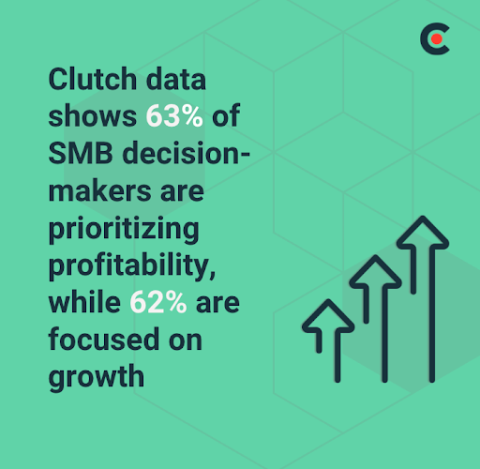
Recent Clutch research shows that 63% of small businesses are prioritizing profitability in 2025, making financial strategy a top focus. As a result, more SMBs are turning to financial consultants to improve cash flow, reduce inefficiencies, and navigate complex financial decisions.
Financial consultants help small businesses create sustainable financial plans for long-term success. They also help businesses solve specific financial and accounting challenges that founders and entrepreneurs may not have the expertise to solve on their own.
Some ways financial consultants can help small businesses and startups in 2025 include:
Spending more money on consulting fees in order to save money may sound counterintuitive, but small businesses have much to gain by investing in a financial consulting professional.
Many small businesses and startups have small teams with little in-house financial training and expertise. Businesses with few employees may not need or want to take on a formal CFO.
Additionally, basic business accounting may work in a stable market, but today’s economic landscape often requires more strategic financial planning.
Samuel Hurley is co-founder of NOVOS, a digital agency in London. Despite being a former accounting student, he faced challenges when forecasting the company’s growth and performance.
“Before we hired a finance consultant, we had three teams operating within the business and it made perfect sense logistically,” Hurley said. “However, once we hired our consultant, he was able to offer us the raw numbers of each team's performance. We saw one of the teams was underperforming and not making us money so we merged that team into another to streamline and make our future more profitable.”
Hurley’s financial advisor gained expertise at a larger firm before becoming an independent consultant on behalf of a smaller consulting company.
Small businesses can bring in financial consultants to improve profit margins and make accounting processes more efficient.
Busy entrepreneurs and small business decision-makers don’t need to add a legal degree to their to-do list.
Legal consultants, or legal advisors, are lawyers who help businesses understand the nuances of the law and how it applies to their operations. Working as an independent consultant or with a firm, they help businesses ensure their practice follows the law.
Legal support remains a key need for small businesses, especially when navigating hiring, contracts, or compliance.
Hiring full-time legal counsel is often well out of the budget for small businesses. Salary.com estimates the median salary for in-house counsel in Washington D.C. is more than $200,000 annually. Legal consultants offer advice on specific legal matters without the price tag of an attorney on retainer.
Larger law firms may provide small businesses with general advice about legal compliance over a longer period of time. For unique situations, however, a legal consultant with specific expertise or experience may be brought in to address issues such as:
Legal consultants can also be particularly helpful for entrepreneurs navigating complex patent law, crafting nondisclosure agreements, or even just obtaining a business license.
In 2025, legal consultants are increasingly helping small businesses interpret evolving regulations around remote work, data privacy, and contract compliance. These are especially important for businesses managing hybrid teams or customer data across multiple platforms.
Sometimes when you’re deeply involved in the day-to-day activities of running a business, it can be challenging to see the forest through the trees.
Where should your business be in the next 5 or even 10 years? What do you need to do to get there? What competitors might emerge during that time?
Strategy consultants can help entrepreneurs and small business owners understand and achieve a vision for their businesses.
In 2025, strategy consulting remains a valuable investment for small businesses navigating growth, profitability, and competition. Strategy consultants help business leaders make decisions using research and experience in the market. Their value is their ability to deliver an outside perspective on the high-level decisions small business owners make every day.
Strategy consultants often bring experience such as:
One small business leader shared that they brought in a consultant to help improve operations and reduce risks. “We need to beef up our IT and cybersecurity to make sure we are prepared,” they said. Strategy consultants are helping businesses like this set clearer goals, make smarter decisions, and build plans that support both growth and stability.
Small businesses can hire a strategy consultant to find practical, forward-looking solutions to the challenges of 2025.
Hiring a consultant can be a worthwhile business investment, but it’s important to know that costs and pricing models vary based on several factors.
Pricing models for consultants typically fall into one of these categories:
Bigger firms tend to charge more. Independent consultants or smaller shops may offer more flexible options. Either way, it’s important to agree on scope and pricing before anything starts — it’ll save you trouble later.
For more details, see Clutch’s full Consulting Pricing Guide.
Finding someone who gets your business goals takes more than a quick Google search. Start by asking other business owners who they’ve worked with. You can also browse listings on sites like Clutch to see verified reviews and portfolios.
Here are a few things to keep in mind:
You’ll know you’ve found the right person when they ask smart questions, bring ideas to the table, and feel like a partner, not just a vendor.
Consultants and contractors both work from the outside, but they do different things. Contractors are usually hired to carry out a specific job — say, designing a logo or handling payroll. They’re task-focused.
Consultants, on the other hand, are brought in to assess the bigger picture. They help you figure out what needs to happen and why. They bring strategic advice and often guide decisions, especially when something isn’t working or the next step isn’t clear.
For many business owners, yes, especially if your team is at capacity or you’re hitting a wall. A good consultant won’t just give advice. They’ll help you work through problems, spot new opportunities, and make informed choices.
And while hiring one does cost money, the value they bring: clearer strategy, fewer mistakes, or faster growth, often outweighs the price.
Hiring a consultant is a smart investment for small businesses looking to grow, stay efficient, and adapt to change in 2025.
Clutch surveyed 500 small business owners and managers at companies in the U.S. with fewer than 500 employees. We define small businesses as having limited revenue and between 1 and 500 employees, which corresponds to the Small Business Administration's definition of small business. The survey ran in January 2025 in partnership with Drive Research.
Twelve percent (12%) of respondents’ businesses have fewer than 5 years in operation; 28% have been in business for 5 to 9 years; 28% for 10 to 14 years; and 32% for 15 or more years.
Fifty-three percent (53%) of respondents are male; 47% are female.
Nine percent (9%) of respondents are Generation Z (born after 1996); 60% are millennials (1981–1996); 25% are Generation X (1965–1980); and 6% are baby boomers or older (born before 1965).
Respondents are from the South (42%), Midwest (21%), West (19%), and Northeast (18%).
Annual revenue of respondent businesses includes: 4% earning less than $100K; 10% earning $100K–$499K; 10% earning $500K–$999K; 27% earning $1M–$4.9M; 17% earning $5M–$9.9M; 13% earning $10M–$19.9M; 11% earning $20M–$29.9M; and 15% earning $30M or more.
Race and ethnicity (multiple selections allowed): 79% White; 15% Black or African American; 7% Hispanic or Latino; 3% Asian; 2% Native American or Alaska Native.