
How to Choose a 3PL: 5 Mistakes E-Commerce Brands Make
Learn how to choose a 3PL that fits your channel mix, avoids hidden costs, and scales with your brand. Real selection criteria, and top providers compared.
Updated May 29, 2026

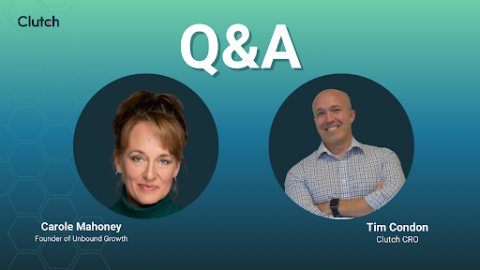
In this interview, Carole Mahoney, the Founder of Unbound Growth, explores how agency owners can transform client relationships by making them active participants rather than passive buyers. This is perfect for agency owners looking to move beyond being seen as just another vendor and build partnerships that command higher rates and create passionate advocates for your services.
In this video, you’ll learn:
Looking for a BPO agency?
Compare our list of top BPO companies near you
Search for industry-leading lead generation companies on Clutch. Read client reviews to find the perfect partner for your upcoming social media project.
Before we dive in, Carole, could you take us through your story and how you’ve become the Founder of Unbound Growth?
Carole Mahoney [00:00-3:41]: I grew up in a family of entrepreneurs where nine-to-five jobs were unusual. When I was laid off from my corporate marketing job during the 2007 Recession, my planned business launch accelerated from five years to six months. I initially contracted with agencies on SEO and pay-per-click work, but soon realized I needed actual sales skills to survive. Despite my aversion to what I thought was pushy, manipulative selling, financial necessity pushed me to hire a sales coach who transformed my perspective.
My original mission was helping small businesses grow, but I discovered they struggled with the same sales resistance I had experienced. Even when my marketing agency delivered leads, clients couldn't close them and eventually couldn't afford my services.
This realization transformed my business into Unbound Growth, a sales training agency using data-driven, scientific approaches to make selling less intimidating for small business owners. I learned that how we feel about sales directly impacts our behavior and results.
When you walk into an agency or a similar type business, what are the common themes you see that need to be sort of addressed right away?
Carole Mahoney [4:17-5:19]: The first thing I hear is that they believe if they do great work, clients will stay and refer others. Of course, great work is necessary for that to happen, but asking for referrals and introductions isn’t even something they typically consider.
One of the biggest mistakes I see with marketing agencies specifically is the classic "the potter has no shoes" scenario. The work they do for clients, they don’t do for themselves. They don’t write content or try to attract clients for their own business. These are two common pitfalls I see agency owners fall into.
Another issue is that they try sales tactics, but when it goes horribly due to their mindset about sales, they quickly dismiss it—saying, “That doesn’t work,” rather than investing in themselves to understand why it isn’t working and how it should. But the biggest pitfall I see is that they don’t do for themselves what they do for their clients. They don’t treat their own business as a client.
Building Your Client Relationships With the IKEA Method
I'm curious about your take on the IKEA furniture and buy-sell relationship analogy. While I've banned IKEA from my home after numerous assembly disasters (which could've made me YouTube-famous), your perspective seemed unique and I'd like to hear more about it.
Carole Mahoney [5:56-7:26]: As I was researching for the book to understand how buyers today make decisions and what they actually want from salespeople, I came across numerous studies. The one that truly opened my eyes to what buyers want today is called the IKEA Effect. It was a study conducted by Harvard to understand why people are willing to pay more for something they have to assemble themselves rather than something put together by an expert.
What they realized is that when we collaborate on a solution, we place more value on it. When we put effort into something, we value it more. I often use the cookie analogy—you can buy cookies at the store or bake them yourself. Which do you value more? The homemade cookies you made yourself or the ones someone casually picked up at the grocery store? The homemade ones taste better, feel better, and carry more meaning because of the effort put into them.
If we approach sales conversations not as pitching, convincing, or persuading, but as collaborating to understand where buyers are and what success looks like to them, we can offer expertise while co-creating solutions. This way, buyers feel the solutions are unique and specific to them—not just cookie-cutter, generalized offerings.
So, how does this translate for an agency owner? How do they specifically apply the IKEA Effect—or what we just called the Egg Cracking Effect? How do they implement this in their day-to-day process of getting more clients?
Carole Mahoney [8:14-11:03]: The simplest approach is to examine the questions in your sales process. First, identify the steps and questions at each stage—something many agency owners lack. Then evaluate those questions: Are you seeking information for yourself, or helping buyers discover what they need? Focus on crafting open-ended questions starting with who, what, when, where, why, and how. When you drill deeper with these questions, buyers reveal their thoughts, previous attempts, and what has or hasn't worked.
These questions trigger important cognitive processes. A Stanford study found that answering open-ended questions changes how people think about challenges. Another Harvard study explains why people enjoy talking about themselves—critical knowledge for sales. Our goal is to get prospects talking more than we do.
When people share information, their brain releases dopamine from areas responsible for trust-building. As buyers disclose more, your job is to probe deeper until you understand their goals, desired results, timeline, and motivations. This allows you to reverse-engineer solutions based on their previous attempts and available resources. The conversation structure makes even your standard offerings feel customized to their needs.
In some ways, it’s Sales 101, right? You’re simply tapping into the psychology that getting someone to talk naturally makes them more comfortable with you, right?
Carole Mahoney [11:23-11:55]: The challenge is that while buyers want to do all the talking, I often see the opposite happening. Even though it’s Sales 101 and seems simple, it’s incredibly difficult for us to stop talking about our product and how we do things. I can’t count how many agency owners I’ve worked with whose pitch starts with, “Well, we’re this, and we got here because of that”—making it all about them. That’s why I made T-shirts that say "Not About Me" upside down—as a reminder for people when they look down.
It is amazing how just being quiet and listening makes a huge difference.
Carole Mahoney [12:31-12:54]: One of the things that I teach my salespeople and managers to do in order to help themselves shut up when they need to is to seek their dopamine hits from other places rather than doing all the talking about themselves. So listen to music. Get some exercise. Hang out with some people. Do things that are healthy and will release that dopamine in your brain so that you don’t seek the dopamine in those conversations. You don’t make it all about you because that’s how you’re getting your highs.
You discuss shifting from vendor to partner mindset, which makes sense. For agency owners watching, what's one or two immediate tips they can implement to transform this relationship for themselves and their partners?
Carole Mahoney [13:19-14:36]: I think the first thing you need to understand, and this is something I drill into all of my agency owners, is understanding what kind of results they need to see, by when, and why it matters. From there, you can figure out how to best collaborate with them or even understand if you can help them at all. It’s really about making sure your conversations focus on getting that piece of information.
Once you understand what results they need and when, that’s how you can create solutions and programs that will realistically get them there. For example, if they need 100 leads from SEO in three months, you’ll know that’s probably not a realistic goal. You’ll need to offer your insights to challenge them and help them understand what a realistic goal is.
If you take on a client expecting those kinds of results in such a short time, they’ll be disappointed, and you’ll lose the client. It costs more to get a new client than to keep a happy one. So, it comes down to setting the right expectations with clients—so you can keep them happy, and they’ll refer you to others. That’s still the fastest way to grow your business.
Do you have, specifically for agency owners, any rules of thumb about how often they should be checking in or having touch points with their clients? Because, as you said, it’s not enough to just do great work—they’ve got to feel good about the relationship and see you as a partner. Are there any tips or a basic formula you recommend for this?
Carole Mahoney [15:03-15:48]: Well, first of all, depending on the scope of the project or retainer, your client should have a dedicated account manager who meets with them weekly, providing updates and facilitating back-and-forth communication. As the agency owner, if you’re the one who sold them, I recommend checking in at least once a month to see if the promise you made is being delivered. Also, find out what improvements can be made.
It’s not enough to just send out an NPS survey or similar; you should have a direct touchpoint at least once a month, especially if you have a 12-month program. This is the time to check on progress, make adjustments, and have executive-to-executive discussions about needed tweaks. It’s also a great opportunity to ask for referrals and introductions to others like them, if you’re enjoying the work.
It’s interesting because it reminds you how often people are a little scared to check in, as if they’re afraid of what they might hear. But it’s actually the opposite. If you're scared to talk to your clients…
Carole Mahoney [16:01-16:27]: Yeah, well, the reality is something’s going to go wrong. Somewhere along the line, something won’t go as expected. The true test of the relationship isn’t when things are going perfectly, but how you react when they go wrong. That’s what actually builds trust. I don’t think anyone expects things to go perfectly, but they’re looking to see how you’ll respond when they don’t. That’s the real test of whether they become a lifetime client.
So tell us a little about the book. What sort of prompted you to pick up and write a book? That's kind of a big commitment.
Carole Mahoney [16:41-18:44]: It’s definitely a big commitment. Full disclosure, I was one of those kids who did the library reading contest every summer. I wanted all the gold stars, right? An avid reader. Actually, when I was 12, I wanted to be in the Guinness Book of World Records as the youngest published author. So, I sat down at my grandfather's typewriter to start writing my book, though I don’t even remember what it was about. Then the next Guinness Book came out, and there was an 11-year-old who was now the youngest. I thought, well, I’m 12—I’m already out.
So, I’ve always had a love for knowledge and books. I’ve always wanted to write one, but this particular book was born out of my journey when starting my own marketing agency and the many mistakes I made. My husband asked me the same question: Why give away all your secrets? I told him, "If I get hit by a bus tomorrow, at least someone else will have learned to avoid these mistakes and navigate around them, hopefully making their life better."
It was something that stayed with me. I won’t say it kept me up at night, but it was the first thought I had before sleep and the first when I woke up. If I didn’t write this book, it would have eaten me alive. Clients were also asking for it because of the concepts I was teaching.
One thing I’ll say is that writing the book was meant to help others shift their mindsets and perspectives, but it also changed me. Going through the process of nailing everything down—making sure it was based on science I had tested, not just theory—was transformative. I also wanted it to be a guidebook for people starting their own businesses, especially since I began writing it during the last recession caused by COVID. The stats showing how many people were leaving corporate jobs to start their own businesses resonated with me because I was in the same situation in 2007. After a year of figuring out whether to go back to a job or make this work, I finally decided to push forward.
If I'm an agency owner listening to this, anything else you want to impart on them before we go to the rapid-fire questions?
Carole Mahoney [18:59-19:53]: I would say, think about your sales origin story. Where does your perception of sales come from? Examine that and apply some logic and rationale to it. Often, the experiences we've had, especially since most of us haven't had good sales experiences, shape our view of sales. We’ve all probably bought a used car at some point, and that experience often becomes our perception of sales, influencing our behaviors and results.
The good news is that with self-awareness and personal goals, you can change the way you think, alter your behaviors, and, ultimately, change your results. I mean, you can see all these books behind me; I’ve studied every sales process out there. The reality is, there is no magical formula—it's about examining your thoughts, understanding how they shape your behaviors, and recognizing how they lead to your results. The great thing is, you absolutely can change these patterns. You can start making small changes in your everyday life. It doesn’t have to be a huge, life-altering commitment, though, a three-month sabbatical wouldn’t be a bad idea either!
What's your go to podcast right now?
Carole Mahoney [20:02-20:39]: I don’t listen to a lot of podcasts. Honestly, I end up starting to yell at the podcast host or the guest at some point. But I will say, one of my favorite podcasts is Women in Sales, run by Lori Richardson, especially since it’s Women’s History Month. I really love her podcast because it helps me feel better about some of the challenges and struggles I face, like, “Okay, it’s not just me, I’m not the only one.” Plus, I learn a lot from those who have gone from here to there—such great, personal, and inspiring stories that she shares. That’s one I’ll listen to regularly, along with the Huberman Lab podcast because I’m a brain science nerd!
One thing that people who don't know you that well would be surprised to learn about you?
Carole Mahoney [20:58-21:09]: Okay, so the people who know me well know this. So the people who don't know me well don't know that. Once upon a time, I was a nun in an opera on stage singing, and I have the photo to prove it.
Most memorable point in your professional career so far?
Carole Mahoney [21:22-21:53]: I mean, yes, it was definitely the publishing of the book. But I launched it at Inbound, a big conference in the Boston area run by HubSpot. I launched it there, and I remember waking up on Saturday morning after the conference, going on Amazon, and seeing that my book was number one. I was screenshotting the heck out of that and sending it to my mom. I was like, “Okay, I’ve reached the goal of not only publishing the book, but it’s actually a number one bestseller!” That’s something I won’t forget anytime soon.

Carole Mahoney, the Founder of Unbound Growth, is a sales coach for the Entrepreneurial MBA program at Harvard Business School, where she’s been called “the Sales Therapist.” She draws on cutting-edge science, statistics, and data from 2.2 million sales professionals to inform her sales coaching work with clients.
Interviewed by: Tim Condon, CRO at Clutch