
Why Salesforce Staff Augmentation Is Becoming a Strategic Choice
Salesforce staff augmentation is no longer a stop-gap. Learn why more businesses now use external specialists to access expertise, move faster, and scale...
Updated October 13, 2026

Your IT infrastructure is key to remaining agile and responding to changes quickly. We sat down with Vikash Sharma, CEO of SparxIT, to get a better understanding of what IT infrastructure services businesses should be prioritizing in 2025.
Every second of downtime costs money, and every security breach damages trust. Yet most executives treat their IT infrastructure as a cost center rather than a strategic asset. That mindset leaves money on the table and opportunities unexplored.
“I firmly believe that IT infrastructure is the invisible backbone of any modern business,” claims Vikash Sharma, CEO of SparxIT. In a world where businesses need to innovate quickly and adopt new technologies to remain competitive, a reliable and solid IT infrastructure is a necessity to run efficiently and grow.
Looking for a IT Services agency?
Compare our list of top IT Services companies near you
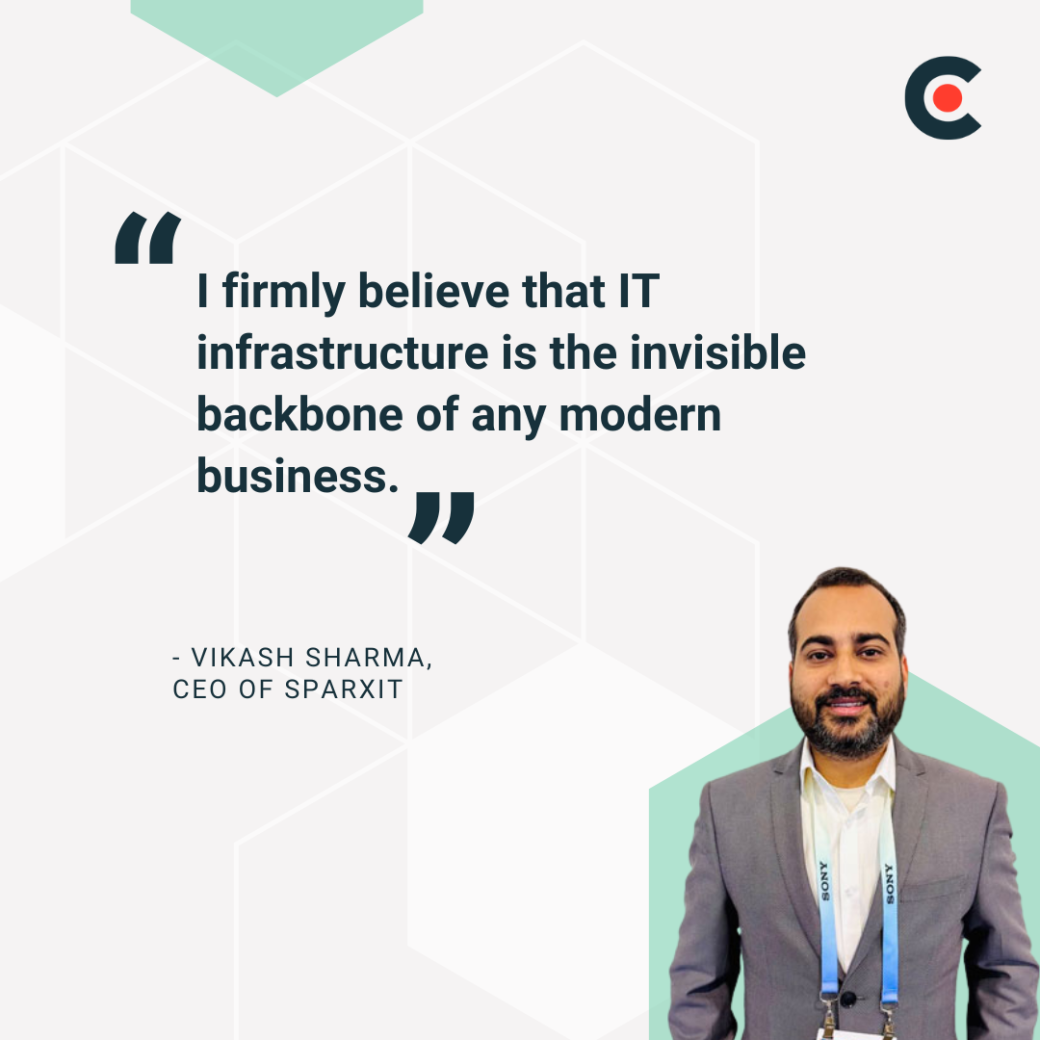
“Without a solid infrastructure and a futuristic mindset, even the inventive digital solutions can fall apart and make the business bleed,” explains Sharma. “A strong infrastructure helps organizations stay agile, respond to change quickly, and embrace new technologies without hesitation.”
In addition to supporting current operations, your IT infrastructure also needs to be able to modernize and scalewith your business. Here's a complete IT infrastructure services guide to help propel your business forward.
IT infrastructure services include everything that keeps your technology ecosystem running smoothly. We're talking about the complete package: hardware management, software deployment, network optimization, security protocols, and ongoing maintenance.
Ideally, your IT infrastructure services should accelerate your business operations, enable rapid scaling, and create competitive advantages you didn't know existed. When done right, these services transform technology from a cost center into a profit driver.
Modern infrastructure services go beyond basic break-fix support. They include:
The benefits? Lower operational costs, faster time-to-market, better employee productivity, and enhanced customer experiences.
And perhaps most importantly, the ability to focus on what your team does best while experts handle the technical heavy lifting.
Different businesses need different support models. Understanding your options helps you choose the right approach for your organization's maturity and goals.
The key isn't picking the "best" service type. It's matching services to your specific needs, internal capabilities, and strategic objectives.
“Renowned businesses are coming to us for cloud migration, DevOps automation, end-to-end product engineering, cybersecurity, and modernizing infrastructure that supports AI integration,” says Sharma. As AI, and therefore high-quality data, becomes a crucial aspect for more businesses, the IT services they are looking for are evolving.
“I have seen entrepreneurs understand the importance of building a robust IT infrastructure with AI, ML, and using transformation services to modify the interpretation.”
To keep up, many businesses are realigning their IT services to align with business goals and shifts in the market.
Here are some of the most popular types of IT infrastructure services.
Managed IT services put external experts in charge of your infrastructure operations. You get enterprise-class capabilities without building internal teams.
These services typically include 24/7 monitoring, proactive maintenance, and help desk support. Your managed service provider (MSP) becomes an extension of your team, handling day-to-day operations while you focus on strategic initiatives.
The real value comes from predictability. You pay a fixed monthly fee instead of unpredictable break-fix costs, your service level agreement guarantees response times, and you gain access to expensive tools and platforms the MSP amortizes across multiple clients.
A managed service provider might be right for you if:
Cloud services revolutionized how businesses consume IT resources. Now, you can provision resources in minutes instead of months with one or a combination of three service models:
Cloud adoption typically starts with low-risk workloads. Development and testing environments move first, then disaster recovery. Eventually, production applications migrate. However, some workloads never leave on-premises servers due to regulatory or performance requirements.
The core benefits that are driving cloud adoption include:
Network services keep your business connected, and modern network services go beyond basic connectivity.
Businesses are increasingly investing in advanced network services to:
Your network directly impacts your end business. Slow applications frustrate employees and customers, unreliable connections disrupt operations, and even security breaches originate from network vulnerabilities. That's why network services deserve executive attention.
Cybersecurity services protect against existential threats. One breach can destroy decades of reputation, and traditional perimeter security isn't enough. You need defense in depth through Endpoint Detection and Response (EDR), Security Information and Event Management (SIEM), and Managed Detection and Response (MDR).
The threat landscape evolves daily. Nation-state actors, organized crime, and opportunistic hackers all target businesses.
Thus, all organizations need cybersecurity services for the following key reasons:
Your IT infrastructure is a complex system with thousands of moving parts. With one weak component, the whole system suffers.
Hardware forms the physical foundation of your tech stack. But gone are the days when "more servers" meant "better performance."
Software breathes life into your hardware. But software sprawl creates its own challenges.
Your network ties everything together. Slow or unreliable networks cripple productivity faster than any other infrastructure failure.
Data drives modern business, and storage strategies determine how effectively you leverage that asset.
Often, you face a fundamental choice: build internal capabilities or leverage external expertise. Neither approach works for everyone. The right answer depends on your industry, size, growth trajectory, and competitive strategy.
“In theory, building every solution internally sounds ideal. But in practice? It’s a bandwidth trap that often leads to delay,” says Sharma. “You’re not just hiring talent, you’re trying to build and maintain a team with specialization and intelligent insights that can move ahead with the reinventing world. That’s not sustainable for most businesses that are planning on scaling at an immense speed.”
Currently, 4 in 5 SMBs outsource some operations to external providers, and IT services rank among the most popular: 38% of respondents outsource IT services. These numbers reflect the practical reality that specialized expertise costs less when shared across multiple organizations.
Here are a few key benefits of outsourcing IT services:
Outsourcing transforms fixed costs into variable expenses. You eliminate recruiting costs, training investments, and benefit expenses. Even equipment purchases fall under the provider's purview instead of yours.
But real savings come from efficiency. Experienced providers resolve issues faster, standardized processes reduce errors, and economies of scale lower per-unit costs. Basically, you pay for outcomes, not effort.
Technology specialization has fragmented beyond any organization's ability to maintain internally. You need security analysts, network engineers, and dozens of other roles. Each requires continuous training to stay current.
Outsourcing provides instant access to deep expertise. Providers employ specialists who work across multiple clients, building experience faster than internal staff. They invest in training and certifications that your internal team may not be able to work into their schedule or budget.
When emerging technologies like AI or quantum computing mature, providers already have experts ready. You avoid the learning curve that slows internal adoption.
Business demands fluctuate, whether it's seasonal peaks straining your resources, new projects requiring temporary expertise, or your divestitures needing rapid separation.
Outsourcing provides elastic capacity.
This flexibility extends beyond staffing. Providers maintain extra capacity in their infrastructure. They scale your resources up or down based on demand. You pay only for what you use.
Regulatory requirements multiply annually.
Each of these demands specific controls and documentation. To maintain compliance, your team needs dedicated expertise to make continuous updates.
Security providers specialize in compliance. They maintain certifications across multiple frameworks, and their processes already align with regulatory requirements. Thus, if and when necessary, your audit preparation becomes routine instead of disruptive.
More importantly, providers see threats across their entire client base. When one client gets attacked, all clients benefit from enhanced protection. This collective defense proves more effective than isolated efforts.
However, not every system or service is perfect. Here are a few cons worth considering before you sign on the dotted line with an outsourced IT infrastructure service provider:
Outsourcing means depending on others for critical operations. Response times follow the Service Level Agreement (SLA), not your immediate needs. Also, providers can only make strategic decisions within capabilities.
Some organizations struggle with this transition. They're used to walking down the hall when systems break. Now, they open tickets and wait for responses. Most often, emergency situations test these relationships.
But you can:
Still, you'll never have the same direct control as you get with internal IT infrastructure.
External providers don't share your company culture, and technical staff might not understand business impacts or the need for prompt response.
Sometimes, even language barriers add complexity when providers use offshore resources. In such cases, technical discussions might work fine, but nuanced business conversations suffer. It's because cultural differences often affect work styles and expectations.
In many practical cases, initial IT proposals rarely capture total costs. Migration expenses might add up, changes outside the original scope could trigger additional fees, or contract renewals may bring price increases.
Common hidden costs of outsourcing your IT infrastructure services include:
Successful outsourcing requires realistic budgeting. So, factor in transition costs and plan for scope changes. Also, negotiate rate caps in long-term contracts.
Most importantly, maintain enough internal knowledge to evaluate provider performance.
Outsourcing expands your attack surface. Providers become targets because compromising them affects multiple clients. Ultimately, their security practices directly impact your risk profile.
Data privacy raises additional concerns:
Thus, vendor risk management becomes critical when you decide to outsource your IT services. Conduct security assessments to evaluate provider capabilities and specify security requirements in your contracts.
Infrastructure migrations rank among the most complex projects organizations undertake.
You might need migration when:
But migration success requires meticulous planning. So, start by documenting your current environment completely and identify all applications, integrations, and dependencies.
“The key to smooth migrations is planning, communication, and contingency,” says Tom McDonald, CEO of NSITServ. “We start by understanding the client's current environment, how their systems are used day-to-day, what their critical business hours are, and what dependencies exist between applications and teams. That helps us map out a migration strategy that minimizes risk and avoids surprises."
When you're mapping out your IT migration plan, the following strategies can help:
Real-world migrations rarely follow initial timelines, and technical surprises might still emerge during implementation. It's always advisable to build buffer time into every schedule.
Your IT infrastructure powers everything your business does. Every customer interaction, every transaction, every decision flows through these technology foundations. Treating infrastructure as mere plumbing guarantees a competitive disadvantage.
Instead, recognize infrastructure as a strategic capability. Invest proactively rather than reactively, and prepare for future needs while managing current operations.
The path forward in your IT infrastructure planning requires an honest assessment.
Whether you build capabilities internally, leverage external providers, or blend both approaches, success demands continuous evolution. Why? Because technology advances too quickly for static strategies.
Your infrastructure journey never truly ends. But with the right foundation, the right partners, and the right mindset, you transform IT infrastructure from a necessary burden into a competitive moat.
The question isn't whether to invest in IT infrastructure excellence; it's how quickly you can achieve it before competitors leave you behind.
![How to Create a Budget for BI & Analytics Services [With Template]](https://img.shgstatic.com/clutch-static-prod/image/resize/715x400/s3fs-public/article/f07e9d6bd89e7f70df9c94301acdd847.png)