
How to Choose a 3PL: 5 Mistakes E-Commerce Brands Make
Learn how to choose a 3PL that fits your channel mix, avoids hidden costs, and scales with your brand. Real selection criteria, and top providers compared.
Updated September 9, 2026

Every public organization has a designated function, intended to serve the general population. Handled and funded by the government, public organizations provide services deemed as essential for the governed.
A public organization is an entity owned, funded, and operated by the government to provide essential services to the public rather than to earn a profit. Public organizations make up the public sector — the part of the economy that delivers services like education, defense, healthcare, and utilities — and they operate at the federal, state, and local levels.
This guide defines the public sector, covers the four features that set public organizations apart from private businesses, and walks through 10 examples with real agencies for each.
Looking for a BPO agency?
Compare our list of top BPO companies near you
Looking for financial guidance? Connect with a top-rated financial services firm.
The public sector, also known as the state sector, is the part of the business world that is focused on goods and services that are intended to benefit the general public and society at large.
Public organizations and companies are owned and operated by the government, as well as being funded through the government in the form of taxes. Unlike private companies, they're typically established by law and held to higher standards of transparency and accountability, since they answer to the public they serve.
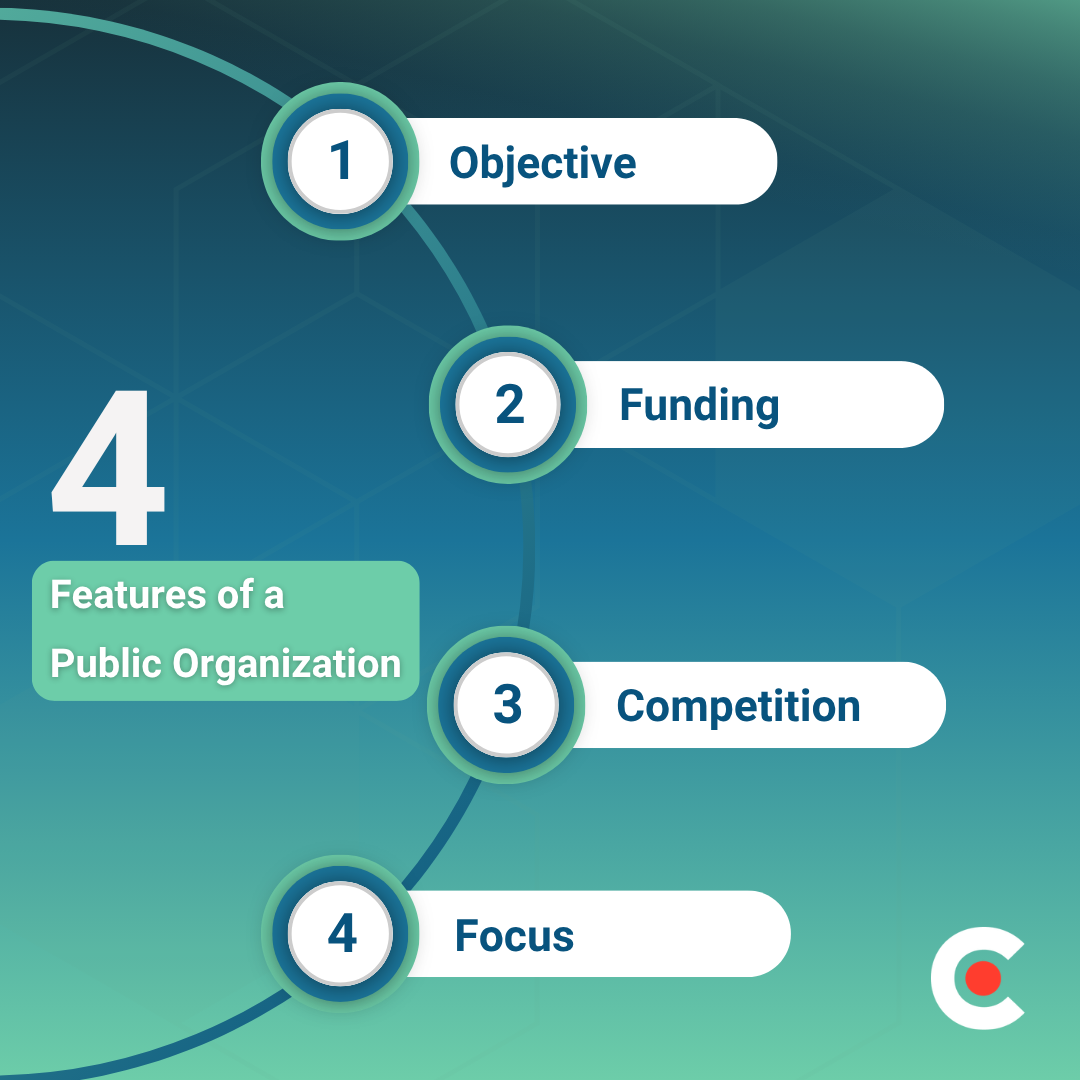
Here are four of the key aspects and defining features that separate public organizations from private businesses.
Public sector employers and agencies do not aim to make a profit from the goods and services they provide. These services are provided for the good of the public.
Public service is usually generated in the form of taxes and fees, rather than through private investment. In some cases, funding can be generated in other ways, but the government is always either the sole owner or majority shareholder of a public organization.
In the private sector, competition for profit between companies can drive changes and adaptations. The public sector generally doesn't face that same market competition, which is why accountability and oversight — rather than competitors — are what hold public organizations to standard.
Organizations in the public sector are focused primarily on infrastructure and essential services for society, like education, electricity, defense, agriculture, transport, and so on, while private sector companies can be found in many fields like tech, finance, and retail.
| Attribute | Public organization | Private organization |
| Ownership | Government | Private individuals or shareholders |
| Primary goal | Public benefit / service | Profit |
| Funding | Taxes and fees | Private investment and revenue |
| Accountability | To the public; established by law | To owners / shareholders |
| Examples | Public schools, the military, USPS | Apple, a local law firm, a startup |
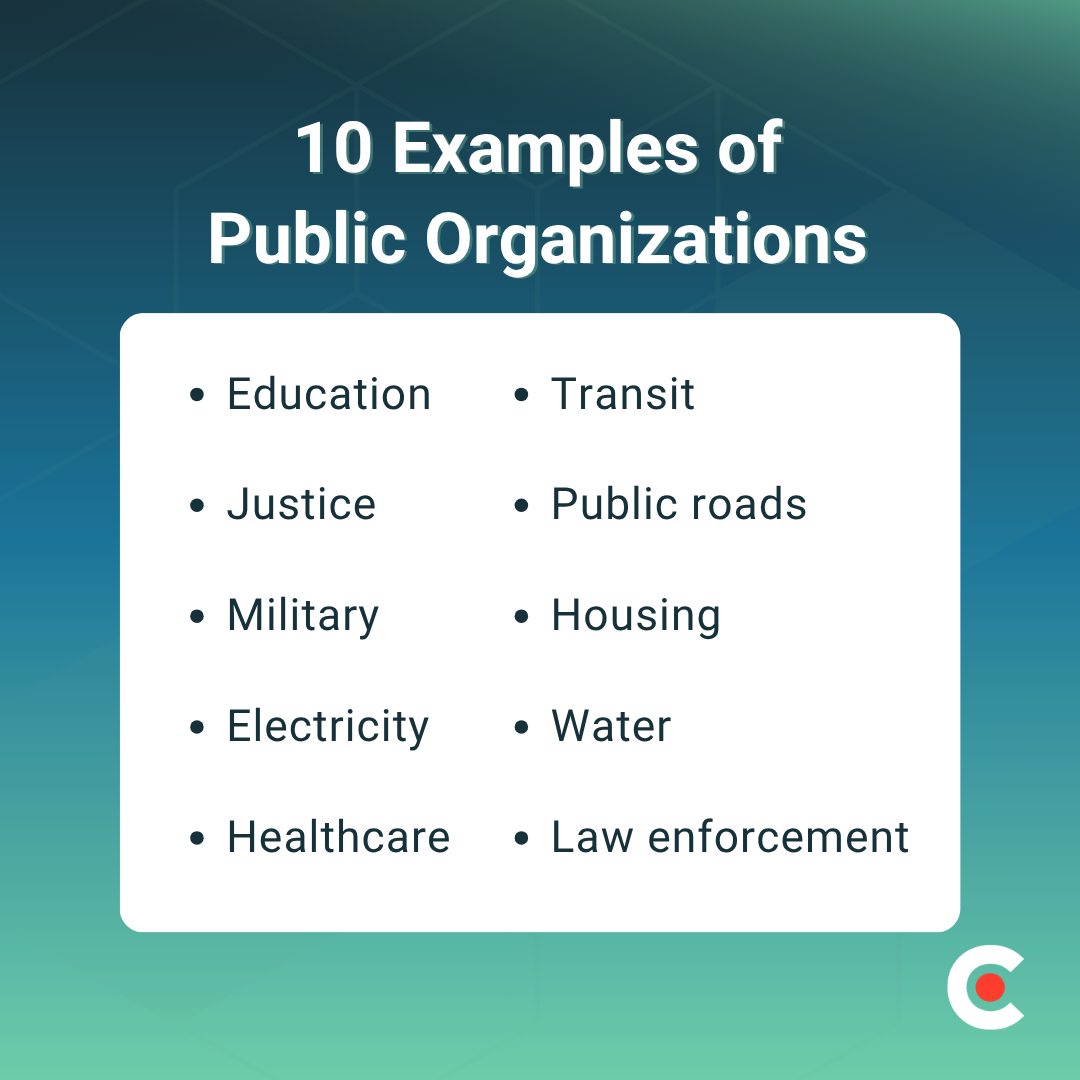
The clearest way to understand what a public organization is comes from examples. Here are 10 areas of public-sector service, each with real agencies that fall under it. These operate at different levels — federal, state, and local — but all share the same defining trait: government-owned, publicly funded, and built to serve rather than profit.
One of the most commonly-cited examples of the public sector is education. Public schools, community colleges, and state universities are classic public organizations, overseen at the federal level by the U.S. Department of Education and funded to improve literacy, knowledge, and skills across communities.
Local police departments, county sheriff's offices, state troopers, and federal agencies like the FBI are publicly funded and created to enforce the law and keep the population safe.
The court system — federal and state courts — along with the U.S. Department of Justice, ensures laws are applied fairly and that violations are handled in accordance with the law.
The U.S. Armed Forces (Army, Navy, Air Force, Marine Corps, Coast Guard, and Space Force), overseen by the Department of Defense, are funded through taxation to defend the country's people and interests.
Public power utilities — such as the federally owned Tennessee Valley Authority (TVA) and thousands of municipal utilities — deliver electricity as an essential service to homes and communities.
Public hospitals and clinics, along with the Department of Veterans Affairs (VA) health system in the U.S. and national systems like the NHS abroad, provide essential treatment, medication, and surgeries. Private clinics operate alongside these public providers.
Transit authorities like New York's MTA, the Bay Area's BART, and the national rail service Amtrak (a government-owned corporation) move people through cities and across the country.
State departments of transportation (DOTs) and the Federal Highway Administration build and maintain the roads and bridges that let people travel in their own vehicles.
Public housing authorities, guided by the U.S. Department of Housing and Urban Development (HUD), develop affordable housing and set building standards for reliable homes.
While much of the world does not have access to clean water, providing this access is seen as an essential duty of the government in developed nations like the US.
Municipal water utilities and local water districts supply clean drinking water and handle treatment, while the Environmental Protection Agency (EPA) sets the safety standards they follow.
The two terms sound alike but mean opposite things:
In short: a public organization is public because the government owns it; a public company is public because its shares are openly traded.
As these examples show, public organizations provide some of the most vital services in society today, helping to ensure that children are educated, the sick are healed, key utilities are provided, and infrastructure is maintained.
It's an organization owned and funded by the government to provide a service to the public — like a public school, a police department, or the postal service — rather than to make a profit.
Most government agencies are public organizations, but the term is a little broader — it also covers government-owned corporations (like Amtrak or the TVA) and public utilities that deliver services directly, not just administer programs.
A public organization is government-owned, tax-funded, and focused on public benefit. A private organization is owned by individuals or shareholders and focused on profit. See the comparison table above for a side-by-side.
No. A public organization is government-owned (public sector). A publicly traded, or "public," company is a private business whose shares are sold on a stock exchange — it's still privately owned and profit-driven.
Public schools, the military, local police, public hospitals, transit authorities like the MTA, the U.S. Postal Service, NASA, and municipal water and electricity utilities are all common examples.