
10 Actionable Link Building Tactics to Build Brand Authority & Legitimacy
Discover 10 actionable link building tactics to boost brand authority and rankings. Learn how quality backlinks build lasting trust in the AI search era.
Updated March 24, 2026

Search is shifting from keyword-focused results to AI-generated summaries, making content structure more important than ever. This article explains how to organize your content for Google’s AI Overviews and includes practical templates you can use right away.
Search has changed more in the last few years than in the decade before it. Google's shift from blue links and featured snippets to AI-generated summaries reshapes how information gets discovered.
AI Overview (AIO)s are rolling out across the U.S. and other regions. It synthesizes answers from multiple sources and formats, not just the top-ranked page.
Looking for a SEO agency?
Compare our list of top SEO companies near you
For creators, structure now does as much heavy lifting as keywords. Maybe more. Well-organized, context-rich content is easier for AI to parse, reuse, and cite.
This piece focuses on structuring content for AIOs. Keep reading for practical templates you can adapt today.
An AI Overview (AIO) summarizes answers directly on the search engine results page (SERP), which is the page you see after entering a query into a search engine. It draws information from multiple websites and provides links to these sources, allowing people to explore further.
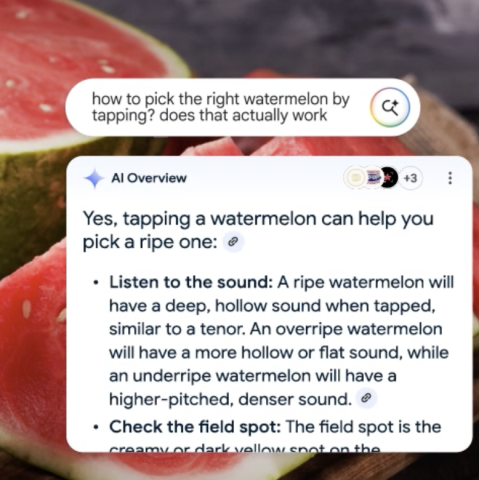
Specifically, Google assembles a clear response from the best available information instead of regurgitating the top result.
For users, this means saving time and getting clarity on complex topics. Meanwhile, publishers get new placement opportunities if their content is built in a way that AI can understand and cite. So, it’s best to get the real value of AI as a business.
Evidently, Google is moving from keyword-dominated search to the three C’s: context, completeness, and clarity. That’s why Adrian Iorga, Founder and President of Stairhopper Movers, recommends creating content aligned with this shift.
Iorga says, "The algorithm now prioritizes content that answers questions comprehensively and contextually. Success means creating content that serves as a trusted resource, not just a collection of keywords."
It’s crucial to understand the state of content in the age of AI. As you may or may not be aware, large language models (and their ranking systems) need signals about what each section means and how ideas connect.
A good content structure (with clear headings, sectioned logic, consistent terms, labeled steps, and scannable summaries) provides those signals. These structural elements help AI algorithms extract the right pieces contextually and attribute them accurately.
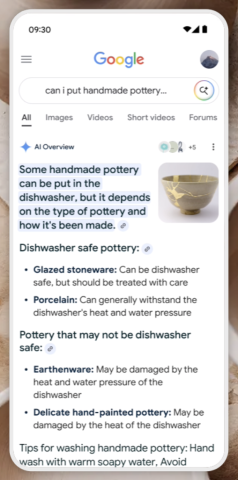
See how AIO provides overviews for this question, Can I put handmade pottery in the dishwasher? below:
Learn from Grant Aldrich, Founder of Preppy. He implements SEO for AIO to boost the visibility and traffic of his online certification website. He’s begun optimizing content structure that’s aligned with AI overviews.
Aldrich explains, "Structure is the language AI speaks fluently. When content flows logically with clear hierarchies and relationships between ideas, AI can extract meaning more effectively. Poor structure creates blind spots that even the best keywords cannot overcome."
On the flip side, unstructured walls of text underperform. They bury definitions and blur steps. They scatter evidence across paragraphs. In a generative SERP, that lack of clarity makes it hard for AI to confidently surface the right answer.
Ultimately, web pages that label concepts and break down processes (even pairing claims with sources) tend to be surfaced and cited more often. So, follow Google's guidance on people-first content.
Structure is the scaffolding that lets both humans and AI navigate your ideas.
Take it from Brandy Hastings, SEO Strategist at SmartSites. He strikes a balance between user experience (UX) and AI comprehension.
Hastings notes, "Clear headings, logical progression, rich context aren't just design choices anymore. They're signals that help AI understand your content's purpose and value."
With extensive digital marketing experience, he shares the key principles of structuring content:
Lead with the core question or takeaway. Then, follow with grouped sections. Finally, finish with "what to do next." Make sure to define terms before using them. And use consistent labels for recurring ideas.
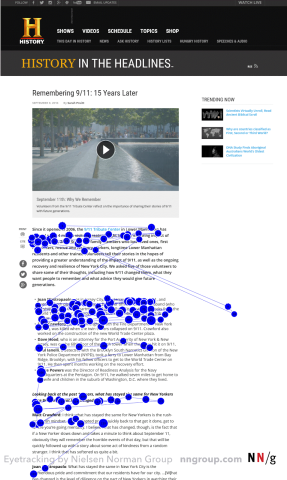
Mark up your hierarchy with H2s and H3s that actually describe what follows. People scan, and so do machines. Nielsen Norman Group's research on scanning patterns suggests that good content design can prevent F-shaped scanning.
Use charts, images with descriptive alt text, short tables, and short quotes from credible sources to ground your claims. Cite your sources in line with links. If a claim matters, show the receipts.
Pair clean HTML with structured data where it fits (FAQPage, HowTo, Product). Schema.org remains the source of truth for supported vocabulary. Meanwhile, you can validate your content structure with Google's Rich Results Test.
These key principles can guide you in creating an excellent content structure. They help AI pinpoint the right span of text and understand relationships. Ultimately, they help present your content accurately and contextually in Google’s AI Overview.
If you only change one habit, make it this: outline first.
Start every piece with a detailed outline that maps your content's journey. AI rewards content that tells a complete story, not fragmented thoughts.
That said, here’s a simple, repeatable process:
Start with a clear outline before writing anything. It helps you organize ideas and map how your content will answer the main question.
When each section has a defined purpose, the whole piece becomes easier for AI algorithms (and of course, readers) to follow. Here’s how:
Lists make information easier to scan and understand. Break key points into short, labeled steps or bullets rather than packing everything into long paragraphs.
This helps readers grasp ideas quickly and makes important details easier for AI to identify. Here’s how:
Turn dense paragraphs into short, labeled steps.
Present the pros and cons or checklists as bullets.
Keep lists tight and purposeful. Don't turn the whole page into a list.
Think about how a reader moves through your content from start to finish. Plan a simple flow that takes them from the problem to the solution.
Adding quick summaries or checkpoints along the way helps busy readers capture the key takeaways fast. Follow the key steps below:
It’s best to develop measurement frameworks for AI-optimized content.
Traditional metrics tell only part of the story now. Look at key metrics to track in the age of AI, like how often your content appears in AI-generated summaries. These indicators reveal whether your structure truly serves both AI comprehension and user needs.
Here are practical ways to track and iterate:
Content templates are practical starting points you can adapt to different types of content.
As you use AI in your content workflow, having a clear structure helps both writers and AI tools organize ideas more efficiently and effectively.
Use the templates below as starting points, and adjust the headings to match your target audience, search intent, content type, and business goals.
This structure helps organize blog posts around a clear problem and solution. Readers and AI systems can follow the ideas more easily.
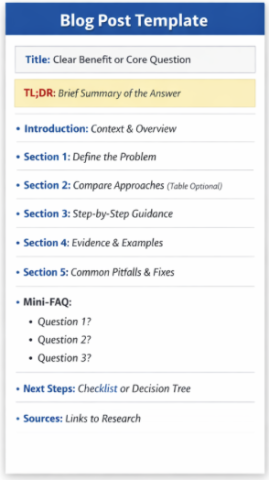
It works well for tutorials, explainers, and educational content. Clear sections improve readability and search visibility.
A clear structure helps present your product’s value quickly. It guides visitors from overview to decision.
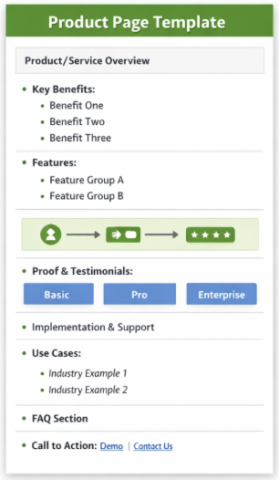
Separate sections for features, benefits, and proof points improve clarity. This structure also helps AI identify your product and its use cases.
An FAQ format answers common questions in a simple, scannable way. Readers can find information faster.
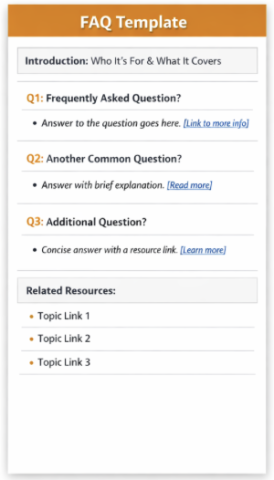
Short questions and direct answers help AI systems extract key details more easily.
We're well past the era of sprinkling keywords and calling it a day.
In AI-shaped search, structure is strategy. When your content is clearly organized and context-rich, it's easy for AI to quote you accurately and for people to trust you.
Start with one page this week. Tighten its structure. Add a TL;DR, a mini-FAQ, better subheads, and one table. See what happens. Then scale the playbook.
Remember, AI rewards content that tells a complete story. Start there, and let structure do what keywords can't.