
Task Automation: How to Cut Repetitive Work
Task automation saves time, gets work done faster, and reduces errors. Learn how to automate repetitive tasks step-by-step and how to decide what to automate.
Updated December 2, 2025

Most businesses aren’t getting real value out of AI because generic tools lack the context of their data, systems, and expertise. Shifting to custom AI models tailored to businesses’ needs allows companies to solve real challenges, improve their decision-making, and drive measurable outcomes.
If you’ve been following the development of AI tools, you’ve probably noticed that AI adoption has been exploding as of late. That being said, it has been shocking to see that business value hasn’t followed the same growth trajectory.
Sure, AI is a great tool to write faster content and experiment with strategy, but time and time again, we’ve seen it turn into another “check-the-box initiative.” As much as it can be helpful, faster outputs don’t automatically equal smarter decisions and more revenue. This is especially true when businesses become stuck using generic AI tools that weren’t designed for their industry, systems, or the way teams work.
Looking for a Artificial Intelligence agency?
Compare our list of top Artificial Intelligence companies near you
But trade in those catch-all tools for custom AI models built around your business’s expertise, data, and customers, and you get value.
It’s undeniable that large AI models like ChatGPT and Gemini are incredibly powerful, but by default, they’re generalists.
These models do not automatically know:
So while they can generate content, ideas, or first drafts, they struggle to:
And unfortunately for many teams, this translates to more noise and less value. It’s because of generalization that teams spend more time fixing outputs rather than accelerating their workflow, and at that point, is AI really acting as a tool or as more of a hindrance?
However, simply highlighting what generic AIs get wrong and how custom models can correct those shortcomings doesn’t paint the full picture; we also have to examine what companies themselves are getting wrong when attempting to implement AI into their operations.
After all, even the best tools won’t do you any good if you don’t take the time to learn them.
Common mistakes we see include:
Ultimately, the biggest failure point boils down to intent.
If you introduce and treat AI as a novelty, it will make your brand a novelty.
The easiest way to pin down whether your AI is helping your business grow is to ask yourself: “Are we measuring success by volume of content generated, or its impact?”
If it’s the former, you may be misusing those tools.
Here are the metrics that matter:
| Success Indicator | Example AI Impact |
| Better strategic decisions | Budget shifted to highest-return campaigns in real time |
| Higher revenue efficiency | Improved ROAS, lower CAC |
| Shorter experiment cycles | Weeks → hours |
| Knowledge accessible company-wide | New hires onboard in days |
| More time for high-value work | Teams focus on creative + strategic thinking |
AI should be improving how you operate, not just what you produce.
Let’s give custom brand GPTs a clearer definition: These should be AI models trained on first-party marketing and product data, industry-specific best practices, internal processes and team knowledge, and strategic frameworks unique to a business.
At Disruptive Advertising, for example, this approach powers our proprietary Disruptive IQ, a suite of custom GPTs tailored to different business models (B2B, eCommerce, B2B, Local).
These models connect to tools like GA4, Meta Ads, Google Ads, and Shopify so AI can pull live performance analysis on the fly, flag problems before they become costly, and recommend tactical optimizations backed by data.
This enables strategists, specialists, and leaders to make more informed decisions at a significantly faster rate, eliminating the need for manual reporting cycles.
It can be said that these custom GPTs effectively become a digital extension of your top-performing employees.
There’s a lot of hype surrounding AI, some of which is warranted, while some is not-so-good. However, companies that are seeing a true impact take a more thoughtful, phased approach.
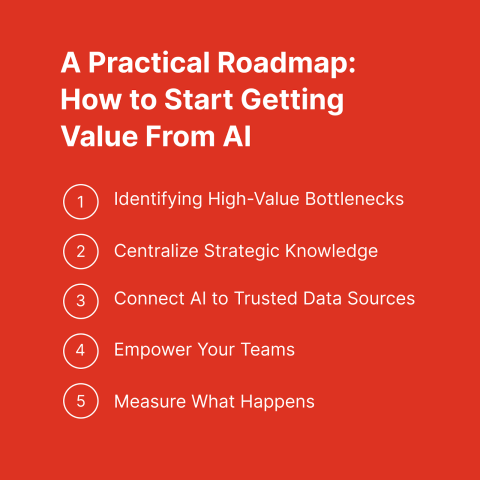
Start where the pain is. Look for tasks that are manual, repetitive, or slow today:
Anywhere your team is waiting, your customers are waiting too, and that’s where AI can immediately free up time and energy.
We’ve pretty much covered this to death, but it’s worth repeating: AI is only as smart as the information you give it.
Collect and organize the materials that reflect your best thinking:
When this knowledge becomes accessible to AI, your expertise scales.
This phase marks the turning point, where AI transitions from being a helpful tool to something more akin to a business partner.
Integrate the systems on which you already rely:
Giving AI the ability to see the real numbers behind your decisions turns it into a strategist.
Another point we love to echo is that technology itself does not drive outcomes; people do.
Give your team practical guidance they can own:
Amplify your talent.
AI success should also show up in the metrics that move your business:
Aligning AI to business outcomes helps make your ROI visible and, in turn, scalable.
Harvard Business School wrote a fascinating article on how businesses are leveraging AI in impactful ways. These companies took a deeper look at some of the most pressing issues in their respective industries and found ways to utilize AI tools to enhance their operations.
Porch piracy has become a major headache for customers, and UPS didn’t wait around for the problem to worsen. Instead, the company built DeliveryDefense, an AI-driven solution that evaluates delivery risk down to the exact address.
This involved analyzing millions of data points with AI, such as past loss history, delivery attempts, and neighborhood trends. Upon collecting the data, their systems assign each drop-off location a confidence score.
Then, high-risk packages can be automatically rerouted to secure pickup points.
How this translates to value: Fewer missing packages means more trust, stronger customer relationships, and lower operational costs.
Even if your business doesn’t deliver goods, this kind of predictive problem-solving shows how AI can help your business identify risks before they turn into revenue losses.
Most dentists have to juggle fast-paced appointments and heavily rely on visual interpretation. VideaHealth supports their judgment with AI that flags hidden issues, such as early cavities or gum disease, on X-rays that might otherwise go unnoticed.
This custom AI tool enhances diagnostic accuracy and consistency across providers, resulting in more reliable treatment and care for patients.
The business advantage: VideaHealth AI reduces human variability, operational bottlenecks, and costly misdiagnoses while improving patient trust.
With so much discourse on whether AI will eliminate the need for humans, this specific tool shows that it’s more meant to amplify experts, not replace them.
Agriculture giant John Deere has been utilizing AI technology to enhance efficiency on farms nationwide. One way they do this is by using their very own See & Spray Technology to distinguish between crops and weeds with pinpoint accuracy.
The company has also used Blue River’s vision-based weed targeting system to produce AI-equipped autonomous tractors that analyze field conditions and make real-time adjustments before planting and harvesting.
The impact: These AI tools have helped farmers reduce chemical waste, maximize crop output, and automate tedious manual labor.
The thing these three companies have in common is that they didn’t add AI to their operations for the sake of “innovation,” but as we mentioned at the beginning, they targeted a specific business challenge and focused on measurable improvements.
While most companies today continue to experiment with AI, why not give yourself an edge by actually deriving value from it?
Fuel your AI tools with your data, your systems, and your subject matter expertise. Don’t just aim to work faster, but work brilliantly.
Move from generic output to an intelligent outcome.
Start now, and you can end up defining what the competitive advantage of using AI in business operations looks like in your field.