
How to Define Brand Values That Guide Every Business Decision
Brand values are the principles that guide company decisions, define what a brand stands for, and shape how it treats customers, employees, and partners.
Updated November 24, 2025

When you run an agency, your reputation can help build trust that may eventually contribute to closing deals. It goes to show how personal branding isn’t optional now. As founders, you build visibility, credibility, trust, and relationships to get your first discovery call.
Whether B2B or B2C, potential clients connect with people before their portfolios.
So, shifting from a faceless agency to a founder-led identity makes prospects feel confident about who they’re partnering with. And when this trust compounds, your content starts generating qualified leads instead of you simply spraying and praying.
Looking for a Public Relations agency?
Compare our list of top Public Relations companies near you
This article will share how founders can turn their personal brand into a client-magnet system.
For your personal brand to stand out, you need clarity about what you want to be known for.
When founders try to appeal to everyone, they end up sounding like everyone else. So, define a niche that highlights your agency’s unique strengths and aligns directly with the type of clients you want to attract.
Ask yourself — What problems do we solve better than anyone else?
Your niche should be a mix of your expertise, passion, and client demand. For example, if your agency helps SaaS startups with growth, position yourself as the founder who understands product-led storytelling or B2B growth content.
The more distinctive your brand positioning, the easier it becomes for decision-makers to associate you with a specific solution. Then, visibility begins to turn into opportunity.
You must speak your audience’s language. Take the time to study how your ideal clients actually discuss their problems. This can guide your messaging. So,
See a pattern? Turn it into your content theme. This will show your audience you truly get them.
Your personal brand should sound like you, not a drab, watered-down version of everyone else. A clear point of view makes you more memorable and acts as a great pitch to potential clients.
Anyone can share opinions. What separates credible founders from the noise is turning experience into actionable frameworks. These are your “what I think” vs “how I do it” posts.
For example, you can create concise frameworks as part of your LinkedIn personal branding strategy. Instead of saying generic things like “consistency matters,” show how it worked for you and the results you achieved.
The most magnetic personal brands feel cohesive. Define 3-4 recurring pillars that reinforce your expertise. These could be:
For example, in his LinkedIn posts, Forbes expert Bhavik Sarkhedi tries to add authenticity through experience-based insights. He reflects on what works to build thought leadership without chasing virality.

Image source: Bhavik Sarkhedi
The takeaway is clear. Your PoV becomes unmistakable when your content reflects your lived experience and clear themes, and that’s what attracts the right clients.
You need a “show, don’t tell” approach to build trust. A great way to do this? Turning your client results, testimonials, and learnings into content that teaches, and doesn’t sell.
Sharing your agency framework in a simple post can spark genuine interest while demonstrating your expertise.
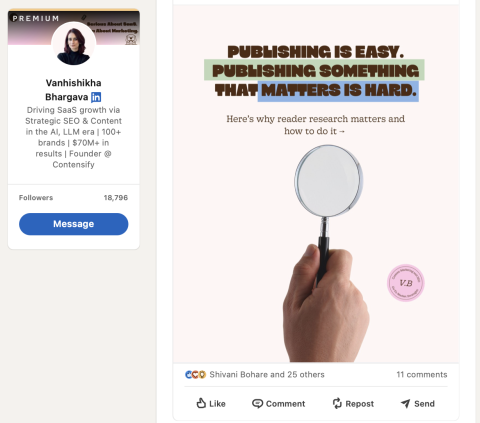
Image Source: Vanhishikha Bhargava
This transparency draws in clients who value capability over salesy pitches.
What happens behind the scenes is equally important. Share how your team collaborates, makes creative or important decisions, or learns from challenges. It’ll humanize your brand and build an emotional angle with prospects.
The challenge is, as your visibility increases, internal alignment becomes essential to maintain consistency across every client touchpoint. So, document processes and keep the entire team aligned with the brand’s tone and standards.
When your team and your content both reflect the same values, your B2B credibility spikes. Clients will notice the professionalism in your results and in how your agency operates.
Social media can turn visibility into opportunity because the more exposure you get, the more familiar and trustworthy you appear to potential clients.
Ideally, agency founders should start with LinkedIn. It’s the most direct way to connect with decision-makers.
Take Eddie Shleyner, the founder of VeryGoodCopy, as an example. He doesn’t always post long stories, but they’re impactful and contribute to him gaining over 100,000 followers on the platform.
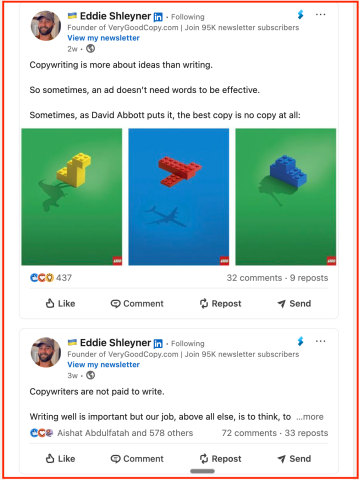
Not only will you find him actively posting on LinkedIn, you’ll also see him share “micro lessons” on X.

Image Source: Eddie Shleyner
Then, expand to YouTube for depth. Long-form content lets you share strategies, analyze client success stories, or share BTS content.
Eddie also collaborates with other marketing companies on podcasts, which you can watch on YouTube.

I get it, as a founder, juggling so much can be overwhelming. So, start small.
What matters more than algorithms is reliability. When people see you show up with practical ideas often, they begin associating your name with expertise and being dependable.
That’s when social proof will bring inbound leads. Plus, your personal brand becomes the channel to drive awareness for high-value clients.
Social media helps with discovery. But owned platforms like newsletters and communities are where they stay and become more invested.
Once you’ve built awareness, the next step is to create a personal ecosystem that turns attention into long-term relationships. This way, you have a space where you own the audience, rather than trying to please the algorithm.
Start by converting followers into subscribers or community members. A simple newsletter or private Slack group can become an ongoing conversation with your most engaged audience. Use it to share deeper insights, resources, or behind-the-scenes lessons that don’t make it to social platforms. This helps you nurture familiarity and authority outside the noise of feeds.
For example, Jay Clouse, the founder of Creator Science, has almost 60,000 followers on LinkedIn. However, he uses his newsletter to elaborate on his frameworks and maintain a consistent brand narrative.
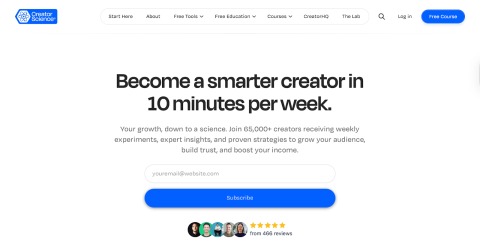
He has over 65,000 subscribers and a 5-star rating in 466 reviews, demonstrating the high value people place on this direct connection.
You can also reinforce your identity through creative touchpoints. Consider personal or agency-branded swag. It could be as simple as a hoodie, hat, or t-shirt that has your logo. Tangible reminders enhance recall, particularly when meeting clients or peers in person.
You can also wear your branded apparel while attending discovery calls, webinars, or while recording videos. Platforms like Printful or Printify make it easy to create such merchandise without holding much inventory.
The goal isn’t just visibility but memorability.
When you have a cohesive brand strategy, it speaks volumes about who you are and what you stand for. It could turn casual followers into advocates and one-time clients into long-term clients.
Visibility without a plan to convert it into conversations or clients is just noise.
The ultimate goal of personal branding is to transform that visibility into tangible business outcomes, including clients, partnerships, and revenue.
So, create a clear lead capture path from your content. Every post should have a next step for people who relate to your ideas. It could be a:
The point is to make it effortless for potential clients to move from curiosity to conversation.
For example, Sorav Jain, founder of EchoVME and Digital Scholar, often shares insightful posts and carousels on his Instagram, wherein the caption and last slide often end with the CTA that starts meaningful conversations.
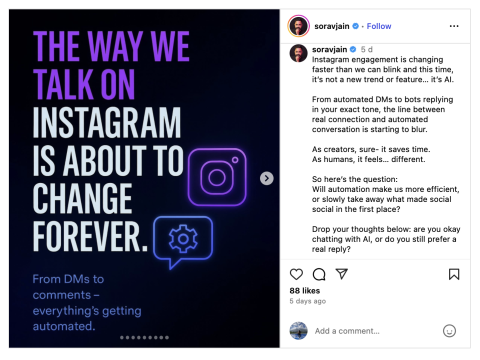
Image Source: Sorav Jain
An empathetic, timely reflection on a current industry update can bring organic discussions that lead to several inbound inquiries without spending much time doing outbound pitches.
Posts like these work because they show awareness, insight, and relevance, all of which naturally attract decision-makers.
This is the social media trajectory you should aim for-
Engagement > Relationship-building > In-depth conversations > Conversions
So,
Take a cue from Akshat Tongia, founder of Content Floww.
In the video below, he dives into exactly how his agency lands high-ticket clients. One of the points he touches upon is how his LinkedIn (7.8k followers), Instagram (200k+ followers), and YouTube (24.8k subscribers) help his agency get inbound leads.
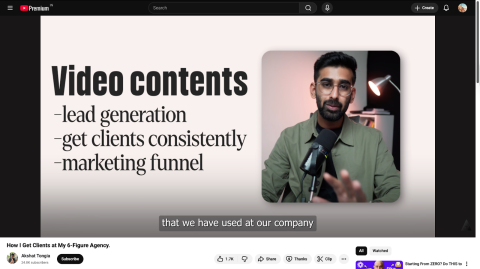
Image Source: Akshat Tongia
Together, these platforms work as an integrated funnel. You build awareness at the top, trust in the middle, and qualified conversations at the bottom. Your content starts functioning like a growth system when every channel has a purpose.
What separates successful agencies from the rest is not scale, but visibility and trust.
A strong personal brand gives agency founders that edge. It builds recognition long before a pitch and creates a steady pipeline of opportunities rooted in credibility over chance.
Build momentum by picking one platform and showing up twice a week with content your clients actually care about. Turn a client win into a story that educates, and start a few genuine conversations with people engaging with your posts.
Do this consistently and see your personal brand become your agency’s most reliable growth engine.