
How to Evaluate a Marketing Agency's Performance in 2026
Most brands judge agencies on gut feel and busy decks. Here's a more honest framework: retention data, attribution accuracy, and why client relationships...
Updated June 25, 2026

B2B buying has quietly become a team sport.
Decisions involve more stakeholders, longer research phases, and buyers who arrive informed long before a sales conversation even begins.
That shift stretches timelines, adds friction, and leaves plenty of room for deals to lose momentum.
Looking for a Digital Marketing agency?
Compare our list of top Digital Marketing companies near you
The companies pulling ahead approach this differently. Instead of pushing sales teams harder, they lean into data.
They spot intent earlier, focus on the right accounts, tailor every touchpoint, and keep marketing and sales working as one system.
And the payoff is real, with intent-driven strategies often cutting sales cycles by 30-50%.
In this article, you'll see why this shift works, what makes it effective, and how to apply it.
Keep reading below.
A shorter sales cycle means little without the right people driving conversations forward. For a practical look at building a high-performing agency sales function, check out our guide on "How to Build a Sales Team: Lessons for Growing Agencies."
To begin with, it helps to rethink what marketing teams are actually trying to achieve.
Many organizations still focus on generating as many leads as possible, filling the funnel with names, email addresses, and form submissions.
But data-driven teams take a different route.
Rather than chasing volume, they look for signs that indicate genuine purchase interest.
This approach is becoming increasingly important because many buyers make key decisions long before they ever fill out a form or speak with sales.
In fact, research from 6sens found that 81% of B2B buyers have already selected their preferred vendor before speaking with a sales representative.
This is the difference between traditional lead generation and intent-driven demand generation.
Traditional lead generation asks, “Who gave us their email?”
Intent-driven demand generation asks, “Who is behaving like a buyer right now?”
Here are the signals worth paying closest attention to:
| High-Value Buying Signal | What It Suggests |
| Multiple visits to product pages | Active evaluation of solutions |
| Pricing page engagement | Interest in budget and purchase planning |
| Demo requests | Strong purchase consideration |
| Content consumption velocity | Accelerating research activity |
| Competitor comparison research | Vendor selection process underway |
| Third-party intent data | Interest observed across external sites |
| Returning visitors from target accounts | Ongoing engagement from decision-makers |
When marketing teams prioritize these signals, they spend less time chasing broad audiences and more time engaging accounts that are already moving toward a purchase decision
Of course, identifying intent is only the first step. The real advantage comes from knowing where to focus next.
Once intent signals are captured, the smartest teams turn them into a prioritization engine.
Most modern scoring models evaluate prospects across three key dimensions.
This layer answers a simple question: Does this account look like the type of customer your company serves best?
Teams usually measure company size, industry, revenue, technology stack, and geographic fit.
A strong fit score helps marketing and sales avoid spending energy on accounts that look busy but sit far outside the ideal customer profile.
The behavioral score looks at what people from that account are actually doing.
Website visits, product page activity, content engagement, demo interactions, and repeated research patterns all help reveal how seriously an account is exploring a solution.
First-party signals carry extra weight here because they reflect real activity within your own ecosystem.
Intent score adds another layer by looking beyond your website.
It can include third-party intent platforms, review-site activity, industry-publication engagement, and competitor-related searches.
This helps teams spot accounts researching the category before they raise their hand directly
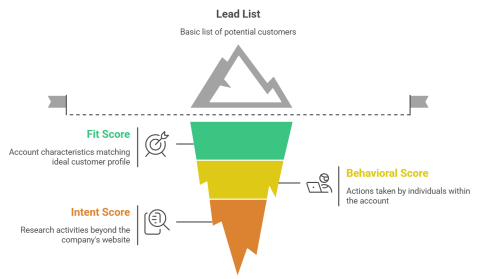
The most effective scoring models combine all three dimensions.
When sales teams focus on accounts with the strongest combination of fit, engagement, and intent, conversations start earlier, move faster, and reach decisions with far less friction.
This approach has a meaningful business impact: companies that use lead and account scoring models generate 77% higher lead generation ROI than those that don't.
Once high-potential accounts become clear, alignment becomes the next competitive advantage.
One of the biggest sources of revenue leakage in B2B is the gap between marketing and sales.
Marketing may celebrate a fresh batch of MQLs, while sales looks at the same list and sees accounts with weak timing, low urgency, or little commercial fit.
And the impact of that disconnect goes beyond operational friction.
B2B organizations with tightly aligned sales and marketing teams achieve 24% faster revenue growth and 27% faster profit growth over three years.
Data-driven teams fix this by agreeing on revenue signals that both sides can trust.
| Revenue Signal | What It Measures |
| Pipeline Contribution | Revenue opportunities influenced by marketing efforts |
| Sales Qualified Opportunities | Qualified prospects entering the sales pipeline |
| Sales Accepted Leads (SALs) | Leads validated and accepted by sales teams |
| Revenue Attribution | Revenue connected to specific channels and campaigns |
| Deal Velocity | Speed at which opportunities move through the pipeline |
| Win Rate by Source | Conversion performance across lead sources |
Closed-loop reporting makes this practical.
Marketing can see what happens after a lead enters the CRM, while sales can share which signals actually lead to qualified conversations.
RevOps keeps the system clean by connecting data, definitions, routing, and reporting.
The result is a healthier rhythm: fewer weak handoffs, faster follow-up, and teams focused on the signals that move revenue forward.
Read next: Why Most B2B Lead Generation Fails
Automation is where all that intent, scoring, and alignment start turning into actual speed.
The goal here is to help the right account move forward at the right moment, while keeping team size lean and giving sales a cleaner context for every conversation.
High-intent leads should reach sales fast.
When someone requests a demo, revisits the pricing page, or engages with multiple product assets within a short window, automation can instantly assign that account to the right rep.
Tools like HubSpot, Salesforce, Marketo, Pardot, and LeanData are often used for this kind of routing.
Automation also helps teams respond to meaningful activity in real time.
For example, outreach can launch when a prospect:
This keeps follow-up timely and relevant rather than relying on random check-ins.
In B2B, one interested person rarely tells the whole story.
Account-based workflows help marketing and sales coordinate across the entire buying committee.
Platforms like Demandbase, RollWorks, and Terminus can help teams track account activity, segment stakeholders, and trigger coordinated campaigns.
Generic drip sequences treat every buyer the same. By contrast, intelligent nurturing responds to actual behavior.
A CFO researching ROI gets different content than a product leader reviewing implementation details.
Tools like ActiveCampaign, Customer.io, and Klaviyo can support this type of personalized journey.
In the next section, we’ll explore personalization in more detail and examine the strategies that make it effective.
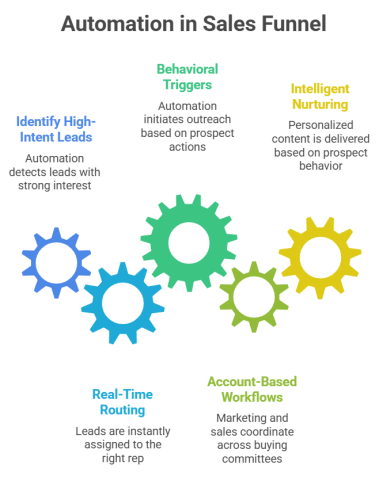
Modern automation works best as a sales support system.
In fact, organizations that integrate marketing automation into their sales workflows can increase sales productivity by 20%, according to Worldmetric.
It handles timing, routing, reminders, and content delivery, so reps can spend more energy on the conversations that actually move deals forward.
Read next: The 20 Best AI Productivity Tools for Every Team
Now let's take a closer look at personalization, one of the most overlooked drivers of sales velocity.
Many teams view personalization as a conversion tactic, yet its impact extends far beyond that.
It also helps prospects reach decisions faster.
According to McKinsey, 71% of consumers expect personalized interactions, while 76% become frustrated when they don't receive them, highlighting the impact of relevance on buyer decision-making.
Data enables marketing and sales teams to create experiences that feel relevant from the very first interaction.
That can include:
The principle is simple: every irrelevant message adds friction, while every relevant message removes it.
Over time, those small improvements create a smoother buying journey and a much shorter path to a final decision.
But that raises an important question: where should optimization efforts begin in the first place?
And the answer is…
Another common misconception in B2B marketing is that sales-cycle acceleration begins once a lead enters the pipeline.
In reality, many of the strongest gains happen much earlier.
High-performing teams spend considerable time refining messaging, positioning, creative strategy, and content relevance before prospects ever reach a sales conversation.
This is particularly crucial, given that B2B buyers are often nearly 70% of the way through their purchasing process before engaging with a seller.
By the time a prospect enters the pipeline, many key perceptions, preferences, and evaluation criteria have already been shaped.
Data plays a central role in this process. It helps teams identify:
So rather than focusing solely on lead volume, teams can see how buyers actually move from first interaction to closed revenue.
This is also where outside growth expertise can make the data easier to act on.
The next layer is turning those lessons into a repeatable intelligence system.
Mature data-driven teams treat revenue intelligence as a living feedback loop.
They connect the full picture across marketing automation, CRM, product analytics, intent platforms, and customer success systems.
That view helps teams answer the questions that actually shape faster deals.
This may help explain why companies using revenue intelligence tools report a 15% higher lead-to-close conversion rate.
Predictive analytics and AI-assisted scoring represent the next stage of this evolution.
In practice, this system often runs through tools like Gong, Clari, Salesforce Revenue Intelligence, or People.ai.
By helping teams identify promising opportunities earlier, they enable more confident resource allocation.
Let’s wrap this up: shorter B2B sales cycles rarely come from louder follow-ups or heavier pressure on sales teams.
They come from better signals, cleaner priorities, stronger alignment, and smarter timing across the whole buyer journey.
Data helps teams understand who is ready, what they care about, and which actions move deals forward.
Use these insights to turn your marketing data into a smarter, faster, and more focused revenue engine.
Buying intent refers to the behaviors and signals that indicate a company is actively researching solutions and moving toward a purchase decision. Common examples include visits to pricing pages, demo requests, competitor comparisons, and repeated engagement with product-related content.
Data helps teams identify high-intent accounts earlier, prioritize the most promising opportunities, personalize engagement, and improve coordination between marketing and sales. This allows prospects to move through the buying process more efficiently.
Traditional lead generation focuses on collecting contact information, while intent-driven demand generation focuses on identifying prospects that exhibit strong purchase signals. The goal shifts from generating more leads to engaging the right buyers at the right time.
When marketing and sales use shared revenue metrics and qualification criteria, lead handoffs become smoother and follow-up becomes more relevant. This reduces delays, improves lead quality, and helps opportunities progress faster.