Lead Quality vs. Lead Quantity: Why B2B Teams Are Rethinking Their Funnel in 2026
Bigger buying committees and tighter budgets are forcing B2B teams to rethink lead quality vs. quantity. Here's how top teams rebalance the tradeoff in 2026.
Updated April 23, 2026

PPC agencies help their clients get the most out of their PPC campaigns. These agencies can strengthen online visibility, generate high-quality leads, and increase sales, but finding the right PPC partner for your business can be challenging. This checklist will help you narrow down your search.
Pay-per-click (PPC) advertising is a model in which advertisers are charged every time their ads are clicked. It can refer to several different ad formats, though, including ads that appear on search engine results pages (SERPs), social media ads, display ads, and more.
PPC ad companies offer a variety of services to help their clients earn the highest return on their investment possible. This includes everything from drafting ad copy and designing ad campaigns to managing ad budget, tracking metrics, and generating reports.
Looking for a Digital Marketing agency?
Compare our list of top Digital Marketing companies near you
With the help of a PPC company, businesses can generate high-quality leads, increase online visibility, and even grow sales.
This article will break down how to go about finding, vetting, and selecting a PPC partner that can help your business meet your goals.
A PPC agency is a firm that manages paid advertising campaigns for businesses. That might include search ads on Google, social media ads, display banners, shopping feeds, or remarketing campaigns.
These agencies handle the strategy and day-to-day work: writing ad copy, setting budgets, choosing where ads appear, and tracking what works. Many also offer keyword research, graphic design, landing page testing, and help with overall brand positioning for paid channels.
Most PPC agencies charge either a flat monthly fee or a percentage of your ad spend. While the ads themselves are priced per click (hence “pay-per-click”), the agency’s role is to manage those campaigns and make sure your budget is being used effectively.
When choosing a PPC agency, it helps to go in with a plan: clear goals, a sense of your budget, and a list of what you actually need help with. The steps below will walk you through how to narrow the field and find a team that’s a good match for how your business works.
When hiring a PPC partner, it’s important to know your business’s primary goals so you can effectively communicate your needs with potential service providers and outline an effective PPC strategy.
How a PPC provider sets up your ad campaign and measures success will depend on the goals of your project.
For instance, many businesses use PPC ads to grow brand awareness and consideration. The idea behind this is that the more a potential customer sees a brand name, the more likely they are to remember the business and hire them in the future.
To increase impressions, PPC advertisers will target a broader audience and retarget users to ensure brand consideration. However, this strategy won’t be effective for businesses who are measuring success based on revenue because the conversion rate may be too low and the cost too high.
Other companies use PPC advertising to grow traffic to their website or increase sales. Unlike those who just want to increase brand awareness, these companies will want to target specific audiences that are more likely to convert. Additionally, with a focus on increasing their ROI as much as possible, they will want to minimize their ad spend, which will likely minimize their reach as well.
When interviewing potential service providers, sharing your goals and your budget will help them explain how they would reach your goals. This can help you narrow down your options when interviewing potential service providers later in the search process.
Not every agency handles the same type of work, so it’s worth getting specific about the services you expect before reaching out. Some specialize in paid search (like Google Ads or Bing), while others run full-service campaigns that span social media, display, shopping feeds, and retargeting. If you’re running ads on Instagram, Facebook, LinkedIn, or YouTube, you’ll want a team with hands-on experience on those platforms.
You’ll also want to think about how much support you need outside of media buying. Some agencies just manage the campaigns, while others offer strategy, landing page testing, conversion rate optimization, or even content support. Getting clear on what’s in scope will help you avoid misalignment and save time when comparing options.
PPC budgets can be broken down into two categories: ad spend and agency fees. Companies need to budget for both, but when hiring a PPC provider, it’s important to discuss their rates first and foremost.
The cost of hiring a PPC company varies wildly depending on the project scope, the duration of the partnership, the agency’s location, and more. Because of this, it can be difficult to estimate how much your project will cost.
When you start comparing PPC agencies, you’ll see a few different ways they price their services. Some charge an hourly fee, anywhere from $100-$149, depending on what’s included. Others bill based on ad spend, usually taking 15 to 30 percent. There are also hybrid setups that combine a base fee with performance incentives. The pricing structure often reflects how involved the agency will be, how complex your campaigns are, and what kind of reporting or support they offer.
When discussing cost with potential PPC partners, be sure to discuss their pricing model and be transparent about what you’re willing to spend.
You should also discuss how much you plan to spend on the ads. The cost of running a PPC ad depends on the platform the ad is running on, the audience, location, targeted keywords, industry and more. This will help them determine the scale of the project and help them create an informed PPC strategy that uses your ad spend more effectively.
Learn more about budgeting for a PPC campaign in, ‘How to Create a PPC Budget [With Template].’
Once you’ve aligned on your goals and budget, it’s time to start your search. You can begin by asking colleagues for referrals or looking online for agencies that work in your industry. As you review options, create a short list of criteria to help compare PPC partners more effectively.
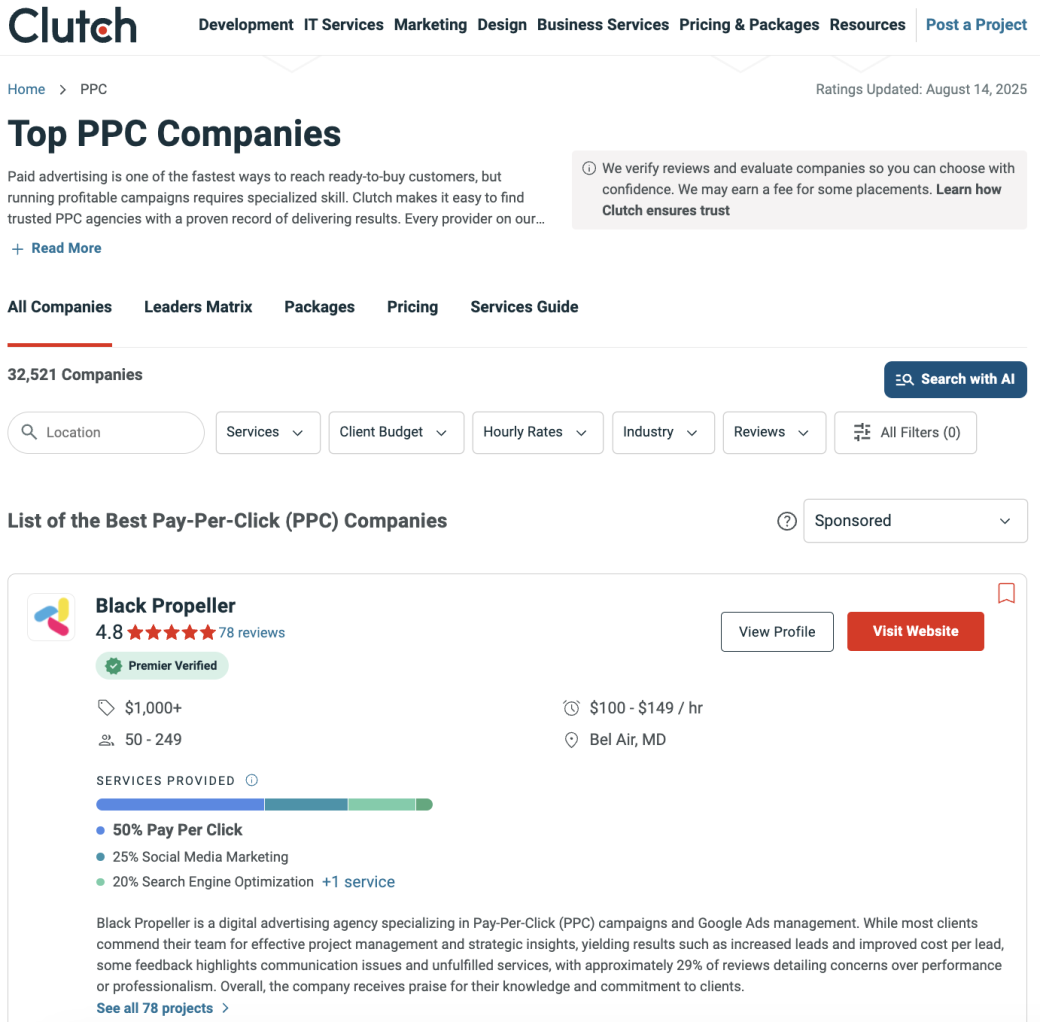
To make your search easier, Clutch connects businesses with vetted top PPC agencies based on verified reviews, project details, and client feedback.
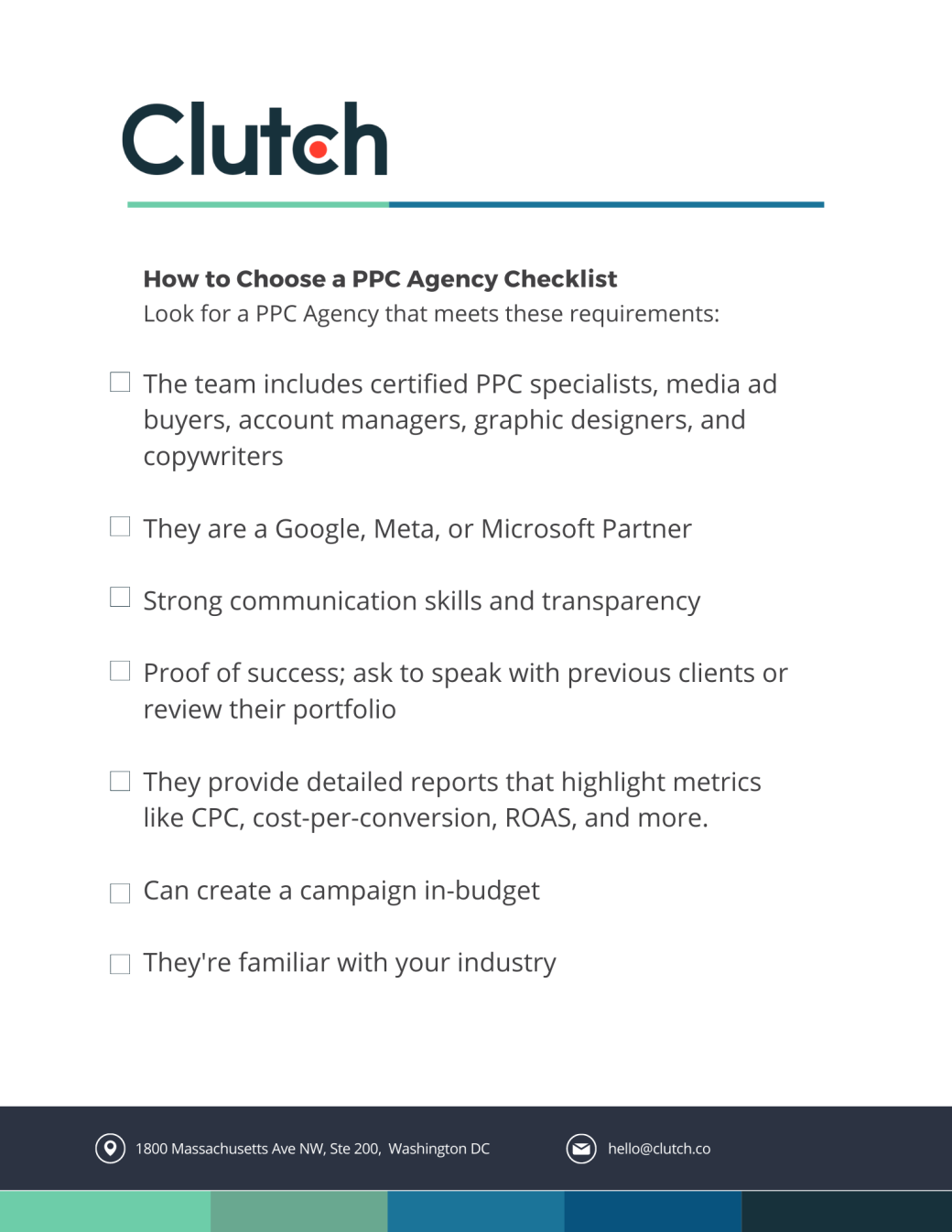
Here are a few things to look for:
Client reviews can give you a clearer picture of how an agency works. On Clutch, you’ll find detailed feedback on real projects, including budget ranges, communication quality, platforms used, and campaign outcomes. Use those insights to filter by what matters most, whether that’s cost, location, or results.
Once you’ve gathered enough information, narrow your list to a few top contenders who check the right boxes for your business. From there, you’ll be ready to set up interviews and dig deeper.
With a list of potential PPC partners, you can contact them and set up an interview. The interview process should help you understand how they would help your business goals using PPC.
In addition to getting a better understanding of how they would approach your project, you can also use the interview to gauge how well you would work together.
Key questions to ask potential PPC partners during an interview:
These kinds of questions can help you see how the agency thinks, what they prioritize, and how easy they’ll be to work with once things are up and running.
Additional reading, ‘B2B Service Providers: Questions to Ask Potential Business Partners.’
As long as you keep your budget and goals in mind, you will be able to find a reliable PPC agency to support your business’s digital strategy.
Whether you’re hoping to grow brand awareness on social media, want to target audiences with high conversion rates using Google Ads, or are hoping to create a comprehensive digital advertising campaign, hiring a PPC professional can help.
Search for leading providers with experience working with companies in your industry that can fit within your budget, and are easy to collaborate with.
Some agencies sound great at first but fall short once the work starts. As you evaluate partners, keep an eye out for signs that they may not be a good fit or might not follow through once hired:
If you’re not sure whether something is a red flag, ask follow-up questions. A reliable agency should be open, easy to talk to, and able to explain how they’ll support your team in plain terms.
There’s no one-size-fits-all approach to hiring the right PPC agency, but knowing what you need puts you in control of the process. Once you’ve nailed down your goals, budget, expectations, and preferred working style, it’s much easier to spot which partners are worth your time. Ready to take the next step? Explore Clutch’s list of PPC agencies and read real reviews from companies like yours to find a partner you can trust.
Still need help hiring a PPC agency? Use this checklist to find the perfect partner for your project.