A healthcare app can be a powerful marketing tool to help patients and healthcare providers manage their care. Learn how to create an effective marketing strategy for your healthcare app and reach new customers with this informative article.
Have you decided to develop a new medical app? That's easier said than done, as many products in this niche need help to gain traction.
One reason for this lack of success is an inadequate healthcare app marketing strategy, which can differ significantly from a general healthcare marketing strategy. Simply providing value isn't enough to make your mark. Due to the COVID-19 pandemic, patients and doctors increasingly prefer remote healthcare channels. It's crucial to establish your presence in this rapidly expanding market.
According to a recent MarketsandMarkets report, the global healthcare IT market was valued at approximately $480.49 billion in 2025 and is projected to reach $961.26 billion by 2030, growing at a CAGR of 14.9%.
Researchers attribute this growth to several key factors:
- The increasing use of big data in healthcare
- High returns on investment associated with healthcare IT solutions
- The need to reduce soaring healthcare costs
- The growing demand for and use of HCIT solutions post COVID-19
- The expanding telehealth, mHealth, and remote patient monitoring markets
Unsurprisingly, the number of consumer digital health apps grew significantly. There are currently over 337,000 digital health apps available to doctors and patients worldwide. Telemedicine adoption has become mainstream — according to Doximity's 2024 State of Telemedicine Report, more than two-thirds of patients surveyed reported having participated in a telemedicine visit, with 41% receiving virtual care in the past year alone.
As you develop a medical application, you're up against fierce competition. It's essential to ensure your digital solution gains popularity in a market with millions of users.
We've compiled a list of the top 16 potent healthcare app marketing strategies, along with bonus tips tailored specifically for your app's target audience. These ideas are actionable, effective, and relevant to medical software.
Why Healthcare Apps Need a Dedicated Marketing Strategy
As the healthcare industry continues to evolve, medical businesses, such as clinics and healthcare organizations, must adapt and incorporate modern technologies into their marketing strategies to remain competitive. Implementing a mobile app strategy can significantly enhance a medical business's overall marketing approach.
Firstly, an app strategy can offer patients convenience and accessibility. In today's fast-paced world, patients desire services that are easy to use and convenient. A mobile app allows patients to schedule appointments, access medical records, view test results, receive reminders, and more from their mobile devices. This level of accessibility and convenience boosts patient satisfaction and can significantly improve the medical business's reputation. A mobile app allows patients to interact seamlessly with the medical business, fostering trust and loyalty.
Secondly, an app strategy can amplify patient engagement. Mobile apps can keep patients informed and up to date on their health by delivering personalized notifications, alerts, and reminders about appointments, prescription refills, and other essential information.
Apps can also incorporate educational resources, patient forums, and interactive features to increase patient engagement and empower them to take charge of their health. Enhanced engagement can improve patient outcomes, and empowered patients are more likely to recommend the medical business to others.
Thirdly, an app strategy can foster better communication between the medical business and patients. Effective communication is a vital aspect of healthcare services. Mobile apps can enable secure messaging between patients and medical professionals, allowing real-time conversations.
Patients can ask questions, seek advice, and share crucial information with their healthcare providers, improving patient care. This level of communication can also elevate the medical business's image, demonstrating that it values patient feedback and encourages open dialogue.
Fourthly, an app strategy can streamline patient data management. With a mobile app, patients can input health data such as medical history, symptoms, and medications, which healthcare professionals can access. This efficient data management can enhance diagnostic accuracy, expedite the appointment process, and minimize medical errors. Mobile apps can also integrate with electronic health record systems, enabling remote access to patient data and significantly improving patient care.
Lastly, an app strategy can help medical businesses stand out in a competitive market. Medical businesses embracing technology in today's digital landscape are more likely to succeed. A mobile app can serve as a unique selling point by offering features that many competitors may not. An app strategy can attract new patients, improve patient retention, and boost the medical business's reputation.
In conclusion, a mobile app strategy can substantially reinforce a medical business's marketing strategy. It can deliver convenience and accessibility, increase patient engagement, enhance communication, optimize patient data management, and enable medical businesses to stand out in a competitive market. While implementing an app strategy requires meticulous planning and execution, the right approach can significantly benefit the medical business and its patients.
Elevating Your Healthcare App Through Effective Marketing
Patient loyalty is no longer guaranteed. According to a 2024 Accenture study, roughly one in five consumers switched providers in the past year — with nearly 90% citing a poor administrative or digital experience as the reason. A 2026 survey found that 69% of patients would switch providers for better services, underscoring the competitive pressure on healthcare apps to deliver a seamless user experience.
Telehealth has become a permanent fixture in care delivery. According to Doximity's 2024 State of Telemedicine Report, more than two-thirds of patients have now participated in a telemedicine visit, and 71.4% of physicians report using telehealth weekly, according to a 2024 AMA survey.
Increasingly, patients consult online reviews of healthcare facilities and professionals before seeking their services. This trend suggests that patients are becoming more discerning, opting for the best choices for themselves and their families. As a result, healthcare providers should view healthcare marketing not merely as a valuable investment but as an absolute necessity.
To stay competitive, join the ranks of businesses that develop and execute successful marketing strategies for medical apps. This approach will help establish trust, convey expertise, and create a positive image of your product among existing and potential customers. Doing so can position you as a market leader and help you achieve your desired financial results.
Key advantages of implementing marketing include:
- Enhanced visibility
- A strong reputation among patients
- Insight into consumer needs and expectations
- Understanding patients' perceptions of your app's quality and outcomes
It's important to note that app marketing is often integral to a broader medical marketing strategy. We're here to share our healthcare marketing ideas to help your medical app gain popularity and drive your business to success:
- Provide Users with Assurances
- Pre-Launch Marketing
- Mobile-First Approach
- Additional Strategies
Provide Users with Assurances
Engaging with people face-to-face differs significantly from interacting through an app. Given its sensitive nature, eHealth has a range of trust issues that must be addressed to convince customers of its worth.
1. Focus on Security
Prioritize end-to-end encryption and HIPAA compliance to turn data security into your strongest competitive advantage. Most online healthcare providers use Electronic Health Records to manage patient data securely.
Still, it is even more relevant in healthcare marketing due to the handling of health data. People are particularly concerned about the safety of Electronic Health Records used by most online healthcare providers.
If you're in this business, you've likely taken extra measures to protect your product from potential external and internal threats. When marketing, emphasize your app's security guarantees and highlight them on your landing page.
2. Connect with Medical Experts
Personal branding is vital in medical app marketing. Involving a renowned physician in promotional activities can greatly benefit your app. Ambassador medical experts can create a lasting impression of your product and garner trust from potential users. The value of your product will be key to winning over these experts, and their endorsement will serve as a true test of its quality.
3. Leverage Patient Reviews + Testimonials
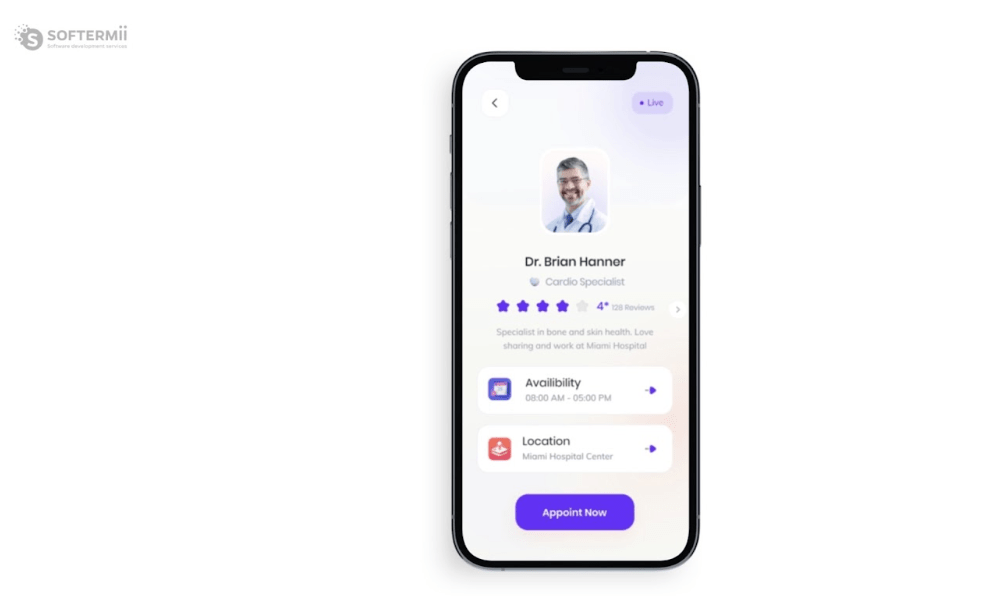
People trust the opinions of others, which is why one of the most effective healthcare marketing strategies is to gather user reviews. Place these testimonials prominently on your main page, and, with consent, include photos for added impact.
Source: Softermii
Consider creating testimonial videos for even greater effect. Proactively seek out these reviews by combining social media and healthcare marketing efforts to solicit feedback on specific aspects of your services.
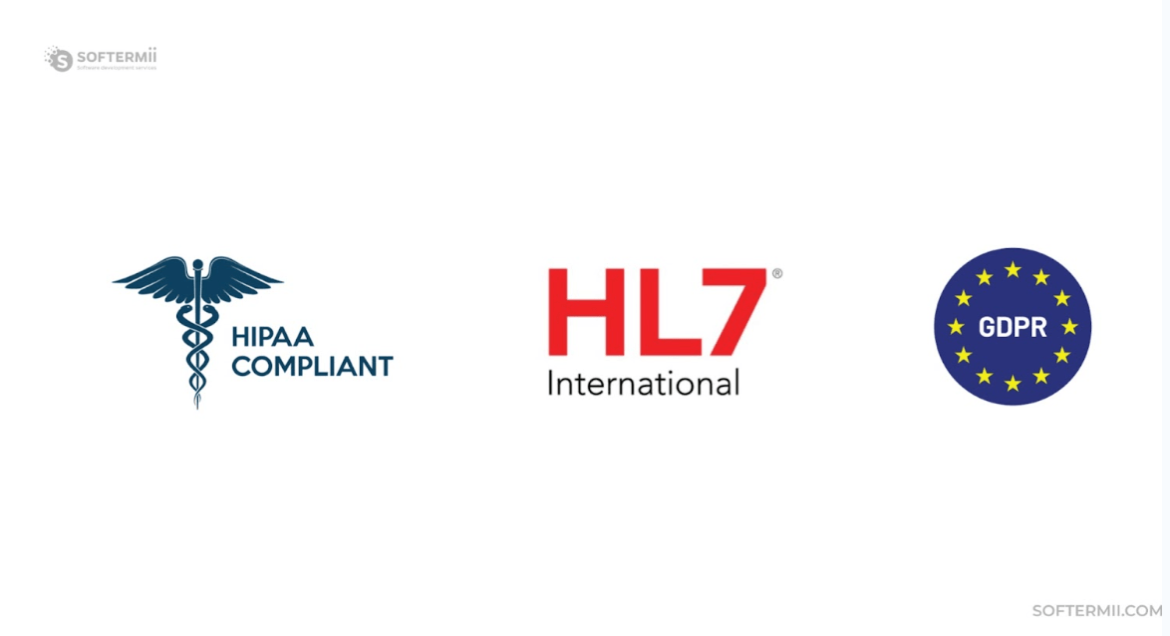
4. Ensure HIPAA and GDPR Compliance
If you are developing a healthcare-related app, you must ensure compliance with HIPAA, GDPR, and the CAN-SPAM Act for email outreach. Additionally, displaying your FDA clearance prominently builds immediate trust. HIPAA, or the Health Insurance Portability and Accountability Act, is a set of U.S. government regulations that protect user data, specifically Electronic Medical Records (EMR) or Electronic Health Records (EHR). GDPR, or the General Data Protection Regulation, is a more recent legal framework in Europe that enforces even stricter guidelines for electronic information exchange.
Source: Softermii
Both GDPR and HIPAA compliance are crucial in healthcare digital marketing trends. They significantly enhance your product's credibility and are essential to your healthcare marketing strategy.
Pre-Launch Marketing: Build Buzz Before You Go Live
As part of your medical app marketing plan, generating interest is crucial before fully committing to the launch. Promote your product well in advance to create anticipation, and leverage relevant channels for app launch promotion to ensure a positive reception once your product is released.
To ensure a positive reception, focus on:
- Promoting your product well in advance to create anticipation.
- Leveraging relevant channels for targeted app launch promotion.
- Securing early feedback from beta testers and medical experts.
Promote your product well in advance to create anticipation, and leverage relevant channels for app launch promotion to ensure a positive reception once your product is released.
5. Understand Your Audience
Knowing your target audience is essential for a successful healthcare digital marketing plan. Different types of health services appeal to specific demographics, so familiarize yourself with these nuances.
Understanding your audience's preferences will help you better cater to their needs and make informed design choices. For instance, older demographics may prefer conservative visuals, while gender-specific audiences might gravitate toward particular visuals and color palettes.
6. Create a Press Kit
A press kit serves as a comprehensive and organized source of information about your product for journalists and the media. When assembling your press kit, ensure it contains all essential components, including:
- Review guide with highlights
- Screenshots
- Logos
- Promotional video
A press kit is a valuable resource for your medical marketing and media efforts, making it easy to provide information about your product upon request. Consider adding it as a dedicated page on your website.
7. Establish Support Infrastructure
Once your product is launched, be prepared for users to question its functionality during onboarding. There may be unclear aspects, aspects that are insufficiently explained, or aspects that are overlooked by users. To make a positive impression, be ready to address these questions promptly and thoroughly. Ensure you have adequate support capacity to handle the influx of traffic during the initial launch period.
Optimize the Mobile Experience
Today's users have high expectations for mobile digital products. Ensure your product's mobile app launch strategy is outstanding, even if it's primarily intended for desktop web use. Here are some key aspects to consider when creating an exceptional mobile experience for your healthcare app:
8. Ensure Exceptional Performance
One crucial aspect of mobile onboarding is guaranteeing your app runs smoothly and quickly. Milliseconds can make the difference between a positive or negative user experience. To minimize waiting time and keep users engaged, consider developing separate native Android and iOS versions of your app. Delivering top-notch performance is a highly effective marketing strategy for healthcare apps.
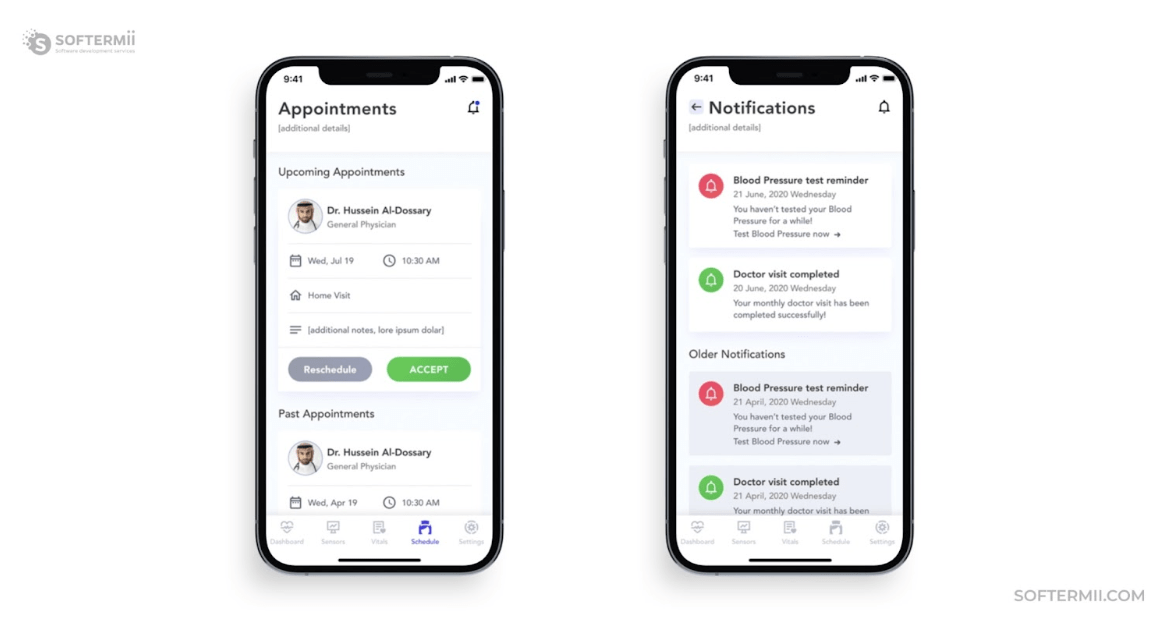
9. Use Push Notifications Strategically
Push notifications offer immense outreach potential but must be used wisely. Unlike email marketing, mobile notifications should provide unique value to users.
Source: Softermii
Consider push notifications as an integral part of your overall interaction strategy rather than just a way to market your app to inactive users.
10. Differentiate with Emerging Technologies
Innovation plays a crucial role in healthcare mobile app marketing. Users often prioritize novelty when deciding whether to try a healthcare app. Integrating new technologies like voice assistants, IoT support, or geolocation capabilities can significantly boost adoption rates.
Integrating new technologies can significantly boost adoption rates, including:
- Voice assistants for hands-free accessibility.
- IoT support for wearable health monitors.
- Geolocation capabilities for finding nearby clinics.
Include these features in your unique selling proposition for maximum impact.
Streamlined Onboarding For medical apps, much of the marketing effort involves keeping your UX/UI free from potential obstacles. Your app's bounce rate will depend on its ease of use. Create the most seamless introductory process possible to attract and retain users.
11. Create a User-Friendly Website
Even if your app is strictly mobile, a user-friendly website is essential for promoting it. Ensure users can easily find the information they need about your product. Address common questions directly on the page and use analytics to identify and resolve navigational issues.
Also, consider implementing SEO, optimizing your website's UI and UX, and setting up a mobile-optimized website version.
12. Create an App Demo Video
An introductory video demonstrating how to use your app can be far more effective than a text guide. Multimedia ads generally outperform text ads, and an engaging website intro video can generate more leads than other marketing methods. Explain your app's purpose and demonstrate its ease of use.
13. Use Plain Language to Reach a Broader Audience
Avoid using excessive technical terms or data in your app marketing strategy when targeting a broad patient demographic. Overwhelming users with complex information can deter them from trying your app. Instead, focus on simplifying information while retaining its substance, and follow the tips above to create a more approachable and user-friendly experience.
Paid and Organic Acquisition Strategies
14. Leverage PPC Campaigns
Not only do people rely on Google for everyday goods, but they also trust it for important health-related products and information. Most effective healthcare marketing campaigns involve paid advertisements to boost search engine presence. One popular method is PPC advertising, where you must closely monitor your cost per app install (CPI) . Use look-alike audiences and ensure you have an explicit opt-in before retargeting existing patients.
Google provides various healthcare advertising opportunities, including paid search results above organic listings. PPC campaigns also offer precise targeting tools to reach your desired healthcare marketing audience. You can use geographic-based targeting and even secure paid placements on Google Maps if you operate a medical facility.
15. Build a HIPAA-Conscious Social Media Presence
Social media is one of the most accessible channels for healthcare app marketing — but it comes with unique constraints. Unlike consumer brands that can freely reshare user testimonials or before-and-after stories, healthcare apps must navigate patient privacy regulations at every step.
Start by choosing platforms strategically. LinkedIn and YouTube tend to perform well for health-tech credibility and educational content, while Instagram and TikTok are better suited for awareness and humanizing your brand. You don't need to be everywhere — pick two or three channels where your target users actually spend time.
One effective approach is empowering your team to become brand ambassadors.
For instance, Doctors Without Borders allows its employees to serve as marketers and recruiters, actively using their social media pages to showcase their daily work. This approach offers free and effective healthcare brand promotion.
A few tactical guidelines for healthcare social media:
- Establish a clear internal review process so posts don't inadvertently share protected health information (PHI)
- Focus on educational content — symptom awareness, wellness tips, how-to guides — rather than promotional messaging
- Engage with health-related awareness events and observances (e.g., Heart Health Month, Mental Health Awareness Week) to join existing conversations naturally
- Consider partnerships with credentialed health influencers (licensed physicians, registered dietitians, certified therapists) whose endorsement carries clinical trust, not just reach)
The goal isn't to "go viral." It's to build a consistent, trustworthy presence that makes potential users feel confident downloading an app that will handle their health data.
16. Use SEO + Content Marketing to Capture High-Intent Searches
People searching for health-related solutions online are often already motivated to act — they're looking for answers to a specific problem. If your app addresses that problem, ranking for those searches can become your most cost-effective acquisition channel.
Start with keyword research focused on the problems your app solves, not your app's name or features. If your app helps manage Type 2 diabetes, target queries like "how to track blood sugar levels," "best way to manage A1C," or "daily diabetes meal planning." Tools like Google Keyword Planner, Ahrefs, or SEMrush can help you identify which queries have meaningful search volume and manageable competition.
From there, build a content marketing strategy around three tiers:
- Top-of-funnel educational content — blog posts, guides, and explainers that answer common health questions related to your app's domain. These build organic traffic and establish your brand as a knowledgeable resource.
- Mid-funnel comparison and solution content — articles like "best apps for managing [condition]" or "how to choose a [health category] app" that position your product within the decision-making process.
- App Store Optimization (ASO) — this is SEO's often-overlooked sibling. Optimize your app store listing with relevant keywords in the title, subtitle, and description. Test different screenshots and preview videos. Monitor and respond to reviews, since both Apple and Google factor ratings into search rankings within their stores.
Don't neglect technical SEO on your website either. Make sure your site loads quickly on mobile (most health searches happen on phones), uses proper schema markup for health-related content, and has a clean internal linking structure that guides visitors from informational content toward your app download page.
The combination of organic search traffic and a well-optimized app store listing creates a compounding loop: content brings users to your site, your site drives them to the app store, and strong ASO converts them into downloads.
Putting Your Healthcare App Marketing Plan into Action
To successfully market your healthcare app, you must address trust issues, ensure a mobile-first design, and implement a pre-launch promotion strategy.
You can increase your app's visibility and reach your target audience by leveraging PPC campaigns, social media marketing, and SEO.
Key elements of a comprehensive marketing plan include offering security guarantees, showcasing medical experts, and showcasing user reviews.
Emphasizing innovation, providing a smooth onboarding process, and creating engaging content can further enhance your app's appeal. By incorporating these strategies, you can establish your healthcare app as a market leader and achieve desired financial results.
About the Author
Slava Vaniukov
CEO, Softermii at Softermii
“I enjoy finding new ways to implement the latest IT technologies for my clients. Apps developed by my team have been called out on multiple ‘Top 10 Best Apps’ lists. I’ve helped companies like Dollar Shave Club, Event10x, and Hollar implement cutting-edge technology to create systems that improve profitability and customer experience.”
See full profile