
12 Years With Clutch: How Intuz Builds on a Partnership That Delivers
A Relationship That Has Stood the Test of Time Intuz is an AI consulting and development company established in 2008, with operations in Silicon Valley...
Updated April 24, 2026

Explore the benefits, features, and other aspects of healthcare software & technology.
The increasing awareness of digital health value, the shift towards value-based care post-pandemic, the growing usage of big data in healthcare management, and chronic disease support the widespread growth of the global healthcare IT market. On the other hand, advanced software development capabilities and AI in healthcare have made accessing medical services easier. The current healthcare IT market is growing at 13.8% and will reach $511.06 billion by 2027.
Therefore, healthcare providers are always searching for new technology that improves patient care and streamlines healthcare facility operations at scale. This has resulted in a number of healthcare software development companies in the USA that intend to streamline specific operations. Some healthcare software targets patients, while others are for clinical research, clinical management, and diagnostics. So, check out the detailed guide on the top 8 healthcare software types to help you make an informed decision.
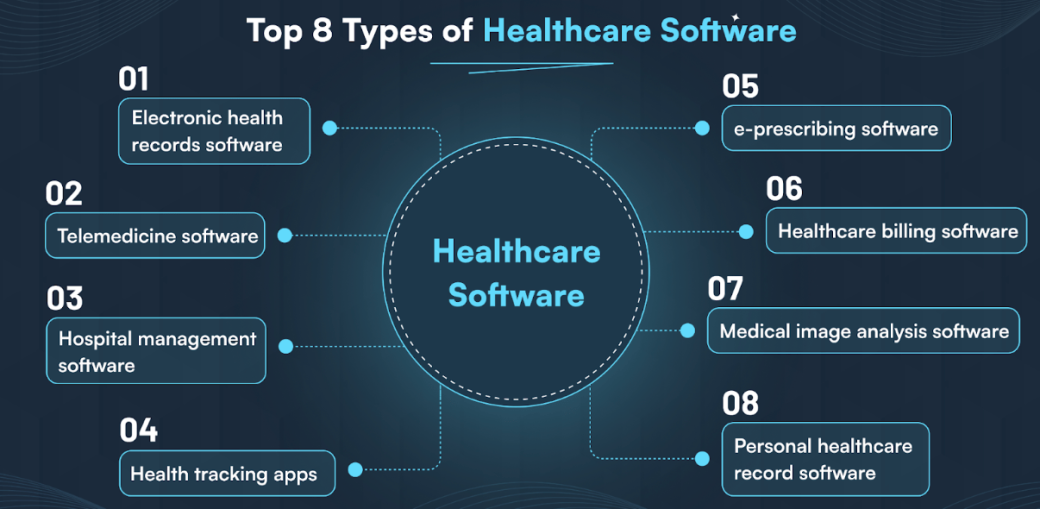
This is one of the highly used and beneficial software developed for healthcare providers to store and manage the medical history of patients, like what they need and what medication has been provided. It also includes the results of the previous and current treatment diagnoses. It eliminates the need for manual work and patient data management, minimizing the workload of healthcare facilities and hospitals.
Having patients' entire medical history at their fingertips helps doctors treat them efficiently. They can have a look at previous diagnoses and medication they have been prescribed to evaluate what patients may need and how to prevent future complications. There are two EHRs; you can choose the best one according to your requirements.
On a digital chart, EMR software stores end-to-end information about medications, medical history, tests, diagnoses, and more.
EPR software is all about managing and optimizing complete information about patients and their medical history, particularly for doctors.
Considering the current digitalization needs in the healthcare industry, EHRs are the next and essential step toward continued progress. They strengthen the bond between patients and clinicians and foster personalization.
Besides EHR, telemedicine is also a rapidly growing segment in the health industry, which is about to reach a value of $286 billion. Post-pandemic, the need for online consulting has intensified, resulting in the rise of telehealth software. It is the best-fit solution for people who live in rural areas or frequently travel with people with disabilities. It is quickly becoming the must-have software for everyone to avail themselves of online consultation with minimum interaction in closed hospitals.
Leading telemedicine software establishes a reliable channel between a doctor and a patient to communicate and get answers to their inquiries. It also allows you to set up a consultation, monitor the online treatment, or conduct quick online checkups. It also helps patients save time traveling to healthcare facilities and avail of medical assistance on demand from anywhere. Because of all these benefits, the telemedicine app development rate has been increasing as it offers a growth strategy for healthcare software development companies in the USA.
By implementing telehealth software, medical organizations can ensure effective communication with patients, simplify daily workflows, and ensure efficient monitoring. It improves patient access to care and healthcare delivery and drives better health. It gives the feel of in-person care.
Hospital management software means the medical organizations can optimize their daily clinical and hospital operations, including scheduling visits and generating invoices. They can integrate this software with your electronic health record system and monitor patient information, payment details, insurance details, and more.
Top hospital management software aims to automate all administrative tasks and minimize the manual task burden on in-house staff. This software also simplifies daily processes and increases operational efficiency at scale. It also improves the overall patient experience without disturbing them by asking or sharing details back and forth.
Every medical facility is bound to record death and birth records, which can be a bit tough to manage manually. So, having an HMS makes sharing reports faster within the given time frame. Moreover, it helps with coordinated and rapid care, minimizes cost, reduces waiting time and readmission, and improves patient safety and clinical care.
These kinds of healthcare software development in the USA are becoming hot favorites as they allow people and doctors to track their diets, physical activities, and movements. The latest type includes maintaining your mental health. However, we do not categorize this application under healthcare software products. Still, we can count them as added resources to keep the data patient data about their daily routine, including food habits.
Wearable devices are also trending to track overall health. Software gets integrated with wearable devices that keep track of your heart rate, sleep time, movement, and more. For example, Fitbit, Apple Watch, and more. Well, this software is more than that; healthcare software development companies in the USA went beyond and started manufacturing devices like wristbands, bracelets, and rings that help patients with infertility, diabetes, and other health challenges.
Now, wearable devices are more than fancy accessories. 75% of patients agree that health-tracking apps and wearable health devices are the best way to monitor their health. Therefore, their adoption is increasing among both patients and regular users since more individuals want to be active regarding their health.
Patients visit clinics to get handwritten prescriptions for medication. E-prescription software has turned this situation upside down by making this service completely available online. Electronic prescription is the procedure through which medical professionals store prescription data in a cloud-based system and send prescriptions to pharmacies instantly.
With just a few clicks, healthcare providers can select and place prescription orders. They can also pick widely used prescriptions and quickly access their go-to drugs. Once they choose the prescription, your pharmacy receives it, which can be modified at any time via the patient portal on this software. This facility is a trademark of an integrated pharmacy management system. It assures that changes at your convenience. The pharmacy starts processing the prescription once they receive the request from the clinic.
E-prescribing software increases prescribers, pharmacies, and patients, increases medication adherence, and helps everyone involved. From doctors prescribing medicine to pharmacies giving it to patients, e-prescribing software streamlines the entire process without any disruptions.
Healthcare service providers currently need medical billing software. This software simplifies the overall payment and invoicing process, reducing time and resource consumption. It also reduces the risk of manual errors and saves you from reputational harm.
You can integrate medical billing applications with your accounting management software to offer a smooth user experience and synchronization. This enables the healthcare service provider to improve reimbursement rates, increase revenue streams, and maintain financial stability. Besides managing and tracking claims and payments, medical billing software can manage numerous tasks in a matter of seconds.
Medical billing software is a way to modernize your conventional approach and pay more attention to patient care and long-term retention amid the highly competitive environment. Besides that, it helps you establish a well-run practice by managing claims and medical billing efficiently.
Medical image analysis software leverages advanced imaging technologies and deep learning techniques to enhance diagnostic accuracy and efficiency. This software can independently identify clinical irregularities in diverse modalities like CT scans, MRIs, and echocardiograms. Processing large volumes of images swiftly streamlines workflows for radiologists, highlighting critical findings for focused review.
As the software evolves, it not only assists in diagnosing and monitoring disease progression but also supports better patient outcomes by allowing clinicians to concentrate on significant abnormalities. Investing in healthcare software development helps you transform healthcare delivery and improve operational efficiency in medical practices.
This innovative healthcare software development approach serves as a comprehensive repository for family members' medical histories, providing patients with an organized, user-friendly interface for all health-related documentation.
As a vital component of custom healthcare software development, Personal Health Record (PHR) software optimizes patient monitoring by granting easy access to crucial medical data. Through features like push notifications and advanced data analytics, users are kept informed about their health status and upcoming tasks.
By centralizing personal health information, this tool not only simplifies administrative processes but also acts as a proactive wellness program, empowering patients to manage medical conditions and adopt healthier lifestyles. From streamlining documentation to customizing wellness plans and alerting medical professionals in emergencies, PHR software enhances both patient engagement and clinical outcomes.
Having important health information like lab results, screening due dates, and immunization records on patients' fingertips makes it easy to share their records. PHRs are powerful tools to manage patients' health from everywhere anytime.
Adopting the right healthcare software is essential to enhance operational efficiency and patient care. From electronic health records to telemedicine solutions, each type of healthcare software development offers unique features that streamline processes, improve data management, and facilitate better communication. By investing in these technologies, healthcare organizations can not only meet regulatory demands but also drive innovation and patient satisfaction. The future of healthcare hinges on these advancements, making it imperative for leaders to prioritize the adoption of effective software solutions.
Prathik Kantesiya is a senior content writer at Agile Infoways LLC and a former English literature student, seamlessly blends his passion for writing with trending technologies and crafts engaging content.