
12 Years With Clutch: How Intuz Builds on a Partnership That Delivers
A Relationship That Has Stood the Test of Time Intuz is an AI consulting and development company established in 2008, with operations in Silicon Valley...
Updated February 5, 2026

In 2026, wearable technology is well-established, but consumer expectations continue to evolve. Today's consumers evaluate wearables less on new features and more on whether their devices deliver consistent, reliable data.
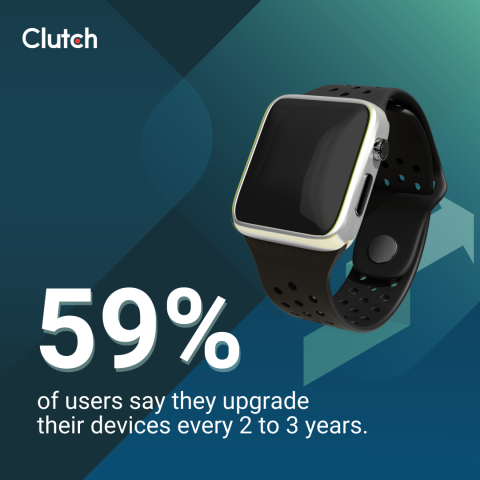
In a survey of 379 wearable tech owners, 59% of users say they upgrade their devices every 2 to 3 years. These upgrades are driven by factors like declining battery life, reduced sensor accuracy, and performance gaps compared to newer models.
As a result, wearable brands still face pressure to innovate, but new features can't come at the expense of core functionality. There's still significant opportunity in the future of wearable technology, but to tap into it, product teams need to understand why users replace their devices and how it impacts long-term loyalty.
Search for wearable app developers on Clutch.
Wearable replacement cycles may be shortening, but it’s not just because customers are clamoring to access new features. The data shows that upgrades are increasingly driven by reliability gaps and degrading performance.
This makes sense. Since wearables have become essential tools for health tracking and daily productivity, tolerance for declining performance has dropped sharply.
Wearable devices aren't just fitness accessories. For many users, they function as ongoing health-monitoring tools that support daily decision-making and long-term well-being. Data from smartwatches and fitness trackers are used to inform how people manage their health, sleep, stress, and more.
This has impacted how consumers evaluate their technology. When devices contribute to health, reliability and continuity become the most important factors for satisfaction. A failing smartwatch may interrupt health records, reset baselines, and degrade trust in the data itself. Ultimately, users upgrade their devices because they're prioritizing reliability rather than new or novel features.
Clutch survey data shows that device wear and malfunction is the number one trigger for wearable upgrades today, cited by 58% of users. This happens as batteries lose capacity, sensors fall out of calibration, and physical components degrade from ongoing use.
Consumers are more aware of when their devices are underperforming. After using a smartwatch for several years, they’re quick to notice inconsistent heart-rate readings, unreliable sleep data, and other growing issues. This erodes confidence in the hardware over time, making replacement the rational choice. As a result, 53% of users upgrade their wearable devices for performance improvements.
So the key drivers behind more frequent upgrades include:
This has implications for smartwatch manufacturers. It shows that you don’t necessarily need to build novel features to capture your share of this growing market. Upgrades are more of a response to friction from older models than curiosity about the latest tech.
Consumers looking to upgrade their devices evaluate performance a bit differently than when they first purchased their device. They don’t necessarily look for the new product that has the best overall technical specifications at launch. Instead, they're more likely to remember how their previous watch from a brand performed over its full lifespan.
This has raised the bar for what counts as acceptable performance in the wearable industry. Devices can work extremely well initially, but if they degrade more quickly than the competition, users will likely turn elsewhere for their next watch or fitness band.
Ultimately, users want health and fitness data they can trust, especially as wearables play a growing role in preventative care. Clutch’s survey found that 37% of users cite improved health and fitness tracking accuracy as a key expectation. This reflects a rising scrutiny of sensor quality and data interpretation.
Battery performance remains a crucial aspect, with 20% of users prioritizing longer battery life when choosing wearables. Many want devices that support full-day or even multi-day use without recharging.
Hardware is only one factor consumers consider when shopping for smartwatches. A wearable’s companion app can be as important, given that it’s the primary point of engagement for many users.
For manufacturers, this is a reminder to focus on app design as much as device hardware. Your software needs stable performance, syncing with minimal user input or delays, and reliable connectivity to third-party apps. Your hardware could be perfect, but you may still miss upgrades if your companion app is subpar.
Consumers are also prioritizing durability. Smartwatches and fitness bands operate in more demanding conditions than most consumer electronics. They’re exposed daily to sweat, moisture, impact, temperature changes, and constant motion. This can all degrade performance quickly if not accounted for.
Expectations around build quality have evolved alongside users’ emerging wearable replacement habits. Consumers expect stronger materials, improved water resistance, and better impact protection by default.
Devices that remain usable over multiple years earn greater trust and increase the odds of winning the next replacement cycle. It all connects back to the brand. When a device fails prematurely, users view the brand negatively. On the other hand, when a wearable surpasses durability expectations, it can earn a customer's loyalty for life.
To meet modern durability expectations, focus on:
It’s also crucial to design based on your target audience. For example, a smartwatch intended for endurance athletes and outdoor enthusiasts may need to be more durable to withstand harsher conditions.
Lifespan, durability, and performance are among the most important factors users consider when deciding which wearable to purchase next. However, innovation can still be influential when done right.
Innovation needs to translate into real-world value that directly improves the user’s experience, whether through greater data accuracy, new insights, or expanded access to useful apps.
Health-related innovation remains one of the strongest motivators for repurchasing decisions. Users are more likely to upgrade to new devices that give them deeper insight into their evolving health journey.
That could mean advances in sensory accuracy, signal processing, or contextual analysis, among other points for improvement. AI integration may also be an expected feature as the technology improves.
Ultimately, innovation can drive repurchasing decisions when the upgrades include:
Just note that adding too many new features can become counterproductive. When updates feel over-engineered, users may become skeptical and lose interest in the product. The goal is to make meaningful upgrades each cycle without bogging users down with unnecessary information or features.
Shorter upgrade cycles have brought tension into the consumer’s shopping process. Many worry about the environmental impact of replacing technology so frequently.
Sustainability may not be the first factor most consumers consider when upgrading, but it increasingly shapes brand perception. Today’s users are growing more aware of device lifespans, challenges around e-waste, and the overall environmental costs of their purchases.
Sustainability can become a competitive differentiator for a smartwatch brand. Researchers say 49% of US consumers purchased a sustainable product in 2025, and an additional 36% say they would have liked to have done so. This shows a broad interest in sustainable products.
There are a few ways to target this. For example, some manufacturers emphasize the long lifespan of their wearable technologies. Others promote trade-in, recycling, and refurbishment programs to help users upgrade more responsibly.
Rising consumer expectations and competition are changing how wearable technology companies think about product design. Innovation and new features can still capture attention, but companies that neglect performance, durability, and sustainability may struggle to gain market share.
One of the biggest challenges wearable brands face is balancing innovation with longevity. Releasing new models quickly can drive short-term adoption but may harm the brand long-term if the devices start malfunctioning after a year. Battery degradation, poor sensor accuracy, and limited software updates can accelerate churn and eat into profitability.
The wearable market has entered a new phase in its development, with users starting to upgrade their devices every few years. Consumers are also more interested in devices that age gracefully and deliver clear improvements over the previous generation, rather than just looking for the biggest new thing. In fact, unnecessary novelty can damage a brand over time, even if it drives a short-term spike in sales volume.
Instead, as expectations for these devices rise, the definition of a “better wearable” has changed to include:
In a market defined by higher standards, brands that understand these trends can win loyalty and outperform. The key is to design the devices and their apps for reliability and usefulness to support users' wellness over the long term.