What Are AI Influencers? A Guide to Virtual Creators
AI influencers abound on social media. Clutch explains what they are, why brands partner with them, and whether people can tell them apart from human...
Updated March 25, 2026

AI is transforming workplaces faster than ever, offering the potential to streamline workflows, boost productivity, and drive innovation.
But what does that mean for those who are actually doing the work?
Looking for a Artificial Intelligence agency?
Compare our list of top Artificial Intelligence companies near you
To find out, Clutch surveyed 428 full-time workers to determine how AI is impacting workers. Despite early fear that AI would displace many workers, the data shows that many aren’t just adapting, they’re thriving.
In particular, those who have embraced AI have earned more opportunities and have been able to leverage it for their own professional advancement.
Key Findings:
Since the widespread launch of AI tools like ChatGPT, there has been a push within many organizations for workers to implement AI into their daily workflows. Earlier this year, we reported that 63% of professionals say that company leadership encourages the use of AI, likely because they see it as an opportunity to boost productivity, improve efficiency, and even lower operational costs.
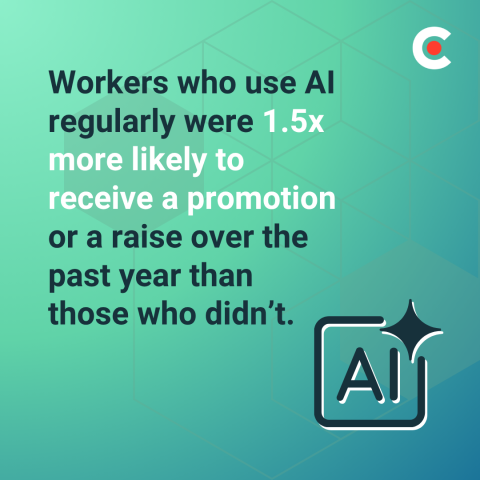
Now many companies are putting their money where their mouth is. Our survey revealed that workers who use AI regularly were 1.5x more likely to receive a promotion or a raise over the past year than those who didn’t.
Of course, compensation increases aren’t awarded simply for adopting AI — they’re tied to the results employees are able to achieve with it. In our report about how AI is being used in the workplace, the majority (74%) of respondents reported that AI has boosted their productivity, helping them complete more work in less time and even improve the quality of their output.
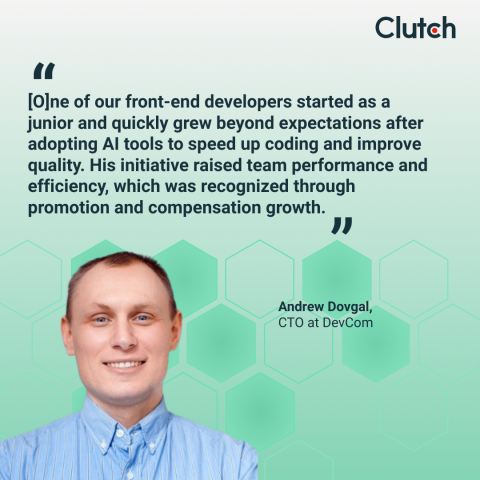
“We’ve had cases where team members advanced rapidly after upskilling in new areas, including AI,” says Andrew Dovgal, CTO at DevCom. “For example, one of our front-end developers started as a junior and quickly grew beyond expectations after adopting AI tools to speed up coding and improve quality. His initiative raised team performance and efficiency, which was recognized through promotion and compensation growth.”
As AI becomes increasingly embedded into daily operations, it is impacting how workers are evaluated when it comes to performance reviews. Employees who effectively leverage AI to deliver faster results, improve work quality, or drive innovation are more likely receive higher ratings.
“At DevCom, we reward those who turn learning into measurable results — not just those who complete courses, but those who apply new skills to move projects and teams forward,” said Dovgal.
In contrast, those who are hesitant, undertrained, or unsure how to apply AI in meaningful ways may find themselves falling behind their peers.
In fact, 66% of respondents believe that AI gives them a competitive edge compared to colleagues who don’t use it.
To keep up with changing expectations and position themselves for their own professional growth, many workers have invested in AI training courses.
For most, this investment seems to be paying off. 89% of those who have completed an AI training course have received a promotion or a raise in the last 12 months, compared to 53% who have not.
It has always been important for workers to continue to learn new skills for professional development and growth, but it is especially important in the lens of widespread AI adoption.
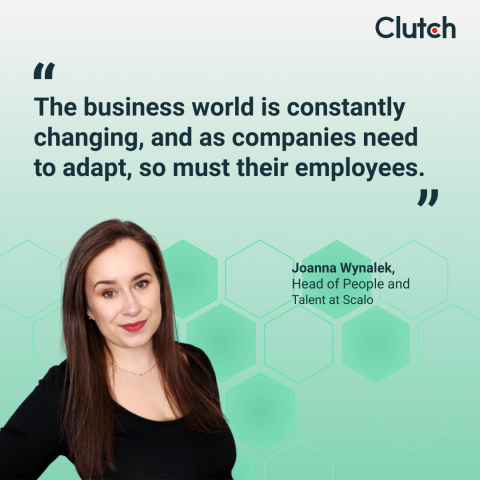
“The business world is constantly changing, and as companies need to adapt, so must their employees. That is why we actively encourage our people to improve their skills through courses, conferences, and other learning opportunities,” said Joanna Wynalek, Head of People and Talent at Scalo. “It ensures that their expertise remains current and relevant to present and future challenges.”
AI is no exception. Workers need a strong grasp on AI to implement it effectively, and training and professional development are the best way to do that.
Since the widespread adoption of generative AI tools, AI revolutionized how people work. Though it was touted as a great way for businesses to speed up their workflows and improve productivity, it did introduce a host of new challenges for employees. While some workers may have resisted the use of AI, even those who were excited about using AI were unsure how it fit into their role at first. Others struggle with integration challenges or how to perfect their prompt engineering.
Despite these challenges, AI continues to be seen as the path forward, and many workers recognize the need to adapt, often through training and professional development.
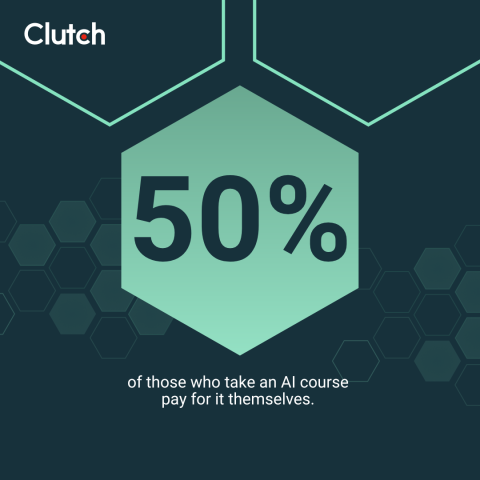
In fact, half (50%) of those who take an AI course pay for it themselves, underscoring just how much employees value a strong understanding of AI — so much so that they are willing to invest their own money in their growth.
Now, employees who invested time and effort in AI training are reaping the rewards. With a solid understanding of AI and how to apply it in their roles, these workers have positioned themselves for promotions, raises, and new opportunities.
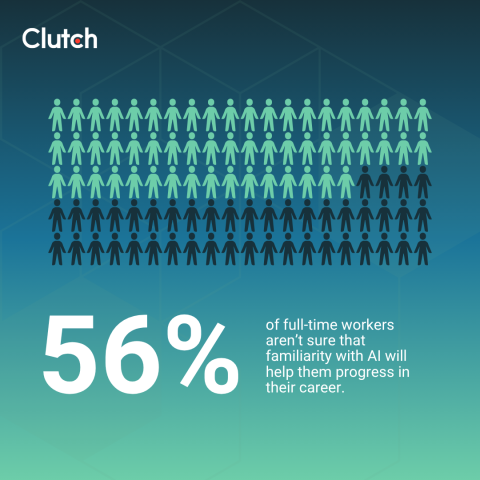
While the data highlights how much employers value proficiency with AI tools, 56% of full-time workers aren’t sure that familiarity with AI will help them progress in their career.
This doesn’t mean that they think AI isn’t a valuable skill or that they aren’t using it in their daily work. On the contrary, 60% view AI as a valuable skill in today’s market — they’re just not convinced that it will help them earn a promotion or land a new job.
This divide underscores the shift in how people view AI fluency at work. Rather than being a way to get ahead, it’s becoming viewed as a required skill for most positions.
Still, this data shows that investing in professional development, specifically in AI training courses, will help workers position themselves for new opportunities. Continuous learning is important for ongoing professional growth, whether you’re angling for a pay bump or a new position.
In addition to helping workers grow professionally, AI is helping many workers be more efficient and effective. In fact, the majority (63%) of workers say using AI positively impacts their work.
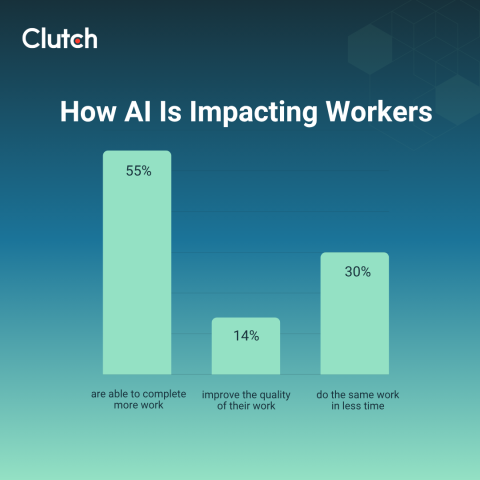
Of the people who are leveraging AI to get ahead: 55% are able to complete more work with AI, 30% are able to complete the same amount of work in less time, and 14% are able to improve the quality of their work.
The productivity boost from AI is a huge win for companies, who see it as a way to help employees work more efficiently and produce more.
“In fact, AI efficiency strengthens our competitiveness: we can deliver faster and more cost-effectively than others, which benefits both our clients and our employees,” says Dovgal.
However, AI could be positively impacting employees even more than the organizations they work for.
Even those who aren’t using AI to take on more work are still putting it to good use by improving quality, speeding up output, and delivering stronger results, but this also opens up a growing debate: how are workers actually using the time they save? Are these efficiencies fueling company growth, or are they giving employees more time for personal tasks, especially in remote and hybrid work environments?
Workers who use AI to finish their tasks faster and use the extra time to take longer lunches or socialize are still, technically, committing time theft. When abused, that can be a huge issue for organizations. But in most cases, this isn’t something businesses need to be concerned about.
“We focus on outcomes, not on micromanaging time. If someone uses AI to finish work faster and keep quality high, that’s success, not suspicion,” says Dovgal. “We trust our teams to use their time wisely. The best people use that extra capacity for higher-value tasks, such as improving workflows, mentoring others, or exploring new technologies.”
Employees who are already engaged and motivated typically redirect their newly available time into tackling additional work, supporting their teammates, or contributing to new initiatives, even if those efforts aren’t always formally documented or closely monitored.
In healthy workplace cultures, the time AI frees up often becomes an opportunity for employees to add value in ways that benefit both the organization and their own professional growth.
Still, AI offers a reprieve for those who work long hours. Among those working more than 40 hours per week, 55% use AI to reduce their workload and reclaim time.
By automating routine or repetitive tasks, AI automation frees up valuable time for workers who are already stretched thin. Instead of getting bogged down in administrative work or manual processes, they can redirect their energy toward projects that drive real impact for the business. This shift not only enables deeper focus on strategic or creative work, but also reduces the stress of constantly feeling behind.
It also introduces greater flexibility, so workers are better equipped to tackle last-minute requests or urgent assignments without the added pressure of working late or sacrificing personal time. Ultimately, that can reduce stress and prevent burnout.
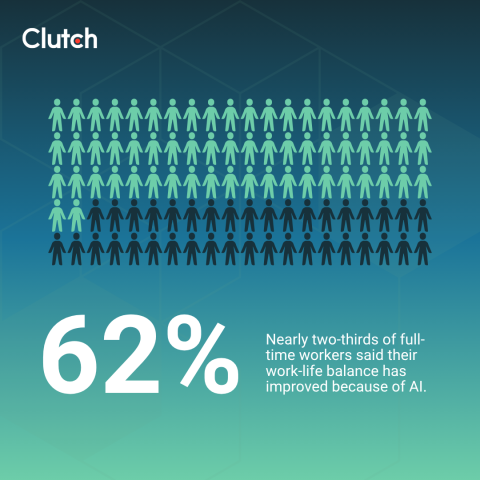
It isn’t just impacting those who are overworked, though. Nearly two-thirds (62%) of full-time workers said their work-life balance has improved because of AI.
It makes sense. By automating certain tasks, workers can spend more time during the day on projects that align with business objectives and provide new opportunities for them. With their reclaimed time, many workers can expand their skillsets, take on high-impact responsibilities, and explore areas that contribute to their long-term growth and career goals.
For others, it simply means they can finish their work within regular hours and log off without lingering stress or a pile of tasks waiting for them later in the evening.
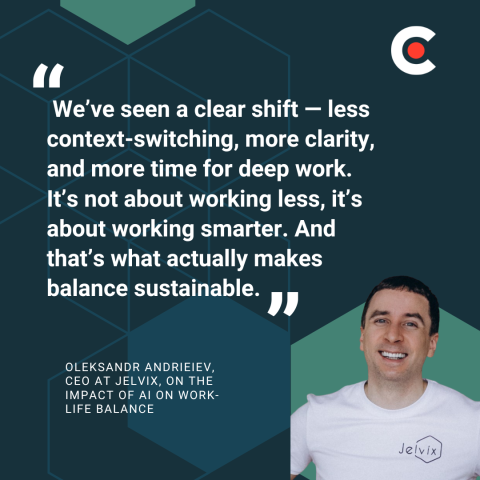
"AI handles the repetitive tasks: report summaries, data cleanup, and first-draft prep. That gives our people space to focus on meaningful work and wrap their day without burnout," says Oleksandr Andrieiev, CEO of Jelvix. "We’ve seen a clear shift — less context-switching, more clarity, and more time for deep work. It’s not about working less, it’s about working smarter. And that’s what actually makes balance sustainable."
The result is a healthier work-life balance. Employees feel more productive and fulfilled during the day, and they have more space to recharge after work.
When AI first took off, many worried that it would lead to widespread job loss, which could be contributing to why 68% of people plan to stay in their current position.
However, this data shows that many companies are still looking to hire. 66% of respondents say that AI either hasn’t impacted their hiring plans or they are actually growing their team.
In fact, 64% are currently hiring, while 10% are looking to fill new roles in the next 12 months.
Despite widespread reports that the job market is slowing, there is still opportunity for those who are looking for new roles. While it may take time to find new positions, they can still find the right position for them if they take their time.
While AI continues to provide a host of challenges for many employees, most workers are benefiting from new technology.
Those who have been committed to professional development and who have looked for new ways to use AI to optimize their workflow, have been able to take on new opportunities. For many, this has resulted in promotions and raises over the past year. For other full-time workers, AI has improved their work-life balance, especially those who struggle with heavy workloads.
Despite fear that AI would upend how organizations operate, and disrupt employment for many workers, it seems that many people are actually flourishing in the age of AI.