Lead Quality vs. Lead Quantity: Why B2B Teams Are Rethinking Their Funnel in 2026
Bigger buying committees and tighter budgets are forcing B2B teams to rethink lead quality vs. quantity. Here's how top teams rebalance the tradeoff in 2026.
Updated March 3, 2026

What your customers say about your products or offerings can make or break a brand. Follow these simple steps to harness the full power of customer feedback in your marketing.
It's no secret: In the golden era of online commerce, consumers double as product investigators.
Just think about it: When was the last time you asked friends for advice or browsed reviews to find the best product or service to buy? Probably recently.
Looking for a Digital Marketing agency?
Compare our list of top Digital Marketing companies near you
According to a Clutch survey, 96% of consumers regularly read reviews when purchasing a product or service they’ve never bought before. In addition, 72% say they would walk away from a product or service if the average rating drops below four stars.
Traditionally, customer relationship management began only after purchase. Now, it has become a vital part of acquiring customers and building brands online.
How can companies embrace customer feedback and turn it into a bona fide branding machine? What are the tools and processes you need to start feeding your communications with audience-led content?
This article will take you through the steps by covering the following topics:
Read on to uncover concrete steps you can take today to mirror your customers' needs, concerns, and interests in your marketing efforts.
According to author and business influencer Seth Godin, “A brand is the set of expectations, memories, stories, and relationships that, taken together, account for a consumer’s decision to choose one product or service over another.”
Let’s break this quote down to relate it to customer research and feedback:
As you can see, the democratization of communication (read: the internet) has made every step of brand building susceptible to customer perception. As a marketer, you can influence the process and improve your brand.
Academic research suggests that brand image not only influences purchasing decisions but also directly affects how consumers perceive the quality of a given product or service.
In other words, your product is only as good as people say it is – so pay close attention to your reviews online.
Before we dig into the “how” part of gathering and listening to feedback, let’s map out where your customers prefer to communicate with you:
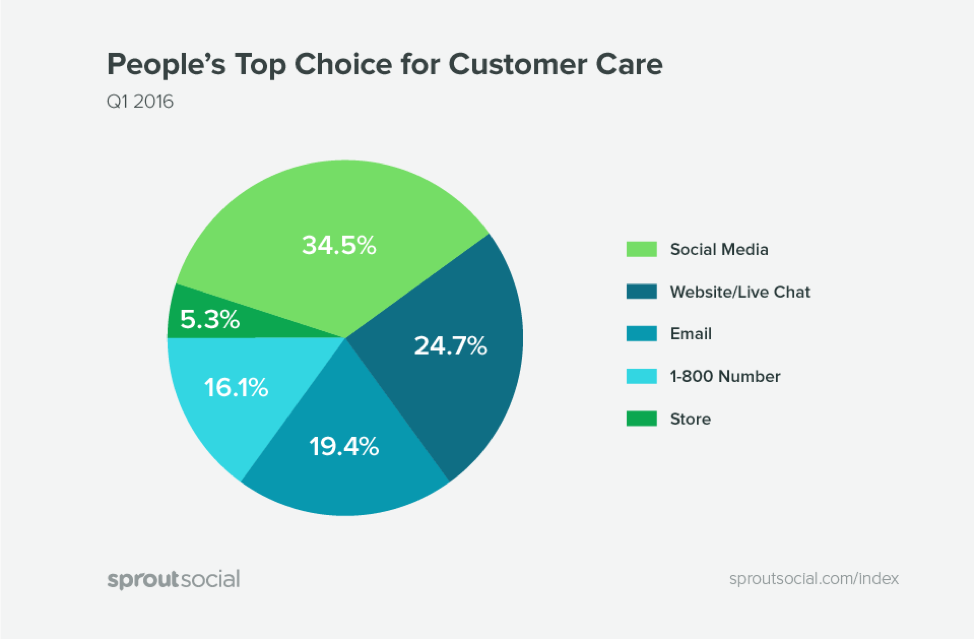
Source: Sprout Social
Looking at the breakdown (in-store excluded), the ways your customers wish to interact with you are split between social media, over the phone, email, and website/live chat.
If you’re serious about becoming a feedback-fueled marketer, it is a great idea to cover most bases by planning and implementing strategies for each of them.
Let’s take a look at the most popular solutions to each.
Tap into software that lets you answer and resolve tickets across customer care channels as a team. Today, several solutions help consolidate feedback and questions from email, social media, and customer care chats.
Before you commit to a product, take a look at your target audience: Where are they currently engaging with you online, and how often? What is natural to their demographic? This way, you’ll be able to prioritize support solutions that best fit your customer profile.
Have you heard of VoIP (Voice over Internet Protocol)? Think of these online phone services as good old landline phones in overdrive.
VoIP phone service helps marketing efforts through customer relationship management integrations.
You’ll be able to enhance the experience with features such as auto-attendants and voicemail services, thereby improving efficiency and reducing costs by automating repetitive customer care tasks.
According to research by the marketing firm Moz, online reviews influence 67% of consumers. What's more, the same research shows that just one negative review can lead to a 22% customer loss.
Here's the good news: Negative reviews are a treasure trove for businesses.
Although it may be lucrative to focus on the good stuff, negative feedback can help you steer your company toward success. In fact, thriving brands are obsessed with aligning their core offering with their customers' wishes.
For example, the Instagram-born beauty company Glossier often polls its social media audience to inform its product development. Glossier understands the importance of customer feedback.
Here are a few case examples and action points to help you decode negative customer feedback.
The data, research, and trends in consumer behavior all tell the same story: When it comes to customer care, consumers need and want instant gratification. They want their realities reflected in brand narratives. This is where you can make an impact, even if you don’t have a huge marketing budget.
Once consumers feel that what you put out there is in tune with what they are saying about you, you’ll be on the path to build a customer-first brand that drives real revenue online and offline.
To succeed, make sure that you have the following bases covered:
To build a stronger foundation for trust in 2026, consider working with a top-rated reputation management company that can help you collect and manage customer reviews as well as respond to the feedback in a way that grows your business.
 Christine Soeun Choi is an SEO associate at Fit Small Business specializing in digital marketing. Currently based in NYC, she has a background in business studies and math with a passion for business development. When not helping small business owners, Christine enjoys taking photos, exploring artwork, traveling, and spending time with her family.
Christine Soeun Choi is an SEO associate at Fit Small Business specializing in digital marketing. Currently based in NYC, she has a background in business studies and math with a passion for business development. When not helping small business owners, Christine enjoys taking photos, exploring artwork, traveling, and spending time with her family.
See full profile