Lead Quality vs. Lead Quantity: Why B2B Teams Are Rethinking Their Funnel in 2026
Bigger buying committees and tighter budgets are forcing B2B teams to rethink lead quality vs. quantity. Here's how top teams rebalance the tradeoff in 2026.
Updated August 25, 2026

Understanding the buying process helps you figure out where and when to use videos throughout your sales funnel.
A video sales funnel matches the right video format to each stage of the buyer's journey — awareness at the top, interest and consideration in the middle, decision-making below that, and purchase at the bottom. Do it well and video reduces bounce rate, persuades customers already in the funnel, and addresses their questions before they have to ask.
Do it thoughtlessly and you spend production budget on videos nobody watches.
Looking for a Digital Marketing agency?
Compare our list of top Digital Marketing companies near you
This guide walks through what to use at each of the four stages, plus the five modern video formats (short-form vertical, personalized sales video, AI-generated video, video podcasts, and interactive product tours) that didn't exist the last time most video-funnel playbooks were written.
Sales funnels usually start with awareness, then move to interest, decision, and finally action. That action could be to subscribe to a newsletter, download an app, or buy a product or service. Your videos should be purposefully created depending on the role they'll play in the customer journey.
Before matching video formats to funnel stages, it's worth knowing what's on the menu in 2026. Five formats reshape what "video in the funnel" means today:
Every stage of the funnel below can use one or more of these formats in addition to the traditional video types. The right mix depends on your audience, category, and production capacity.
The top of the funnel is the awareness phase. The customer is just becoming familiar with your product, services, and brand — and it's up to you to capture their attention. Video is one of the highest-leverage awareness-stage tools available; marketers who use video consistently report meaningfully higher qualified lead volume compared with text-only campaigns.
Content types you can use in the awareness stage include:
Short-form vertical video on TikTok, Reels, Shorts, and LinkedIn is the current default for top-of-funnel awareness. What performs consistently: a hook in the first 2 seconds, native vertical format (not horizontal ads reformatted), sound-off comprehension (captions or on-screen text), and real people over stock. The format works especially well for reaching Gen Z buyers and for driving discovery through algorithmic feeds where paid distribution alone can't compete.
How-to and explainer videos give you the opportunity to highlight your product and services and introduce viewers to the many benefits you offer.
These videos help to build brand awareness and introduce consumers to your product. If your explainer is impressive to the viewer, they’ll likely continue on in the sales funnel to the next phase to find out more.
Since consumers are just becoming aware of who you are and what you offer, culture and behind-the-scenes content gives them more. HubSpot's ongoing culture-video series — featuring interviews with company leadership, employees, and visuals from around the office — remains a widely cited example of the format.
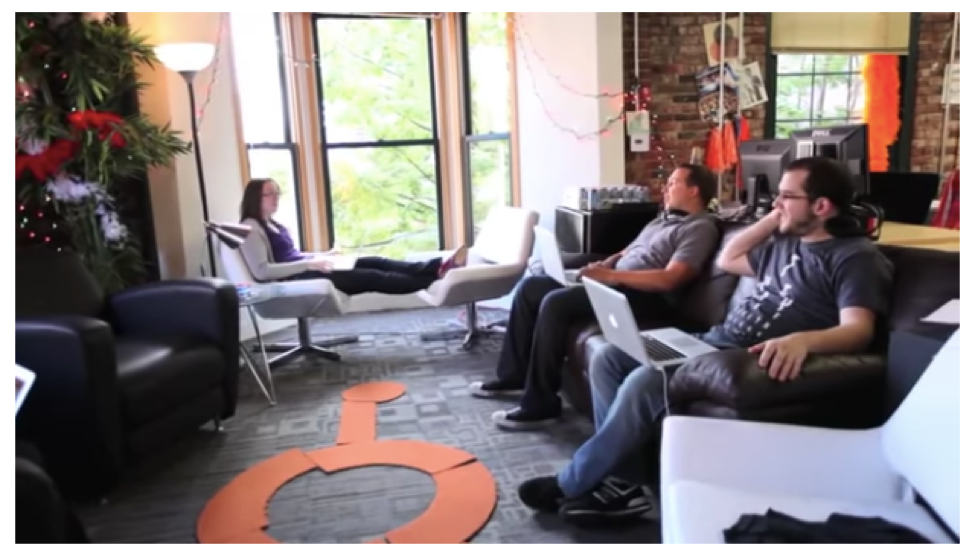
Culture videos and behind-the-scenes looks at day-to-day operations help audiences form an early impression of your brand's people, values, and personality. In 2026, they double as employer branding assets (see Clutch's guide on attracting employees with content marketing) and give the sales funnel a durable human anchor.
The next phase is in the middle of the sales funnel. At this point, consumers have become familiar with the brand and are ready to find out more.
If you’ve successfully captured their attention with how-to and company culture videos, they’re very likely to stick around to find out more. They’re showing interest in your products and services and want to better understand how it works and how it might benefit them.
They’re considering their options, and it’s up to you to convince to take another step forward.
Content types to use in the interest and consideration stage include:
Product demonstration videos go in-depth about how your product works — showing the functions and features and demonstrating how to correctly use the product. Well-made demos let the viewer visualize themselves using the product and see how it can benefit them.
Headspace's animated demo videos remain a widely cited example: short, snappy, easy to follow, and walking through all the options (meditations for improved sleep, pain management, patience, self-esteem).
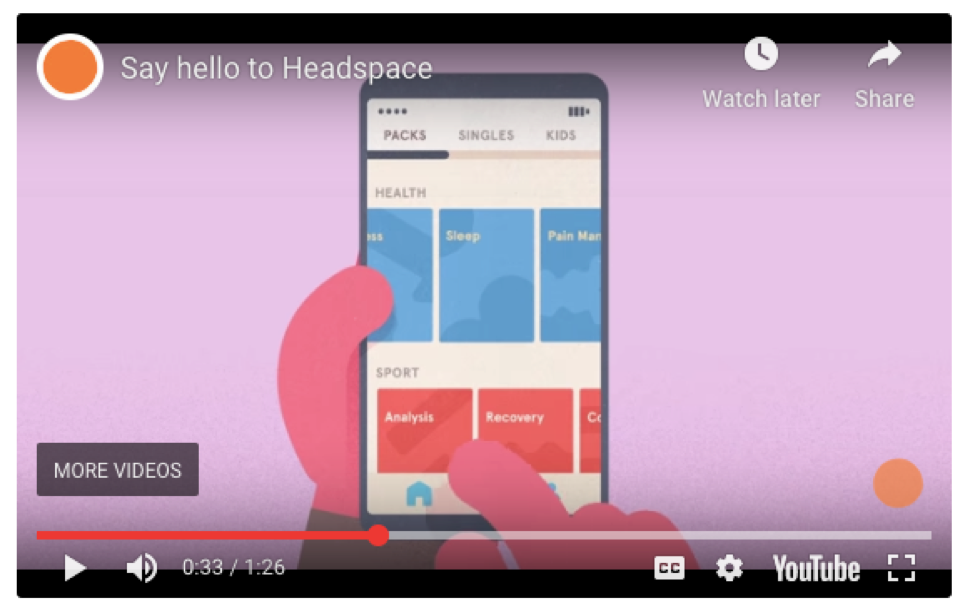
The format still works — what's changed is that many teams supplement traditional demo videos with interactive product tours (Storylane, Arcade, Navattic) that let prospects self-navigate at their own pace.
Video podcasts have become one of the most durable middle-of-funnel formats in B2B. Recorded interviews with company leaders, industry experts, and named customers double as long-form thought leadership and as source material for short-form clips distributed on social channels. Clutch's August 2026 research on video vs. audio podcasts shows 39% of listeners use both formats, which means a video-first podcast reaches the audience twice.
Sitting down with an industry influencer or thought leader and asking them questions your customers might have also works. These interviews build authority among customers, share valuable insight with your target market, and produce high-signal content for prospects still in comparison mode.
Still in the middle of the funnel, consumers reach the decision phase of the buying process. At this point, they are moving towards making a purchasing decision.
They’re weighing the benefits with the cost and want to know that this is the best solution for their needs and their budget.
Content types to use at the decision stage include:
Since consumers are in the process of making their buying decision at this stage, it’s a great time to present them with case studies.
Case studies are compelling and convincing, and they allow you to demonstrate your authenticity. You can showcase real customers and have them serve as real life examples of how your product or service is beneficial.
When the subject of the case study is relatable and connects with your target market, it creates an emotional connection for viewers to your brand.
Similar to how case studies show how your product worked for an actual customer, testimonials allow customers to share their opinions with the audience.
A testimonial video is going to be less detailed than a case study, but it’s still an opportunity to allow your satisfied clients to talk about how happy they are with your brand.
Testimonials can be quick, convincing marketing videos that can be used throughout your sales funnel to reach potential buyers.
Buyers at the decision stage are usually comparing you against one or two specific competitors. A short, honest video that acknowledges the comparison and explains where you fit best (and where you don't) can move a fence-sitter faster than any marketing-team-produced overview. The format works especially well on YouTube — buyers actively search "[your product] vs. [competitor]" queries during this stage.
Customers who have reached the bottom of the funnel have made their purchasing decision: They are hooked and ready to be reeled in, but your work as a marketer isn’t finished.
You need to continue marketing to your customers to maintain their business and their overall satisfaction. Show appreciation to your buyers and invite them to share their feedback and reach out for support if they need it.
Content types to use at the purchasing stage include:
Personalized sales video — a Loom, Vidyard, or Sendspark recording addressed to a specific named prospect — is one of the highest-conversion BOFU formats in B2B. A 2–3 minute custom video walking through why the prospect specifically will benefit from your product routinely outperforms a text email and a generic case study PDF combined. Common use cases: post-demo follow-ups, executive-level "why we're a fit for you" videos, and objection-handling responses that would be awkward in text.
Interactive product tours (Storylane, Arcade, Navattic) let a prospect click through a live-looking demo without booking a call. Better than pre-recorded demos for self-service buyer research, better than a "book a demo" CTA for reducing sales-cycle friction. Adding a product tour to your pricing page or comparison content is one of the fastest ways to accelerate self-service buyers to purchase in modern SaaS funnels.
Offer incentives for the purchase in a sales video. Share a coupon code or present a deal that your buyers can take advantage of.
Avoid sounding pushy, and instead, focus on how the deal or discount helps customers. You might also include an exclusive or a freebie that’s only available to customers.
You have an opportunity to address frequently asked questions that customers have; create a video that addresses the most common questions and concerns from your buyers.
Explainer videos are great in the middle of the funnel, but they have their place at the bottom of the funnel, too. Consider creating more detailed explainers to show customers exactly how to use your product and how to get the most out of it.
These detailed explainers can share more in-depth info that customers will find valuable as they use your product or service.
One of the benefits of video marketing is the versatility the medium provides. Video can and should be used strategically throughout your sales funnel to inform, entertain, and convert at the same time. In 2026, the modern video-funnel operator has more format options than ever — short-form vertical for awareness, video podcasts for consideration, personalized video and interactive tours for conversion — layered on top of the traditional explainer, demo, testimonial, and case study formats that have always worked.
Take advantage of the range of formats now available and match them to your target market's actual consumption patterns at each stage. If your team doesn't have in-house video production capacity, working with a video production partner that understands funnel-stage strategy — not just video craft — is often the fastest path to a working video funnel.
A video sales funnel is a structured approach to using video content at different stages of the buyer's journey — from first awareness through purchase and beyond. Instead of relying on one video type for all purposes, a video funnel matches the right format to each stage: short-form vertical video and explainers at the top of the funnel for brand awareness, product demos and video podcasts in the middle for consideration, case studies and testimonials for decision-making, and personalized sales video and interactive product tours at the bottom for conversion. Done well, a video sales funnel reduces bounce rate, persuades customers already in the funnel, and addresses buyer questions before they have to ask.
The standard mapping in 2026: at the top of the funnel (awareness), short-form vertical video on TikTok/Reels/Shorts, explainer videos, and company culture content. In the middle of the funnel (interest and consideration), product demo videos, video podcasts, and interviews with industry thought leaders. Still in the middle (decision), case study videos, testimonial videos, and comparison content targeting "[your product] vs. [competitor]" queries. At the bottom of the funnel (purchase), personalized sales video (Loom, Vidyard), interactive product tours (Storylane, Arcade, Navattic), sales videos with incentives, and FAQ explainers. The traditional four-stage structure still holds — what's changed is the range of video formats now available at each stage.
Five major shifts. First, short-form vertical video (TikTok, Reels, YouTube Shorts, LinkedIn) became the dominant awareness-stage format — replacing longer horizontal video as the default entry point. Second, personalized sales video (Loom, Vidyard, Sendspark) became standard practice for B2B bottom-of-funnel outreach, routinely outperforming text email and generic PDFs. Third, AI-generated video (Runway, Sora, HeyGen, Synthesia) added a new production tier for high-volume variation and personalization at scale — best used for content that doesn't need to feel authentically human. Fourth, video podcasts became a durable middle-of-funnel B2B format that doubles as long-form thought leadership and short-form clip source material. Fifth, interactive product tours (Storylane, Arcade, Navattic) added a new self-service demo format that reduces sales-cycle friction. The traditional TOFU/MOFU/BOFU structure still holds — what's expanded is the format menu at each stage.