![How to Create a Budget for BI & Analytics Services [With Template]](https://img.shgstatic.com/clutch-static-prod/image/resize/715x400/s3fs-public/article/f07e9d6bd89e7f70df9c94301acdd847.png)
How to Create a Budget for BI & Analytics Services [With Template]
Use our custom template for your business intelligence and analytics needs.
Updated March 5, 2026

According to new Clutch data, 57% of consumers say their personal data has been compromised at least once. What’s more, the threat is growing, as the number of reported incidents continues to increase steadily year over year.
Company breaches are the most common source of exposure, accounting for 30% of all data compromise incidents. When this happens, bad actors may be able to access your login credentials, financial details, home address, or even your Social Security number.
The consequences range from fraudulent charges and account takeovers to long-term privacy risks and credit damage. Knowing what to do in the hours and days after a data leak can be the difference between a minor inconvenience and a year-long recovery process.
Looking for a IT Services agency?
Compare our list of top IT Services companies near you
Looking for a cybersecurity agency? Search for an industry leading provider on Clutch.
Data breaches aren’t always obvious. But if you notice some of these red flags, it’s worth investigating further:
Several types of personal data could be exposed in a data leak, depending on the information you provided to the company. This includes:
The more sensitive the information is that was exposed, the sooner you should take action. Moving quickly can stop an attacker before they get the opportunity to take advantage of your information.
Here’s what to do if you think you may have been impacted by a data breach.
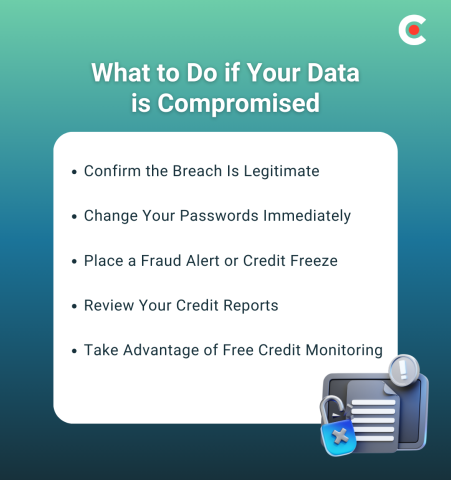
First, you need to verify the notification you received is real by checking the company’s official website or social channels. Avoid clicking on links in emails that claim to be from the breached organization, as cybercriminals often exploit these situations with convincing phishing messages designed to steal your information. You may need to call the company if you can’t confirm the breach digitally.
Update the password for your breached account first. Then, if you’ve used the same password elsewhere, change those, too. Set strong, unique passwords for each account and enable multi-factor authentication (MFA) for an added layer of protection.
Once you’ve activated MFA, hackers won’t be able to breach those accounts with just your login credentials. They’d also need a one-time code, which is typically sent via SMS or an authentication app.
Check your bank and credit statements after you’ve changed your passwords. An attacker may test accounts with small transactions before attempting larger ones, so don’t look past any suspicious activity, even if it's just a tiny amount.
Next, set up transaction alerts on all of your impacted accounts. These will notify you of transaction activity as it happens in real time. That way, you can contact your financial institution immediately to protect your funds.
Fraud alerts tell lenders they should take extra verification steps before opening new credit accounts in your name. This gives you a layer of protection in case an attacker tries to use your information to take out a loan or open a credit card.
You could also go one step further and freeze your credit. This makes it virtually impossible to open new credit accounts in your name, so you don’t have to worry about a hacker somehow getting past the fraud check.
Fraud alerts are less disruptive to your credit, so it may be a better option if you’re actively applying for a loan or new card. But both options are free and easy to place through the three major credit bureaus: Equifax, Experian, and TransUnion. Each of these websites will guide you through the process of creating a fraud alert or freezing your credit.
You’re entitled to free credit reports from all three major bureaus at AnnualCreditReport.com. Take advantage of this if you think you’ve been the victim of a data leak. Look for accounts you don’t recognize, unfamiliar hard inquiries, or incorrect personal information, as these can all be signs that someone is using your identity.
Many companies offer free identity-monitoring services to customers affected by a data leak. These typically cover new account alerts and credit report changes, but they won’t necessarily catch every form of fraud. It’s worth enrolling if it’s offered, as it’s essentially a free layer of protection. However, you shouldn't rely on free credit monitoring as your only line of defense.
Data breaches often start with a company failing to protect its customers' information. But your digital habits can impact how severe the incident becomes and how quickly it spreads. Following these best practices will help you keep the damage to a minimum.
First, never reuse passwords across multiple websites or apps. It may be easier to remember them this way, but you don’t want a single data leak to compromise all your accounts. This is the most common and preventable way that a single breach turns into a multi-platform, long-lasting security crisis.
Simple passwords, like your pet’s name or “password123,” are much easier to crack using automated tools. Avoid these and follow the experts’ recommendation to update your passwords every three to six months. Use a mix of uppercase and lowercase letters, numbers, and special characters to make your accounts harder to breach.
It’s also critical to turn on MFA for any accounts that contain sensitive information or financial access. Without it, a stolen password is all it takes to compromise you.
You can also protect yourself by sharing fewer personal details online. The more information you share on social media, the more data hackers have to exploit. So avoid sharing your street name, birthday, and other revealing details publicly. Hackers often use this information to guess passwords, answer security questions, and write more convincing phishing emails.
Another good practice is not filling out optional fields on signup forms. These aren’t necessary and only give potential hackers more information if they breach the company’s databases.
Breaches often lead to secondary follow-up attacks. For example, you might get a phishing email impersonating the breached company, fake compensation offers, or scam calls using your leaked data.
When these messages arrive unsolicited, be cautious. Instead of responding to the message or call you receive, reach out to the company through the channels you know and trust to confirm the information. Brushing up on basic security hygiene can help you spot and avoid these tactics before they cause damage.
The steps you take immediately after a breach matter, but they’re not the end of protecting yourself. Here are some actions to take in the following weeks and months.
Signing up for a password manager is a great place to start. A password manager is software that stores strong, unique passwords for every account you have, reducing the need to reuse credentials or remember complex phrases. Pair that with MFA across all platforms and get into the habit of regularly updating your credentials every three to six months. Taking these steps alone can close off the most common entry points hackers rely on.
It’s also worth being more selective about the personal information you share with companies. Think twice before giving your phone number, address, and date of birth — especially to a new business or one that seems like it may have subpar protection in place.
Identity theft doesn’t always happen immediately after an attack. So keep an eye out for unexpected collection notices and bills. You might also get unusual credit denial letters or IRS and medical billing notices for services you never used. These are all signs that someone may be using your information.
If you notice one of these red flags, take action quickly. The longer you wait, the harder it may be to convince the company asking for money that you don’t actually owe them anything.
If a breach exposes highly sensitive data, it may be worth investing in a dedicated identity theft protection service. This is a good option if your Social Security number was leaked, and you’re concerned about it impacting your credit.
Look for services that offer real-time monitoring, stolen funds insurance, and recovery assistance. Simple credit alerts can be helpful and are typically available for free. Paid services tend to be more comprehensive and may provide human support if theft occurs.
Data breaches happen and are largely out of your control. But the way you respond matters. Acting quickly to secure your account, monitoring your finances, and following security best practices can help you contain the damage before it spreads and impacts your life. In an era where breaches are increasing, preparation and response time are your greatest assets.