Evaluating an Marketing Agency in the AI Search Era
AI search has completely changed how people interact with online content. When an AI summary appears at the top of search results, Google users only click a...
Updated May 25, 2026

Influencer marketing has become a staple for today’s brands. But without a tailored strategy, you could be leaving money and engagement on the table. Learn how to optimize your campaigns with tailored strategies and influencer types informed by Clutch data.
Influencer marketing has grown massively over the last ten years, rising from just $1.7 billion in 2015 to over $32 billion in 2025. The industry’s maturation has created several tiers of influencers for brands to partner with, from small accounts with fewer than 10,000 followers to celebrity pages with millions of followers.
The emergence of these different types of influencers has created new marketing opportunities. But you’ll need tailored strategies to take advantage of them. The one-size-fits-all approach that worked in the early days of influencer marketing tends to fall flat today in the age of social media.
In a 2025 Clutch survey of 277 consumers, we found that nearly 50% hadn't purchased a product based on an influencer's recommendation in the past year. But it was clear that different tiers of influencers are attractive to people who do take influencer recommendations seriously.
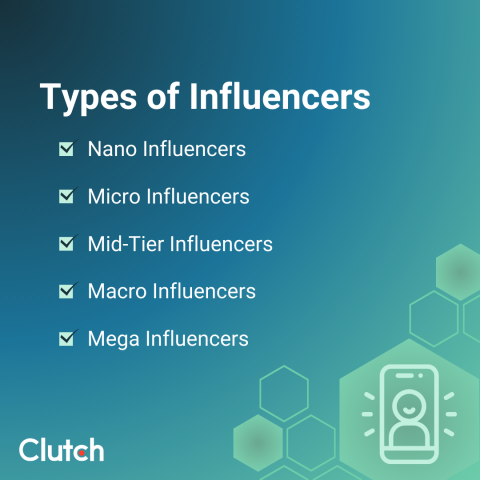
This guide will help you decide which influencer types (macro influencers, micro influencers, nano influencers, mega influencers, mid-tier influencers) your business should work with and which strategies are most effective for each.
Let’s take a closer look at the main categories of influencers your brand may want to partner with. These influencer tiers are based on size. But you may also want to experiment with groupings based on social platforms, demographic differences, and other elements relevant to your goals.
Nano influencers are the smallest influencers that brands work with. These accounts can have as few as a couple of hundred followers or as many as 10,000. According to Clutch data, 13% of consumers prefer product recommendations from nano influencers. This suggests that at least some of your target audience would prefer to learn about your products from small accounts they trust.
Either way, nano influencers have niche communities with high engagement rates. This makes them a good fit for niche products and authenticity-driven campaigns. Nano influencers typically charge between $10-$150 per post.
For example, a sustainable skincare brand might be preparing to enter a new state. As part of that, they could partner with a local eco-conscious nano influencer. This could help the brand connect with the niche, local community of buyers that will determine revenue in the region.
Micro influencers are a middle ground between the intimacy of nano influencers and the reach of macro influencers. Clutch reports show that 20% of consumers prefer recommendations from micro influencers. This was the top tier of the poll, indicating strong demand for these kinds of partnerships. They can help you reach more people with your message while maintaining a strong engagement rate.
Micro influencers can charge between $100-$1,000 per post.
Micro influencers are great for reaching niche communities at scale. For example, a vegan food brand might target plant-based foodies on Instagram with a series of posts featuring micro-influencers across the community. These ads tend to deliver strong engagement rates and cost-effective exposure.
Mid-tier influencers are known for balancing scale with authenticity, often maintaining a recognizable personal brand while still engaging meaningfully with their audience.
Unlike mega influencers, their followers tend to be more niche and trust-driven, which leads to higher engagement rates. Brands value mid-tier influencers because they offer credibility without the high costs or perceived inauthenticity of celebrity endorsements. As a result, they are often seen as a strategic middle ground in influencer marketing.
Mid-tier influencers are used best when a brand wants to expand awareness while still driving genuine interest of consideration. For example, a fashion brand launching a new clothing line might partner with lifestyle influencers who already are in the world of the brand’s “thing.” These influencers can create in-depth content such as styling videos or personal reviews that feel natural rather than overly promotional.
Clutch data shows that 9% of consumers prefer recommendations from macro influencers. Macro influencers are large creators who tend to share more professional content. They’re helpful for expanding brand awareness in the communities you’re targeting.
Macro influencers can charge between $5,000-$15,000 per post.
For example, a national fitness app brand that’s launching a new app might use well-known macro fitness influencers or even celebrities to maximize visibility. These influencers are best for delivering professional content designed for mass market appeal.
Mega influencers are content creators or public figures with follower counts typically exceeding a million. Their influence comes primarily from their massive reach and high visibility rather than close personal connections with followers.
Audiences tend to follow mega influencers for entertainment, aspiration, or status, which can make their endorsements feel more like traditional advertising.
Mega influencers are best used in large-scale campaigns that aim to generate widespread awareness quickly. For example, a global beauty brand launching a new product might partner with a celebrity influencer to introduce the item across multiple channels at once.
While these partnerships are costly (some mega influencers can charge over $10k per post), they are effective for mass-market products or major launches. In these cases, the goal is not deep engagement but broad cultural impact and instant recognition.
The de-influencer trend is a social media movement where content creators typically discourage people from buying certain products or following overhyped consumer trends rather than promoting purchases like traditional influencers do.
De-influencers often share honest critiques, point out when products aren’t worth the hype, or encourage mindful, value-focused spending instead of impulse buys. This shift aims to push back against consumerism and promote a more critical and intentional approach to shopping and consumption.
First, why can’t you use the same strategy with every influencer? That would save money and make results easier to compare. However, every influencer has their own unique audience, which is important to consider for the following reasons:
Ultimately, a one-size-fits-all approach leaves opportunity on the table. Tailoring your strategy influencer-by-influencer will help you get more value from the money you spend on partnerships.
When deciding which route to take when finding an influencer marketing partner, use the ‘3 R’s’ framework:
The '3 R's' framework—Reach, Relevance, and Resonance—provides a strategic method for vetting influencers beyond just follower count.
The key takeaway is that each class of influencer has its own value proposition. You’ll get more out of your campaigns if you partner with influencers who offer advantages related to your goals. But what does that mean in practice when comparing micro vs. macro influencers, nano vs. macro influencers, and micro vs. nano influencers? And more! Beyond the 3Rs, we explore more below:
Nano influencers offer the highest engagement rates and levels of perceived authenticity. But they have limited reach and make campaigns challenging to scale.
You should use a nano influencer when you’re:
However, you shouldn’t use a nano influencer if:
Micro influencers offer a strong balance of reach, relatability, and engagement. But they aren’t the best for any of these, offering lower engagement per view than nano influencers and less reach than macro influencers.
You should use micro influencers when:
However, you shouldn’t use micro influencers when:
Mid-tier influencers are content creators who typically offer a balance between broad reach and authentic audience engagement.
You should use mid-tier influencers when:
But you shouldn’t use mid-tier influencers when:
Macro influencers offer maximum exposure for your brand and polished, professional content. However, they have lower trust levels than other influencers, and you end up paying a higher cost per engagement.
You should use macro influencers when:
However, you shouldn’t use a macro influencer when:
Mega influencers are creators or public figures with a large follower base, often celebrities or widely recognized personalities who deliver massive reach and visibility but typically lower engagement rates.
You should use mega influencers when:
However, you shouldn’t use mega influencers when:
Influencer marketing has advanced significantly in the last ten years. In the past, getting an influencer to talk about your products was often enough to drive results. However, today's market is more competitive, making it harder to cut through the noise.
That’s why it’s so important to diversify your approach based on the kind of influencer you’re working with and your goals. Tailored strategies, intentionally designed for the audience you’re targeting, have the best odds of success in this landscape. You can start designing those strategies yourself using the information in this guide or partner with an influencer marketing agency if you’d like some support.
Dive into more insights on influencer marketing and product recommendations in our new survey.