
The Real Cost of Your MVP in 2027
AI made code cheap, but not software that holds up. See how MVP cost drivers have shifted and why human validation and taste are now what you’re really...
Updated May 5, 2026

Small businesses are entering 2026 with a strong commitment to technology, with 55% of companies planning to increase spend on tech in the coming year.
For many, this isn’t just an upgrade; it’s a necessity. Technology has become central to small-business survival and long-term growth.
Looking for a Software Development agency?
Compare our list of top Software Development companies near you
As AI and digital tools reshape nearly every industry, businesses increasingly depend on tech solutions to stay competitive, meet customer expectations, and operate more efficiently.
To keep up in today’s market, businesses need to continually invest in tools that drive smarter, faster, and more resilient operations. Here is how that will play out in 2026.
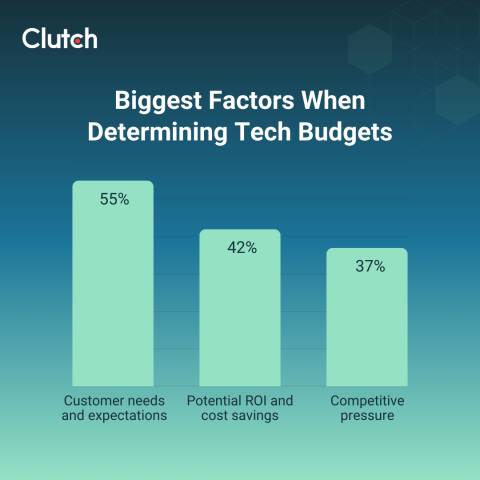
The rise in tech investment stems from the fact that technology has become essential for attracting new customers. Business leaders report customer needs and expectations as the most influential factor when creating their 2026 tech budget (55%).
Consumer expectations have evolved dramatically in recent years. They now expect fast service, seamless digital experiences, and personalized interactions across every touchpoint. Whether they’re browsing a website, making a purchase, booking an appointment, or reaching out to customer support, they expect the process to be smooth and easy.
To meet customer standards, companies need to invest in automation and other digital tools that streamline operations and improve the customer experience. New technology can help these businesses respond faster and provide the convenience customers now look for.
Businesses that fall behind risk frustrating potential customers and losing market share to competitors who deliver a smoother, more modern experience. That’s why 37% of small businesses also list competitive pressure as one of their top considerations as they solidify their 2026 budgets.
“Technology is a competitive differentiator,” says Keith Shields, the CEO at Designli. “Businesses that modernize their platforms, improve their digital touchpoints, and adopt scalable architectures position themselves to grow sustainably. Those that delay investment often find themselves struggling to meet expectations and losing market share to more adaptive competitors.”

This influences how businesses will spend their tech budget and what features they want to build in 2026. As companies build out their tech strategy, they must consider how to meet evolving customer expectations and how those decisions will impact their business.
Market research that analyzes the competitive landscape can help identify which technologies will deliver the most value. Before building out their tech strategy, businesses can conduct surveys, gather customer feedback, analyze usage data, and study competitors’ digital offerings to identify gaps and opportunities. Ultimately, this can help determine which technology investments will have the greatest impact.
As businesses build out their tech strategy, they will also prioritize projects that deliver a high ROI while also reducing costs (42%). This makes sense as companies double down on tools that deliver meaningful impact and fuel sustainable growth. When investing in these technologies, especially those that are more expensive, companies hope to use them as a way to expand their business while streamlining operations.
By aligning tech investments with customer needs and business objectives, companies can drive growth, enhance the customer experience, and stay ahead in a competitive market.
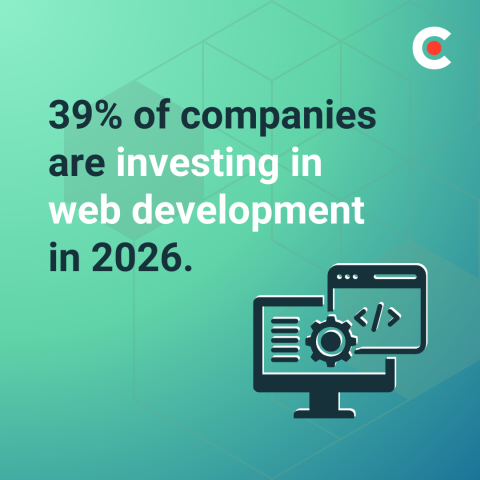
To meet rising customer expectations, companies are planning significant tech investments in several key areas in 2026. Web development (39%) tops the list, reflecting the ongoing importance of a fast, user-friendly website as a primary way customers discover and engage with a business.
Mobile app development (38%) follows closely, driven by consumers’ increasing use of smartphones to shop, book services, and interact with brands.
At the same time, 37% of businesses are looking to invest in software development, largely because it will help them streamline operations and optimize internal workflows, a top priority in the coming year.
Businesses are prioritizing tech that will improve their operational efficiency (31%), even over tools that will reduce costs (13%) or grow revenue (9%).
This underscores the importance of improving operational efficiency for scaling their business as well as meeting customer demands.
"Investment is only a growth driver if the technology matches the implementation context,” explains Andrew Dovgal, the CTO at Devcom. “It’s not just about buying 'tech'; it’s about buying speed and scalability.”

Streamlined operations allow companies to respond faster to inquiries, process orders more accurately, and deliver services with greater consistency. As consumers demand faster, more convenient, and highly personalized experiences, inefficient processes can quickly harm a brand’s reputation and result in lost sales.
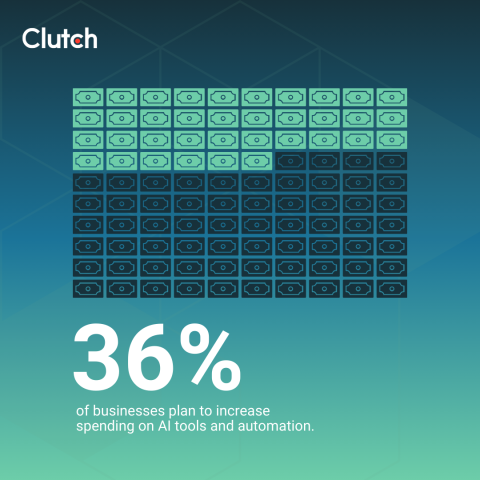
With an emphasis on streamlining operational efficiency, 36% of businesses plan to increase spending on AI tools and automation.
With tools like ChatGPT and AI-powered agents accessible to most businesses, leaders see AI as a way to scale their business, allowing their team to handle more tasks with fewer resources. In fact, 74% of professionals claim they use AI at work to automate tasks, work faster, and lighten their workload.
Some of the ways companies are implementing AI include:
While AI can streamline internal processes and reduce costs, it’s also important to note that it can help businesses respond to customer needs quickly and consistently. More efficient workflows can also help businesses provide better service and build stronger customer relationships.
Additionally, AI can also help companies create personalized experiences that customers are beginning to expect. “Customers want personalized experiences that anticipate their needs before they ask. AI transforms customer data into practical insights that power these tailored interactions,” explains Nick Damoulakis, CEO of Orases. “Generative AI and language models analyze past behavior to understand preferences and predict what customers will want next. This enables businesses to deliver exactly the right content and recommendations when people need them most.”

Ultimately, these personalized experiences increase engagement, build loyalty, and drive higher conversion rates by making interactions more relevant to each customer.
As customers increasingly expect seamless touch points and personalized content, investing in AI has quickly become a necessity. Over time, it will no longer be a differentiator, but rather a critical component to remain competitive. “What isn’t said is that once AI is easy, it will no longer be a competitive advantage over competitors,” explains Chad West, the managing director at instinctools.

“While others debate the timing, some learn how to best leverage the current state of AI by starting small and safe, and incrementally investing in AI as it passes pre-defined gates. These companies are much more likely to overpass their competitors in their space and overtake them in other related spaces,” says West.
Many businesses struggle to execute on their tech strategy, even if they know what they want to build or how they can streamline operations. Small businesses in particular face several challenges that slow down their ability to adopt new tools or implement new technologies.
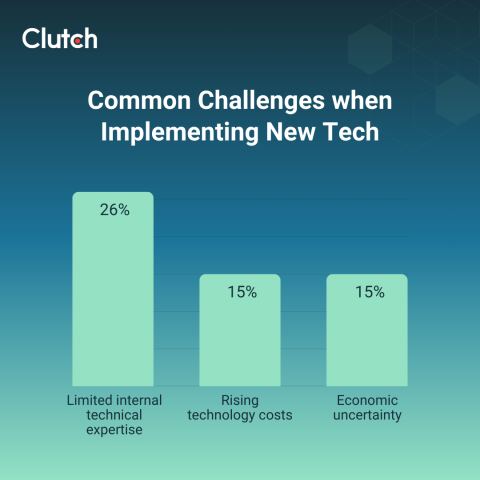
Small business leaders list limited internal technical expertise (26%) is their biggest challenge. Without a large internal development team with a strong understanding of new tech, it can be difficult for small businesses to implement, maintain, or evaluate new systems without outside help.
Even companies that already have internal development teams may not have the bandwidth to take on new projects, and scaling their team to accommodate big development projects can be expensive.
The price of incorporating new tech or building tools from scratch is another reason why companies often hold off on investing in new tech. Business leaders also list rising technology costs (15%) and economic uncertainty (15%) as some of their biggest challenges.
They’re not wrong to be concerned about the cost of these projects: just implementing popular AI tools can cost small businesses several thousand dollars per quarter, but bigger projects like custom software development can be very costly.
According to data collected through Clutch reviews, the average cost of a software development project is $132k, while web development projects cost roughly $66k, and AI projects cost $120k. For many small businesses, this is enough to make them hesitate or delay large projects.
Economic uncertainty is only compounding this concern. More than three quarters (77%) of business leaders are adjusting their tech strategy in response to economic conditions, with 29% delaying tech investments in response.
Reasonably, leaders are hesitant to invest heavily in long-term tech initiatives when future conditions feel unpredictable. Investing in big tech projects puts pressure on already tight budgets, forcing them to prioritize only the most essential projects.
With all of these challenges in play, there can be a gap between the technology businesses want and the technology they can realistically execute. However, hiring an external partner can be a great way for small businesses to get the expertise they need while managing costs in the coming year.
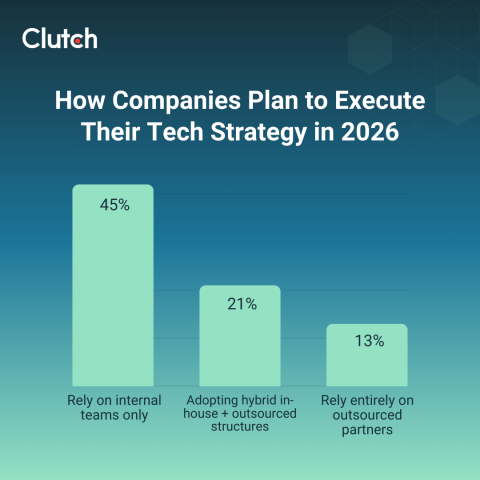
To execute their tech strategy, most small businesses rely solely on their internal team (45%), compared to 21% who use a hybrid model of both in-house and external partners, and 13% who rely entirely on outsource partners.
For businesses that can afford it, internal development teams can be very helpful. They are familiar with the company’s products and customers, which can help them provide tailored solutions. As an added bonus, in-house teams help businesses maintain control over the development process.
Building an internal team may be out of reach for many businesses, though. In addition to the cost of team salaries (including the salaries of skilled engineers, designers, and product specialists), companies need to cover benefits, ongoing training, software licenses, and infrastructure costs.
Outsourced or hybrid teams offer a more affordable alternative, providing access to specialized expertise without the long-term financial commitments of full-time hires.
“Outsourcing gives you immediate access to teams already built with this in mind, where developers work across diverse projects and tackle different technical problems,” advises Boyana Peeva, a senior marketing professional at the software development company, Dreamix. “You get specialized expertise without the six-month recruitment cycle. More importantly, you tap into partners who've accumulated domain knowledge through repeated exposure to similar problems.”

This not only reduces overhead costs, but addresses concerns surrounding the limited technical expertise of in-house teams. With diverse teams of specialists, external partners are equipped to provide high-quality results regardless of the scope of your project.
“These teams carry institutional memory from past projects – they've seen what works, what fails, and why,” explains Peeva. “That preserved experience means fewer costly mistakes and faster delivery. You control costs, scale based on actual needs, and gain flexibility that internal teams can't match. And, your competitors are shipping features while you're still posting job descriptions.”
This approach gives small businesses greater flexibility, allowing them to scale development efforts when needed and bring in specialized experts if their project scope changes.
Additional reading, “How to Decide Between In-House Software Development and Outsourcing.”
As businesses look to implement more modern tech solutions like AI and automation, they require expertise in everything from data engineering and machine learning to UX design and systems integration.
Specialized expertise like this can be difficult to hire for in-house. Few people have the experience or training needed to complete these projects and those who do are expensive to hire full-time.
Outsourcing these projects gives businesses access to niche experts exactly when they need them, ensuring modern tech projects are successful.
"Customer expectations are accelerating faster than most small businesses can retool internally,” says Sergei Dubograev, Senior Vice President of Development at Clutch. “Strategic partners give teams immediate access to specialized technology and expertise they were never designed to build in-house, turning innovation from a long-term ambition into real execution. Outsourcing done right is how companies keep pace with faster, better-equipped competitors."
With external support, small businesses can look to innovate in a way they wouldn’t be able to if they had to rely solely on their in-house team.

Additional reading, “Leveraging Outsourced Talent for Competitive Edge in Development and Cybersecurity.”
27% of small business leaders list quality of work as their top priority when hiring an outsourcing partner. After all, the quality of their work directly shapes the success, security, and scalability of a project.
Following that, cost (23%) is the second most important factor when choosing a partner. While budget always matters, basing your decision solely on price can lead to technical debt, rework, or delayed timelines that end up costing far more in the long run. Especially when they’re focused on innovation, business leaders want to make sure that their investments will have a positive impact on their business.
The goal is to find a partner whose rates fit your budget while still providing the skill, reliability, and quality needed to build something that performs well and scales with your business.
Before hiring a partner, the best way to assess the quality of their work is by looking through their reviews and portfolio items. While client reviews give you insight into what it’s like to work with them and the results they’ve been able to provide, portfolio items showcase the depth and style of their technical work. You can review projects they’ve completed, the industries they’re familiar with, and the level of complexity they can handle.
On Clutch, you can browse verified client reviews with real project examples to get a clear picture of each provider’s capabilities and track record. Additionally, you can see how much each project costs and filter by budget to find a partner in your price range.
With this information, you can compare providers side-by-side, making it easier to find the perfect partner for your project.
Going into 2026, small businesses are investing more in tech in order to appeal to potential customers and meet evolving expectations. In recent years, AI and other tech advancements have made consumers expect fast, efficient, and personalized solutions. To meet these needs, companies are looking for cutting-edge ways to provide a better customer experience and streamline internal processes.
While limited internal resources can make meeting these expectations challenging, outsourcing is a cost-effective way to introduce new tech and create custom solutions. Regardless, companies need to innovate to keep up with others in their industry.
Clutch surveyed 405 small and medium-sized business owners in the United States in November 2025.
57% or respondents were male and 43% were female.
10% of respondents were ages 18 to 29; 37% of respondents were ages 30 to 44; 38% were age 45-60, 16% of respondents were 60 and older.