
The Real Cost of Your MVP in 2027
AI made code cheap, but not software that holds up. See how MVP cost drivers have shifted and why human validation and taste are now what you’re really...
Updated January 20, 2026

As new technologies continue to emerge in 2026, companies must create effective tech strategies to take full advantage. By following these steps, organizations can determine the best approach to meet their business objectives.
To successfully compete in 2026, companies must have a tech strategy in place. These structured plans detail how an organization will use technology to achieve its business objectives.
According to a Clutch survey, more than 55% of companies plan to increase their technology spending in 2026, while just 5% expect to cut back. That investment reflects a rapidly shifting landscape shaped by accelerated AI adoption, expanded automation, tighter budgets, rising customer expectations, and faster innovation cycles. Together, these forces are raising the stakes for how companies plan to invest in tech in the coming year.
Looking for a Software Development agency?
Compare our list of top Software Development companies near you
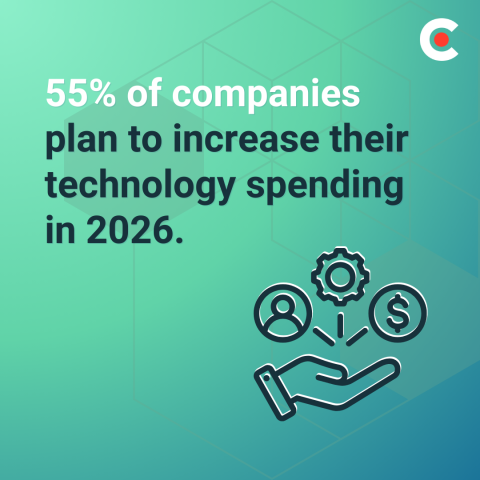
Clutch found that the business objectives behind the increased budgets varied. Among the businesses surveyed, 31% prioritized better operational efficiency, 13% sought to cut costs, and 9% aimed to increase revenue.
Regardless of the objective, a well-defined tech strategy helps organizations navigate complexity, allocate resources effectively, and stay competitive.
The good news? Building an effective tech strategy doesn’t have to be overwhelming. Follow these seven steps to streamline the process and set your business up for success in 2026.
An effective tech strategy starts with a clear assessment of business needs and the existing tech stack. This can ensure that new investments integrate smoothly, fill real gaps, and deliver measurable value rather than adding unnecessary complexity.
The first step is to conduct a full audit of existing tools, systems, and workflows. From this initial analysis, companies can identify what’s working, what’s outdated, and where gaps are creating inefficiencies or bottlenecks.
Some key areas to evaluate include:
Companies must conduct this assessment using real data rather than their assumptions. Relying on educated guesses can lead to poor planning and unneeded costs. Companies also may not realize the existence of redundant tools or costly tech inefficiencies that cause employees to use workarounds.
Specific metrics, such as usage analytics and error rates, provide businesses with data-driven insights to address gaps and improve their operations. Getting feedback from employees can also provide context and help companies identify the points that the numbers don’t show.
Once you have a clear understanding of the company’s current technology, you can move to the next step: aligning your tech strategy with both short- and long-term business goals.
While it may be tempting to adopt a new tool because it’s trending, it can lead to higher costs without returns. This makes it essential to define the business’s goals in areas where the technology will impact it most, such as growth, efficiency, risk reduction, innovation, and customer experience.
Once a company prioritizes its goals, it can begin to map out how technology can make a positive impact. For example, if a company wants to focus on growth and building scalable infrastructure, it may want to adopt automation tools and cloud platforms, while a company looking to improve efficiency may want to implement AI tools that can handle repetitive tasks. At the same time, companies seeking to enhance customer experience through data-driven personalization and support can turn to tools that improve consistency and speed up response times.
Business leaders must remember that effective technological alignment spans multiple teams. Teams that work directly with customers understand user needs and must work with leadership and operations teams to guarantee a seamless workflow. This means companies need to map out how their tech strategy will benefit all areas, including the communication and collaboration between teams, to fuel a more productive organization.
Once the technology and the company’s business goals are in alignment, the company can begin comparing its current capabilities with future needs. This comes in the form of identifying what useful tech is missing, what tech is holding the organization back, and what tech has the potential to cause future risks.
The first step is to identify gaps between the company’s existing tools and future demand. Common gaps can take many forms. Systems that don’t scale to handle traffic spikes or seasonal demand can result in missed profits. When employees handle processes manually that AI can automate in seconds, it takes up valuable resources.
Failing to gather data effectively or not putting it to good use can lead to poor decisions and inconsistent forecasting. Another issue to look for is where multiple platforms or tools perform similar functions across teams. Getting rid of these redundancies can help teams get on the same page and reduce costs.
Identifying gaps while staying informed about emerging technologies can uncover valuable new opportunities. For instance, cloud platforms allow companies to scale faster and speed up delivery through improved collaboration. Upgrades in system security and performance also allow more resources to go toward innovation and growth.
It’s still important to consider the risks involved with each new addition. Be wary of security vulnerabilities and compliance issues that come with new tools. Also, if the company’s in-house staff aren’t familiar with how the new technology works, it will require additional training, which can delay timelines and take up resources.
Tech strategies require prioritization. Companies that try to tackle every issue at once will spread their teams too thin and delay overall results. Using a prioritization framework can help businesses determine which projects to focus on first and which areas can wait.
Structured frameworks help simplify decision-making, allowing companies to focus on execution. Helpful prioritization frameworks include:
The best way to prioritize high-impact projects is to use consistent criteria. Assess how the project impacts overall business objectives, such as customer experience, risk reduction, or growth. Next, determine the cost, which includes the initial investment, long-term maintenance, and staff training expenses. Risk is also an area to focus on. If the project causes security exposure, creates compliance issues, or involves complex implementation, it may be more of a hindrance than a help.
Projects that use new technology should deliver fast time to value. If a new system takes several months to implement, but doesn’t begin reducing costs or improving efficiency in a few weeks, it shouldn’t be a high priority. It’s also essential to account for any technical dependencies that projects may require before they can be successful.
There are several high-impact projects in 2026 drawing high priorities from many companies. AI integration allows teams to automate workflows, enhance customer experience, and improve decision-making. Cybersecurity upgrades protect against increasingly advanced risks. An efficient data strategy improves personalization and prediction for customer experience. Finally, modernizing legacy systems helps companies improve overall performance and integration while opening up the ability to scale easily.
For a tech strategy to be successful, it needs a realistic roadmap. This roadmap should contain multiple phases that begin with quick wins, move on to mid-term initiatives, and finally end with long-term transformation. A formula embracing these three layers keeps teams focused by delivering early results and keeps the strategy relevant over time. Each stage of the roadmap should define key elements, including:
One area that roadmaps must account for is how the technology and environment around AI are constantly changing. Data privacy laws and regulations can change, leaving unprepared businesses struggling to adjust. Companies that take this into account from the onset and prioritize flexibility will be able to pivot and continue to make progress.
No roadmap is perfect from the onset. Businesses must continue striving for improvement and adapting to market conditions. Businesses that use a set it and forget it approach risk limiting their progress and becoming stagnant as new trends and technologies emerge. Reviews, feedback, and data should help the process of optimization.
A tech strategy is only as good as the team executing it. While many companies employ capable staff, they may not all be familiar with the technologies involved in a project. It’s vital to determine if it's better to implement training sessions that will take time to complete, or if companies should outsource to experts who already have the experience and know-how to get started right away.
In most cases, using a hybrid outsourcing model allows for the biggest upside. Hybrid models bring in outside development teams and specialists to deal with the testing and execution of a project. This helps keep the burden of these tasks off of internal teams, who can instead focus on strategy and overseeing the company’s vision. Overall, a hybrid approach where the internal team and outsourced talent collaborate leads to faster innovation and efficiency.
There are a few key elements to consider when determining which tools and partners work best with the internal team already in place. Maturity is a very important starting point. Vendors should have the necessary experience, as well as stability, to meet the project’s needs. Outside teams also need to use tools that integrate seamlessly with existing systems and don’t pose a security threat. Finally, the outside team should meet the timeline needs, as changing vendors before the project completion will result in delays and potential rework.
Once the first six steps are completed, implementation can begin. Companies should prioritize agile delivery, which promotes flexibility so teams can make improvements as new insights emerge and priorities change. This should involve frequent check-ins, meetings, and feedback loops. Cross-team communication is also important, especially with hybrid outsourcing models that involve internal and external teams.
In order to make the right adjustments, success must be measured. A company needs to define which KPIs will best indicate if the tech strategy is propelling it toward its business objectives. Metrics can help show efficiency gains, customer satisfaction, cost savings, uptime, and adoption rates. When projects don’t meet KPIs, organizations must reassess their approach and make adjustments.
Even if projects consistently perform well and meet KPIs, it’s vital to continuously review the tech strategy. With AI and new technologies emerging and evolving constantly, it’s possible that good results could become great results with small tweaks and refinements to the overall tech strategy.
While tech strategies should mirror a company's needs and its objectives, it’s good to know what is making waves. Organizations should keep an eye on these six trends in 2026 to prepare for the future.
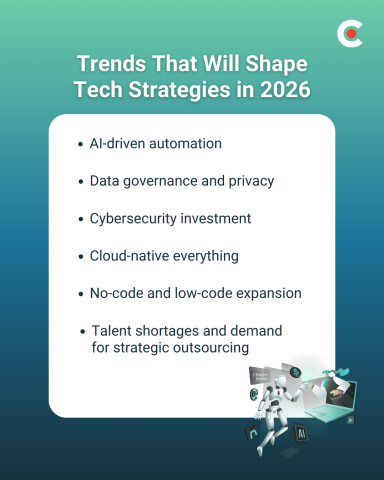
AI-driven automation is influencing decisions, creating predictive workflows, and optimizing operations in real-time. Companies that fail to take advantage of AI automation risk falling behind. Transferring data-heavy and repetitive processes from manual labor to AI tools can speed up execution while lowering costs.
Data governance is becoming increasingly important as data volumes grow and regulations tighten. Making sure that collected data is accurate, secure, and ethical is vital not only for legal and regulatory compliance but also for customer perception.
As technology becomes more advanced for businesses to meet their objectives, it also improves for cybercriminals. Investing in cybersecurity is a must for companies that need to safeguard customer data, protect operations, and reduce risk across the board.
Additional reading, “Cyber Attacks Are on the Rise: How Businesses Are Adapting.”
Cloud platforms serve multiple purposes, including better collaboration between teams, improved scalability, and faster innovation. Teams that take full advantage of cloud capabilities can deploy faster updates and adapt to infrastructure changes as needed.
Platforms that use no- and low-code allow non-technical teams to create workflows, apps, and automations without bringing in engineers to make it happen. This trend eases the pressure put on development teams and results in faster innovation and fewer bottlenecks.
With new technologies popping up and advancing daily, it’s unrealistic to expect internal teams to adapt to everything, especially since there is a shortage of developers. Outsourcing roles to experts with specializations and experience is the best way to remain competitive while keeping long-term costs to a minimum.
Developing a tech strategy in 2026 takes more than jumping on the newest trends. It requires clarity, alignment, and a willingness to evolve. Taking this seven-step approach allows businesses to find a strategy that drives growth, efficiency, and innovation. It’s essential for companies to get a head start in planning for their 2026 tech strategy. Building flexible roadmaps and investing in the right tools can position them on the cutting edge of technology and lead to long-term success.