
Task Automation: How to Cut Repetitive Work
Task automation saves time, gets work done faster, and reduces errors. Learn how to automate repetitive tasks step-by-step and how to decide what to automate.
Updated December 19, 2025

AI is already enhancing workplace performance by boosting productivity, automating repetitive tasks, and giving employees the data and insights they need to make smarter decisions.
As a result, interest in AI is accelerating quickly, with 44% of employees now saying that familiarity with AI tools is a valuable skill in today’s job market.
To keep up with evolving expectations, many professionals aren’t waiting for their companies to train them. Instead, they’re investing in themselves: half (50%) of all workers report paying out of pocket for AI courses or certifications.
Looking for a Artificial Intelligence agency?
Compare our list of top Artificial Intelligence companies near you

This trend highlights a growing urgency among employees to stay competitive, stay relevant, and capitalize on the career opportunities AI is creating.
Looking for an AI development company? Check out Clutch’s list of top artificial intelligence companies.
AI adoption is gaining steam across nearly every industry. Unsurprisingly, information and tech industries currently use AI the most, but real estate, financial services, and healthcare are also implementing AI in numerous ways, too.
As automation, analytics, and AI-driven decision-making become standard, familiarity with these tools is quickly turning into a career advantage.
No matter what industry you’re in, understanding how to weave AI into your everyday workflow can help you stay adaptable, open new career opportunities, and keep pace with the evolving expectations in the workplace.
To stay competitive, executives and employees alike are looking to future-proof their careers by taking online courses. In these courses, they learn how to leverage AI in their role to automate routine tasks, interpret data more effectively, or streamline processes.
Upskilling and pursuing additional education are becoming crucial in today’s fast-paced work environment. As technology evolves, employees who actively expand their knowledge not only stay relevant but also open doors to new opportunities and career growth.
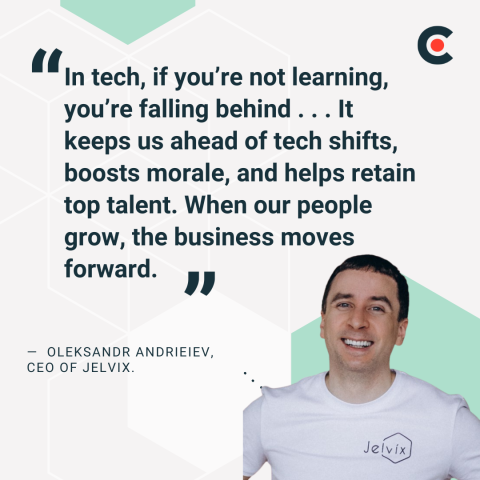
This is true across all industries, but especially in tech. "In tech, if you’re not learning, you’re falling behind," says Oleksandr Andrieiev, CEO of Jelvix. "We push a “learn-it-all” culture where people actively grow their skills and share what they know. It keeps us ahead of tech shifts, boosts morale, and helps retain top talent. When our people grow, the business moves forward."
By investing in learning—whether through courses, certifications, or hands-on experience—professionals can adapt to changing workflows, enhance their value to employers, and contribute meaningfully to their organizations’ success.
Additional reading, 'Reskilling in the Age of AI.'
A quick online search yields dozens of courses tailored for people who want to learn more about AI. To get the most value from your time, keep these factors in mind:

Getting on board with AI capabilities and benefits doesn't have to be an expensive endeavor. There are free and low-cost courses available through online learning platforms, universities, and tech companies.
With these free courses, you can learn AI basics and how to apply them at work.
Taught by instructors from the University of Helsinki, Elements of AI is available through the MinnaLearn platform. It explains how AI works and its potential use cases in the workplace. The course includes two parts:
The Elements of AI course also includes a downloadable guide that explains how companies can improve AI literacy among teams. This is especially important for European Union-based businesses that have to comply with the EU AI Act. The regulation requires employers to train workers before allowing them to work with AI tools in business.
Behind every AI system is a sophisticated machine learning model that uses math and data to derive results. In the Machine Learning Crash Course from Google, you'll learn about regression and classification models used for machine learning. The course explores how to create and transform clean data to train machine learning models, a skill useful for those in analytics roles.
The crash course ends with a look at advanced machine learning systems, such as large language models (LLMs) and neural networks. It also reviews ways to apply machine learning models in real-world settings.
AI for Everyone is taught by Andrew Ng of DeepLearning.AI and is available through the Coursera learning platform. It offers a non-technical review of the foundations of AI, including machine learning. This course also explores potential real-world use cases for AI and ways to integrate it into your organization. It closes with a review of AI's limitations and how it may impact jobs and developing economies.
AI for Everyone is useful for any stakeholder interested in learning how to apply AI in an enterprise setting, even those without a computer science or engineering background.
Several platforms offer paid AI tutorials. These courses go beyond the basics and provide you with practical, hands-on AI experience.
Available through Coursera, the DeepLearning.AI Specialization is a five-course, three-month series that results in a career certificate. It's meant for people with some introductory-level experience in Python programming and machine learning who want to further their AI knowledge.
Students learn to build and train several types of neural networks, including a Convolutional Neural Network and a Recurrent Neural Network. They also implement best practices to avoid bias and variance arising from data sets.
Could your organization benefit from improved analytics and reporting? The Udacity AI Programming with Python course teaches analysts how to integrate Python and AI into their workflows for improved reporting and visualizations.
Students study Python programming and Python libraries such as NumPy and Matplotlib. They learn how to build machine learning models and implement neural networks using PyTorch. The total program length is 73 hours and includes 12 courses and two projects.
The ColumbiaX AI certification is a 12-week program available through the edX learning platform. It's taught by Columbia University professors and explores the history of AI and techniques used to build AI models. The course includes a few hands-on projects where students build a search agent and a game using AI and machine learning.
Employers with specific real-world applications for AI, such as building intelligent agents, can benefit from having teams take this course. The career-oriented program is great for beginner and intermediate learners.
AI courses that go beyond the basic uses of the technology to dive into role-based specifics can benefit workers in specific areas, such as marketing and data analysis.
The decision to implement AI tools usually rests with company leadership — which is why executives can benefit from learning this technology's capabilities. With these courses, managers get a clear understanding of AI benefits and use cases.
Offered by Harvard Business School Online, AI Essentials for Business is a four-week course developed for executives and aspiring leaders. It explains how an AI-first company can realize cost savings and operating efficiencies. Leaders explore how to apply AI to an organization's strategy, evaluate potential AI risks, and develop governance policies for successful implementation.
Available through the Coursera platform, GenAI for Executives & Business Leaders: An Introduction is a three-hour course taught by IBM. It touches on the history of generative AI and its use in business settings. Executives learn how internal data influences generative AI and specific use cases.
In this five-hour class from Microsoft and LinkedIn Learning, executives learn how to plan for AI adoption and integration. It emphasizes the importance of ethical AI and how to increase AI know-how among employees.
Teams can benefit from in-person training where they can interact with other professionals and instructors, such as in the AI for Executives Program at UC Berkeley. This three-day course is taught on campus and includes multiple case studies and leadership panels. Attendees receive a certificate and plenty of networking opportunities.
Marketers can elevate productivity and customer engagement through AI. These courses explain how, with lots of relevant tips for content creators, marketing strategists, and analysts.
Available from HubSpot, this free three-hour course teaches you how to create effective generative AI prompts and review outputs. It also explores ways to use AI-powered analytics tools.
Artificial Intelligence in Marketing is taught by a University of Virginia professor and available through Coursera. It's 10 hours long and covers several case studies of AI usage for customer engagement. Learn how algorithms, networks, and data can create a competitive advantage for stronger client relationships.
This three-hour course from LinkedIn Learning teaches students how to automate routine marketing tasks with AI. It explores several different popular AI tools, including Jasper, Salesforce Einstein AI, and ChatGPT, and their usage in marketing workflows.
AI shines in data analysis for its ability to find hidden patterns and examine large data sets. These courses teach data analysts how to use AI in their everyday tasks.
Available through Coursera, this eight-week IBM course teaches analysts how to recognize use cases for AI. It also covers AI prompting and selecting the best tools for visualization and analysis.
The DeepLearning.AI Data Analytics Professional Certificate gives students an in-depth look at using LLMs to review and interpret data. It's available through Coursera and takes about four months to complete.
This free, one-hour course from Codecademy explains prompt engineering for data analytics. It also includes a hands-on AI data analysis project.
AI can improve lead generation and provide clear insights into customer needs. These courses teach sales executives to get the most out of the technology.
In this 30-minute course available through LinkedIn Learning, students learn about AI use in sales and its limitations. While it may not be as lengthy as some options, it covers a lot of information, including the use of generative AI for customer interactions and sales strategy development.
HubSpot Academy offers a six-week online bootcamp for sales and marketing professionals. It starts with an overview of AI, then expands into its applications for customer relationship management (CRM) and automated workflows. You'll also gain an understanding of AI agents that support specific sales activities.
Once employees complete a course, acknowledge their efforts and see how their new skills can be applied on the job. Use their newfound knowledge to test out AI concepts in small projects or workplace tasks. Many courses share potential use cases for AI to help identify tasks ripe for improvement.
Various online communities exist for professionals interested in discussing AI-related topics. The OpenAI Forum facilitates AI networking and hosts regular events. DeepLearning.AI has an online community for students hosted by Andrew Ng, a respected AI instructor. Groups can also be found through LinkedIn and Coursera.
If possible, learners can connect with a mentor or colleague for extra support during and after a class. Their guidance can improve motivation, especially during longer courses.
Some AI courses offer official certifications that employers recognize. This is a common practice with learning platforms and universities. Encourage participants to update their resume with their new certificate and enroll in other relevant training.
AI may be relatively new to both executives and employees, but interest in it is quickly gaining steam. As AI adoption expands across nearly every department and industry, developing the ability to apply AI in your workflow gives you a competitive edge. It positions you to adapt, innovate, and thrive in a rapidly evolving workplace.
With the multitude of free and affordable classes available, AI education doesn't have to break the bank. Find courses that interest you and relate to your role. Adopt a continuous learning mindset, and as AI keeps evolving, your organization will be ready to take advantage of its benefits.