
Task Automation: How to Cut Repetitive Work
Task automation saves time, gets work done faster, and reduces errors. Learn how to automate repetitive tasks step-by-step and how to decide what to automate.
Updated May 28, 2026

AI is reshaping who gets hired, how business teams operate, and what gets outsourced. Many companies are reworking their org charts in real time, chasing speed, cost savings, and better outcomes. Here’s how AI in recruitment is changing the rules.
AI has moved from a novelty in the back office to a staple on the front line of hiring. Algorithms now handle the type of work that used to belong squarely in a recruiter’s hands. These newly automated tasks include things like screening resumes, scheduling interviews, and analyzing candidate data.
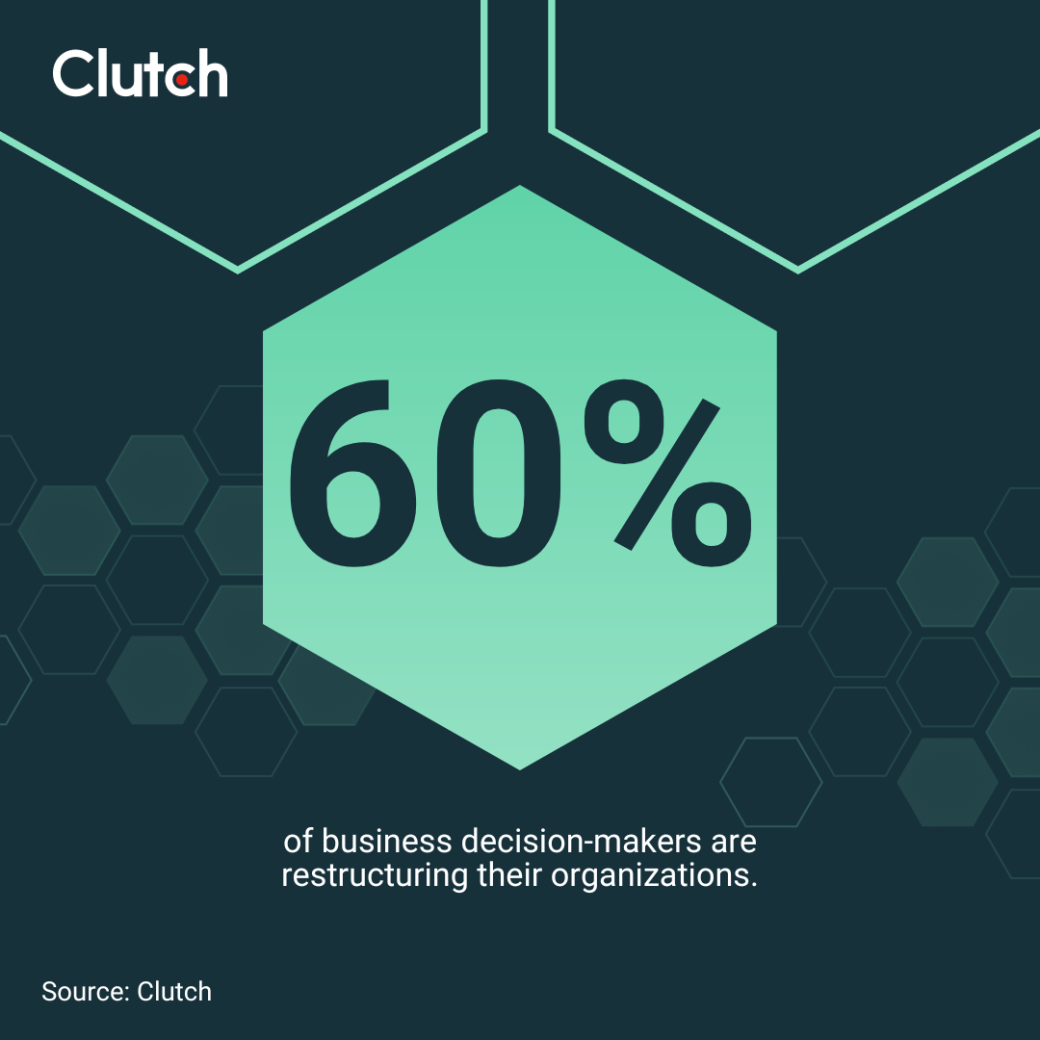
The newly rewritten rules go beyond convenience. According to Clutch data, nearly one-third of companies are changing how they hire or outsource because of AI. Another 60% are restructuring their organizations entirely. They’re reassigning or automating manual tasks, trimming staffing excess, and reconsidering what the best strategy is to get the job done.
Looking for a Artificial Intelligence agency?
Compare our list of top Artificial Intelligence companies near you
Hiring no longer starts with a job posting but with intelligent and rapidly evolving tech tools. The increasing adoption of AI in recruitment is forcing business leadership to reconsider which roles are essential, which ones can be automated, and how much human involvement is still worth the cost.
Hiring used to mean finding the right people to fill your empty seats. Now, reshaping business with AI means deciding whether those seats even need actual humans to occupy them.
During its unimaginably fast progression, AI has changed the business standard. You can now use it to write your job descriptions, scan candidate resumes, sort applicants, and match skills to roles. AI often performs these tasks faster and more accurately than human recruiters ever could. This doesn’t eliminate the need to have people on staff, but it certainly raises the bar on what those people need to bring to the table.
Some jobs edge closer to obsolescence every day. Automated tools are increasingly replacing administrative assistants, data entry clerks, junior-level analysts, and many other roles. AI performs those functions with fewer errors and zero chance of burnout. AI is redefining other roles, like customer support representatives and technical writers, by taking over the repetitive, data-based work and leaving humans to handle the nuance, innovation, and deeper problem-solving.
This new direction creates pressure across the board, as:
For executives, the challenge is less about whether AI can handle a particular task and more about when it should replace a person entirely in a particular role. An increasing number of business leaders also consider a third option: combining AI and a human workforce to achieve optimal results. Many are finding this choice to be the best of both worlds.
There’s a catch to all this automation: People who can effectively work alongside AI are getting harder to find.
The demand for tech-literate candidates is quickly outpacing the supply. That lack of skilled talent extends beyond engineers and developers, too; roles in sales, marketing, and operations now require a certain comfort level with automation tools, data analysis, or both. This narrows the talent pool even more and leads to bidding wars for candidates who can readily plug into a tech-enabled workflow.
The pressure affects HR first. Traditional recruiting methods fall short when job requirements change faster than job descriptions. Screening tools may overlook qualified applicants who don’t fit specific keyword categories. Even when the right person surfaces, your competition might already be in talks with them. AI in recruitment doesn’t eliminate these challenges; it just changes where they show up.
Meanwhile, the skills gap continues to grow. AI is evolving faster than most training programs, leaving many mid-career professionals behind. Reskilling takes time, and not every company is willing or able to invest in it.
Recruiting under these unprecedented circumstances requires speed, but that’s not all. It also takes accuracy, flexibility, and a willingness to question whether a role needs to exist in its current form.
Many companies outsource routine tasks to save time and money. Now, AI can automate many of those same functions.
Organizations across industries once outsourced or contracted out various jobs to overseas teams. Some of these included:
Today, a growing number of execs are choosing tools over teams, at least in areas where automated tasks make sense. Business leaders are comparing platforms instead of reviewing vendor contracts. In some departments, the term “outsourcing” doesn’t even apply anymore; it’s as if automation is the only option.
This sudden behavior shift has moved the focus from headcount allocation to platform selection. Business leaders want:
In many cases, AI checks all three boxes. However, it doesn’t come without trade-offs.
Replacing outsourced labor with AI means giving up a layer of human oversight. Software doesn’t always flag gray areas or spot context that matters. It may not recognize some subtle errors, which may not come to light until the next compliance audit or a client meeting.
There’s also a long-term cost to consider. Vendors can adapt, but platforms can’t learn unless someone actively and intentionally trains them. If no one in-house understands how the system works, any cost savings would go out the window when something breaks or regulations shift, and you’d need to hire or contract someone to update the system.
The outsourcing conversation has changed, but it’s far from over. It’s just less obvious where the humans fit now.
The way companies structure their teams is changing fast. AI tools now influence everything from role design to workflows within and between departments.
Recruitment strategies have to keep pace with these changes. If job descriptions still reflect roles built around outdated workflows, AI won’t be much help. It will only be sorting candidates for jobs that are no longer necessary. Company leadership, including HR leaders and department heads, needs to revisit the fundamentals: Which tasks and roles still require a human? Which can be fully automated? And what skills are we missing right now?
The companies pulling ahead are the ones adjusting their org charts with thoughtful planning and intention. They’re adopting AI in recruitment, but they’re also reimagining their teams and strategies around it. They’re reworking how their departments operate, how their teams communicate, and how work flows throughout the entire business.
Filling roles isn’t the end goal anymore. The real challenge in this new and extraordinary AI age is designing systems that can handle speed, scale, and constant change. For that, you need to choose the right people and the right tools, and most importantly, you need to know when to rely on each.