Bringing AI into the SDLC: Promises, Challenges, and Best Practices
Explore the key implications of AI SDLC and its main challenges. We also provide tips and guidelines to help you overcome the obstacles of AI-powered SDLC.
Updated November 24, 2025

Writing emails, updating files, running reports — all these tasks take much less time to complete thanks to AI. A simple prompt in an AI chatbot can help workers handle tedious jobs like summarizing lengthy documents or evaluating data. Of the workers leveraging AI to enhance productivity, 30% report being able to complete their tasks in less time.
Managers are paying attention, and some are questioning whether AI-driven efficiency could allow employees to complete tasks too quickly and use the reclaimed time for personal matters rather than work.
Despite concerns about time theft, companies are far more likely to see benefits. AI works both ways. It supports employees with fast workarounds that allow them to complete work faster. But companies benefit, too, when workers have extra time to spend on more pressing problems.
Looking for a Artificial Intelligence agency?
Compare our list of top Artificial Intelligence companies near you
Search for industry-leading AI development companies on Clutch.
Time theft is an illegal activity that occurs when an employee claims hours for time they didn't actually spend on the job.
For example, a worker may take a two-hour lunch break instead of the allotted 30 minutes, but claim the hours on their timecard. Or an employee may say they worked a full eight-hour day when in reality they were watching TV for part of the day. Such activities violate an employer's code of conduct, and serious offenses can result in legal consequences.
So if employees finish their tasks before the workday ends because they use AI, are they using that time to be more productive or are they committing time theft?
Probably not.
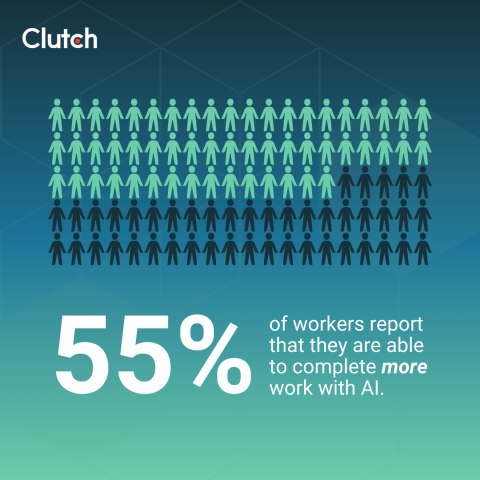
New data from Clutch reveals that most (63%) of workers say AI positively impacts their work, and 55% are able to complete more work with AI.
Let's take an example. Say you have a complex report that's usually completed manually with data entry. This task takes an employee a full day. If the employee uses AI automation to complete the report in only an hour, freeing up their time for other activities, the work still gets done.
You have the required report, and the employee hasn't abandoned their responsibilities. They just found an optimal way to handle the task in a shorter timeframe.
A tremendous amount of low-value work occurs in most workplaces. There's so much, in fact, that business leaders often overlook it as "just a part of the job." They may be used to seeing employees spending hours on mundane tasks, and the thought of completing them in less time can cause shockwaves.
Slow, tedious tasks have hindered productivity for decades. For years, it was normal to spend hours reading lengthy documents or filling out a spreadsheet, but now someone can complete those tasks in seconds. Many companies are still adjusting and trying to determine what that means for operations.
But that's a good thing. Executives are always looking for ways to elevate productivity and accomplish more with their teams. AI poses a proven way to do so. With these tools, teams can analyze massive datasets in minutes. Sales teams can draft personalized emails instantaneously. And those long days of data entry and other workaday tasks? Hopefully, gone with the wind.
In its place, employees are able to take on complex, creative, and exciting tasks that deliver actual value. Instead of glazed-over eyes in the conference room, you can hear excited chatter in the hallways as people think of new ways to use their time to benefit the business.
Implementing AI in every business function may not happen overnight. But as you take steps to find ways AI can enhance your organization, you can look forward to several perks.
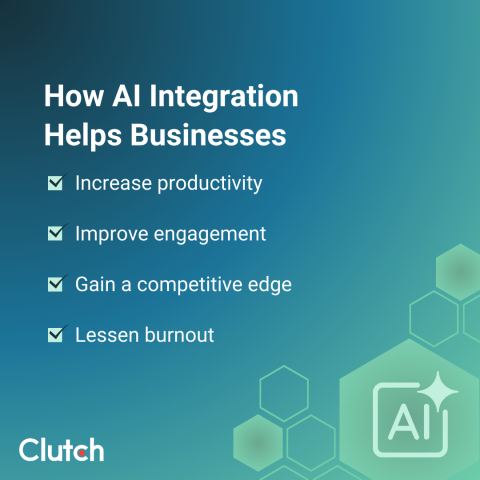
With AI, a report that usually takes two days to finish could become a two-hour job, saving hours of work for a single employee. With the newfound extra time, they can accomplish other tasks they're responsible for and take on additional responsibilities.
If the rest of your team does the same thing, you may see a significant jump in output, without hiring extra staff.
Employees are still exploring how they can implement AI into their workflows. The very idea of changing how work gets done can spur higher engagement, especially among workers who want to make their mark in your organization. Finding key opportunities for AI could open the door to career growth.
But even if your team isn't out to overhaul their jobs with AI, using appropriate tools revamps the workday. Staff can offload routine tasks that don't require high-level thinking to AI, and focus on those that engage their minds and skills.
Employees who use AI complete their work faster, which means more time for innovation. Instead of spending their day on everyday tasks, they can work on big-picture problems in their area. For example, an accountant could use the extra time to find ways to shorten the close period. Or a front-end developer could leverage AI to test multiple website designs and identify the most effective.
Every business (and role) is different — so carefully consider how your team can use their time to give your organization a strategic advantage.
As employees eliminate mundane tasks with AI, the need for overtime and long hours declines. Hopefully that means that exhausting 10 or 12-hour days will be rare, reducing the risk of burnout among your staff.
Burnout causes unwanted physical and mental effects. It also reduces employee productivity and performance. In the worst cases, a team member experiencing burnout may leave their job for other opportunities.
With the help of AI, you can reduce your team's workload and improve their work-life balance. You'll have applicants lining up to work for you, rather than running for the doors.
Yes, AI is fast. And by using it, you'll notice a lot of time-consuming tasks take a lot less time. That doesn't mean that employees are putting less effort into their jobs or that they're dishonest. They've found a way to use available tools to their (and the company's) advantage.
This change may require a cultural shift, especially among organizations that equate long hours with employee success. To adapt, refocus on an employee's output rather than their total work hours. For example, if an employee can now write 850 lines of accurate code and debug it in five days rather than five weeks, it's a win-win for your business. You're producing more than before, and doing so cost-efficiently.
Andriy Dovgal, CTO of DevCom, believes in this approach and applies it to his team. "We focus on outcomes, not on micromanaging time. If someone uses AI to finish work faster and keep quality high, that’s success, not suspicion," he says. "We trust our teams to use their time wisely. The best people use that extra capacity for higher-value tasks."
To put this advice into action, encourage your employees to find other ways to contribute to the organization. For example, they may assist other colleagues with AI automation or contribute to a relevant strategic discussion with management.
If you're beginning to implement AI in the workplace, set a few guidelines and share your expectations. You want employees to feel comfortable using the tool to boost their output. Here are a few proven techniques to start with:
Integrating AI into the workplace takes time. It's not an instant change. Allow employees to experiment with its capabilities, and see what adjustments they propose.
AI has the potential to minimize the time your team spends on routine work. That's a net positive. As a leader, you want employees to focus on tasks that bring value, not busywork that clogs their schedule.
Employers who integrate AI into the workplace stand to realize significant benefits. Teams may become more efficient, allowing them to take on more complex tasks. Employee engagement and satisfaction could jump as workers use AI to streamline redundant tasks and concentrate on the ones that call for their human skills.
AI may bring transformational change to organizations, especially those that prioritize long hours. Instead of judging employees by the time they spend, look instead at their output and work accuracy. Top organizations see AI not as a tool for time theft but as a productivity partner that unlocks serious competitive advantages.