
Task Automation: How to Cut Repetitive Work
Task automation saves time, gets work done faster, and reduces errors. Learn how to automate repetitive tasks step-by-step and how to decide what to automate.
Updated December 9, 2025

Ensuring employees receive fair, competitive pay can significantly reduce uncertainty and strengthen their sense of stability. By focusing on compensation and retention, employers can uphold workforce confidence, even as AI and automation reshape the workplace.
AI is reshaping modern work by taking over time-consuming tasks, surfacing insights instantly, and integrating automation across entire workflows. This shift is raising expectations for both efficiency and output quality, pushing teams to work faster and more strategically.
Many employees feel uneasy about the rapid rise of AI and automation, largely because they fear these technologies could eventually replace their jobs. Headlines about robots taking over tasks or companies streamlining teams can amplify that anxiety, making workers question the long-term security of their roles.
Looking for a Artificial Intelligence agency?
Compare our list of top Artificial Intelligence companies near you
Despite this shakeup, the core motivators for workers on the job remain unchanged. Compensation remains key for improving company morale and retaining skilled employees.
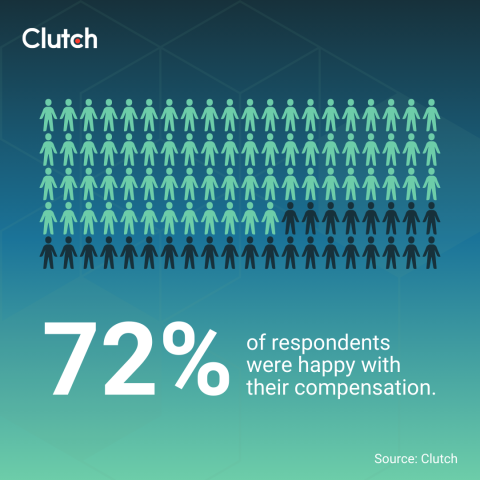
A Clutch survey found that 72% of respondents were happy with their compensation, and 68% intended to stay in their role as a result.
Providing fair, competitive pay can ease much of that uncertainty by reinforcing a sense of stability and value. By prioritizing compensation and employee retention, employers can maintain a steady, confident workforce even as technology evolves.
Automation is streamlining workflows, leaving fewer rote tasks for human workers.
For instance, rather than entering data into a spreadsheet, analysts can now spend more time combing through it for insights. On top of that, developers can spend more time solving bigger software problems rather than coding routine lines, and AI chatbots can handle front-line customer service.
As expectations evolve, companies increasingly want workers who can integrate AI into their daily processes and use it to manage tasks more effectively, making AI literacy a more valuable skill than ever.
But what employers expect and what employees believe don’t always align. Only 44% of workers said AI familiarity is a meaningful skill in the labor market, suggesting many still feel unsure of its relevance. Yet among those already using AI, the benefits are clear: nearly two-thirds (62%) say it has helped improve their work–life balance.
Still, workers are concerned about job security, changing responsibilities, and how valuable their skills will become in the next five to ten years.
Organizations can ease those concerns by reinforcing stability, supporting development, and strengthening trust across the workforce.
People work to get paid, so it's no surprise that compensation is a major factor in employee satisfaction. Employees who are well-paid are generally more willing to adopt new technologies and meet tougher metrics.
Fair compensation is an investment in your employee and your relationship with them. It signals to an employee that your organization values their work and that it's a good place for long-term career growth.
In the midst of AI uncertainty, feeling valued by your company is no small thing. Now, businesses are recognizing that AI is a skill and are compensating workers appropriately. In fact, those who use AI regularly are 1.5x more likely to receive a promotion or a raise, according to Clutch data. Another report claims that wages are rising twice as fast in most AI-exposed industries, and workers with AI skills command a 56% salary premium.
AI is a rapidly developing field, and some skills are highly technical and require an understanding of certain concepts that are unfamiliar to most people. To effectively attract and retain talent, companies need to be able to provide fair compensation for in-house team members, especially those working in tech.
AI can sometimes create anxiety about job security, especially when employees worry that automation might replace their roles or reduce the value of their skills. This uncertainty can affect morale and trust if organizations are not transparent about how they plan to use AI.
However, companies that adopt AI responsibly, clearly communicate its purpose, invest in reskilling, and ensure equitable pay despite changing workflows tend to see stronger loyalty among their teams.
What does that look like in practice?
Companies should be involving staff early in the process, asking for feedback, and providing training, so people can grow into higher-value work instead of feeling left behind.
They should also conduct pay equity reviews to make sure that shifting responsibilities or new skill requirements do not create unfair compensation gaps. When employees feel supported rather than threatened, they are more likely to embrace new technology and stay committed to the organization’s long-term vision.
To educate workers on AI and alleviate their concerns, businesses should maintain open lines of communication at all levels of their organization.
Clear communication about your organization's use of AI is vital, and employees who know your company's expectations and plans have less to fear from it.
Talk with employees about:
You can work this information into organization-wide communications, but another tool is the individual compensation review. As AI shifts their roles, employees need to know what their new responsibilities are and how their manager expects them to use AI in their day-to-day workflow. Employees may also find it easier to express their concerns and questions face to face.
Not everyone needs to learn the same skills. AI proficiency for a web developer looks a lot different than AI proficiency for a financial analyst. Avoid blanket policies, and make sure your employees understand how you want them to use AI in their specific roles.
You may see the opportunities implicit in AI, but do your employees? Work AI into your expectations for advancement and support employees in their upskilling efforts. AI has real career benefits, and your employees should see the potential for them as well as the company. A Clutch survey found that 89% of respondents who completed an AI training course have received a promotion or raise in the past 12 months, compared with 53% of those who haven't received AI training.
But half of those who received an AI training course paid for it themselves, pointing towards one possible strategy for AI integration. Organizations could consider subsidizing employee training or offering it in-house.
AI will become a bigger part of working life in 2026 and beyond, but not everything will change. Employees will still be primarily motivated by compensation and more inclined to stay at organizations where they feel valued and secure.
Retaining the loyalty of a skilled workforce, at a minimum, requires you to provide fair pay. Better work-life balance and clear advancement paths are also important to employees, and AI can help you provide both.
Innovation and equitable compensation shouldn't be enemies, and at successful organizations, they're not. Together, you and your employees can see AI as a tool to improve productivity and reach for bigger and better things. With an enthusiastic team by your side, your company will be ready to tackle whatever new technologies bring.
AI is growing in importance to businesses around the world. It's already restructured workflows everywhere, from front-line customer-facing roles to the C-suite. While organizations can benefit from its predictive power, ordinary workers can use it to improve work-life balance and enhance their skills.
AI isn't a magic wand, though. By keeping compensation a top priority, smart organizations can ensure employee retention.