
Task Automation: How to Cut Repetitive Work
Task automation saves time, gets work done faster, and reduces errors. Learn how to automate repetitive tasks step-by-step and how to decide what to automate.
Updated May 29, 2026

Artificial intelligence has become a must-have content marketing tool, up there with spell checkers and photo editors. This practical guide will help you use it responsibly.
When artificial intelligence (AI) became mainstream around 2023, many marketers treated it as a novelty and an existential threat at worst. LinkedIn and Reddit were filled with gloomy posts predicting the death of content marketing and social media.
Despite these early fears, evil robots haven't swooped in to destroy the marketing industry. And most professionals have embraced AI, at least to some extent.
Looking for a Artificial Intelligence agency?
Compare our list of top Artificial Intelligence companies near you
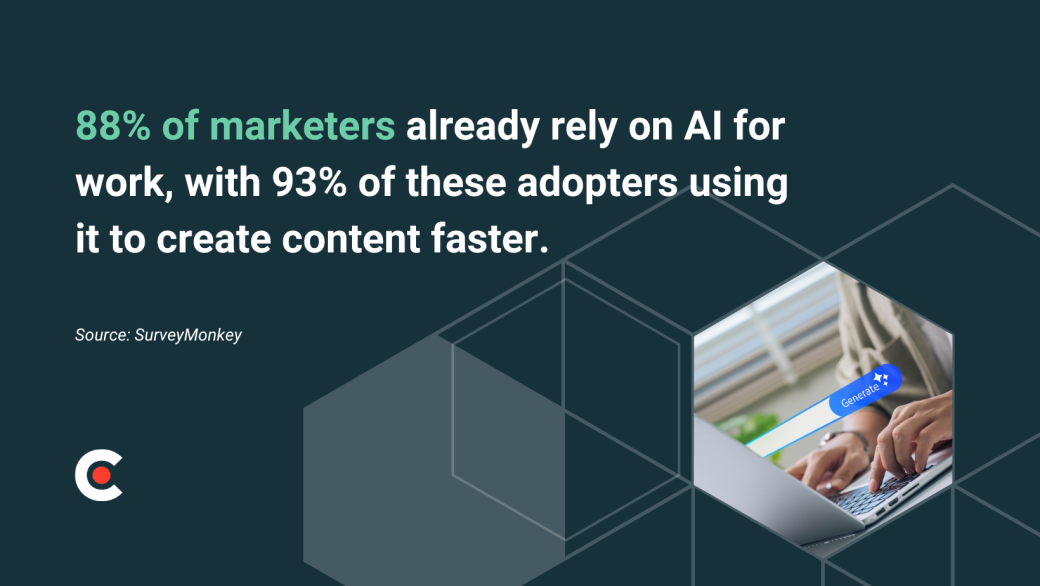
A SurveyMonkey study found that 88% of marketers already rely on AI for work, with 93% of these adopters using it to create content faster.
AI also offers the tantalizing prospect of higher output and smarter decision-making.
Of course, this technology has a few limitations.
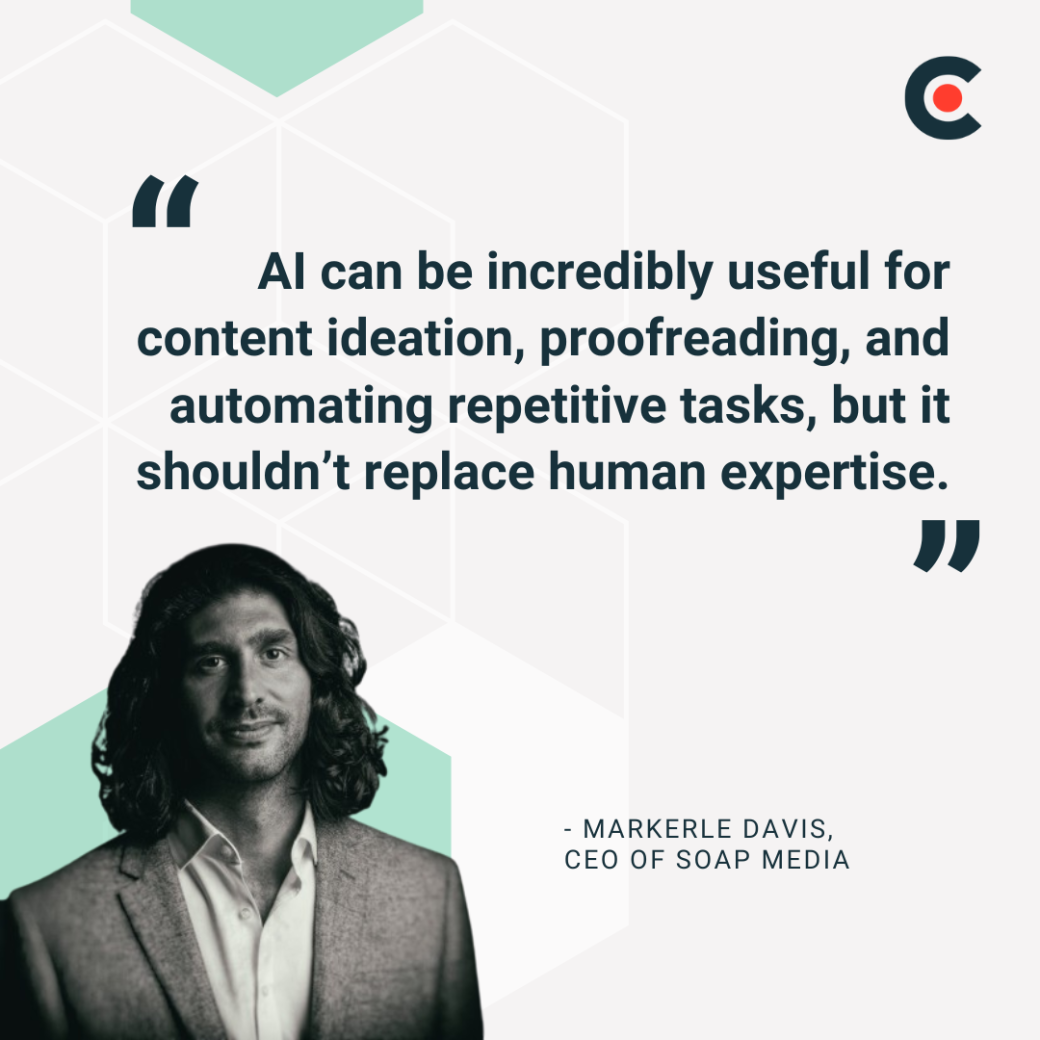
Markerle Davis, CEO at Soap Media, explains, “AI can be incredibly useful for content ideation, proofreading, and automating repetitive tasks, but it shouldn’t replace human expertise.”
This AI content marketing guide will help you balance boosting efficiency and keeping that all-powerful human touch.
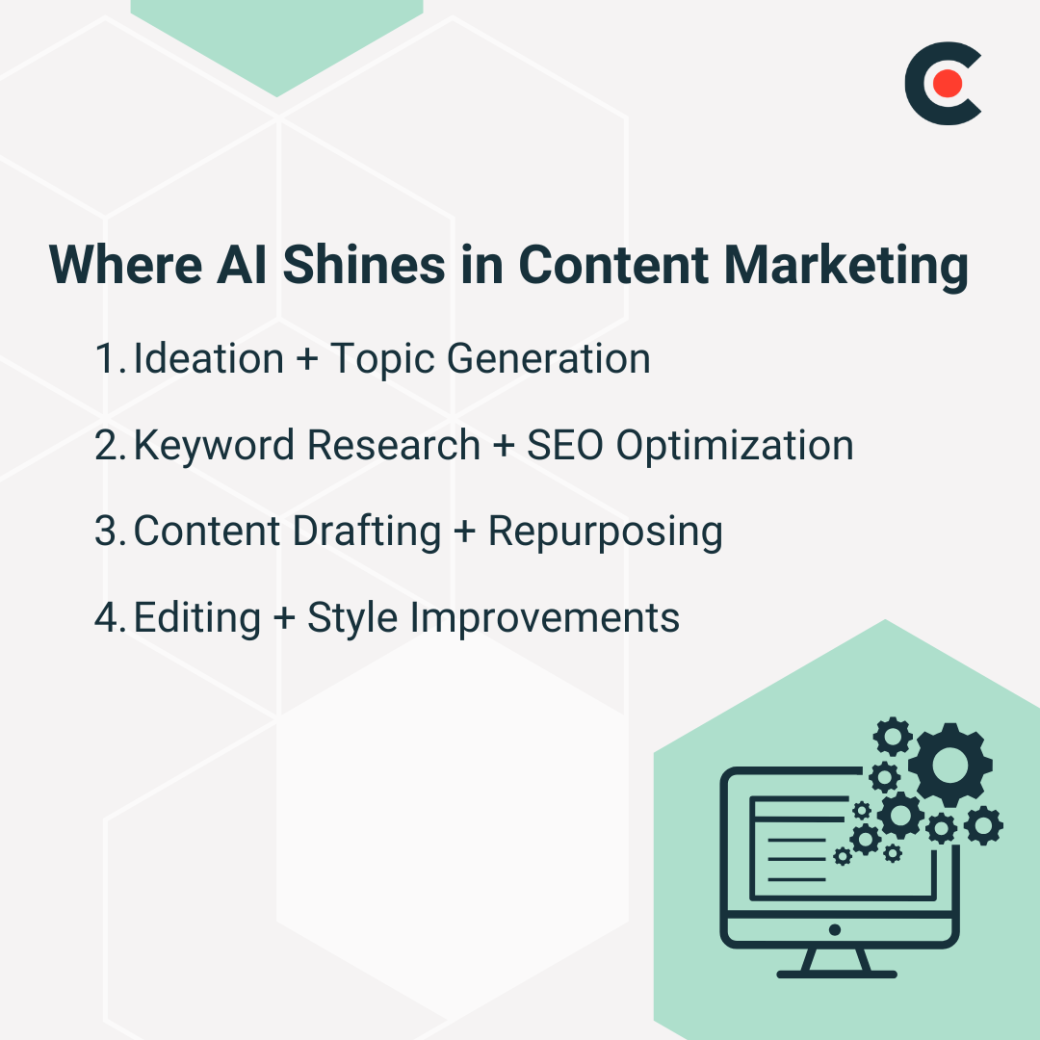
You already know that artificial intelligence can’t take over all your content marketing — at least, not if you want to maintain your high-quality standards. But there are four areas where this technology excels right now.
Like any muscle, your creativity can get overworked. And sometimes, it needs help stretching in new directions. For example, you might struggle to develop 50 unique blog topics or catch yourself repeating the same stale social media posts every day.
Generative AI (gen AI) can generate virtually unlimited ideas. Be sure to experiment with different prompts and audiences, such as:
Specificity is key. Other marketers also use AI for ideation, so don’t plug in generic prompts like “vegetable gardening topics.” Otherwise, you might discover that competitors have already covered all your favorite AI-generated ideas. Plus, tailoring your prompts for your audience can help you create content that’s actually useful.
Additional Reading: ‘How Marketers Are Using AI Agents’
Choosing the perfect keywords can sometimes feel like trying to solve an impossible riddle. You might spend hours plugging phrases into Google, looking for tiny variations in the suggested search terms. Or you may agonize over whether you should go for high-traffic or more obscure keywords.
Take the guesswork out of this process with AI-powered keyword research. Tools like Ahrefs use AI to generate keywords and estimate how tricky it would be to rank for them. They can also help you understand your audience’s search intent (Informational? Navigational?). That way, you can create more relevant content that will rank higher in the search results.
AI can assist with search engine optimization (SEO), too. For example, you could use AI software to automatically insert internal links and reformat your web pages according to SEO best practices. Some tools even insert relevant keywords and suggest extra sections.
Despite these benefits, SEO optimization is one of the most underused applications of AI.
The American Marketing Association found that only 8% of marketers use Gen AI for this purpose. That doesn’t mean this technology is useless in this area—far from it, in fact.
By using AI for SEO, you could leapfrog up the rankings, passing less tech-savvy businesses.
You’ve probably already experimented with using ChatGPT to write emails or even silly odes to your dog. But gen AI tools could also help you create content for your business, provided you have a few guardrails in place.
“The benefits of using these tools are drafting content at a high volume and ensuring key phrases are used in the content,” remarks Eric Elkins, CEO of Widefoc.us. “But you need a strong editing and QA process to follow.”
In other words, you shouldn’t copy and paste ChatGPT’s output directly into your blog. That’s because pure AI writing tends to be formulaic and sometimes just plain weird.
For example, researchers at Florida State University discovered that ChatGPT often overuses words like “delves,” “garnered,” and “underscore.” One or two of these terms might not raise eyebrows, but too many can make your content sound inhuman.
Luckily, it’s relatively easy to humanize AI-generated content — at least, easier than writing it all yourself. Use these strategies to turn even the most robotic materials into human-like gold:
AI can also help you recycle your content for different channels. For example, video repurposing platforms extract the juiciest snippets from lengthy webinars or documentaries. Then, you can easily turn these extracts into Instagram Reels or YouTube Shorts.
You might have your grammar handbook memorized, but you’ll still make the occasional error. Maintaining the same tone across blog posts, Instagram posts, and everything else you work on is also challenging.
Artificial intelligence is essentially spell-check on steroids. Grammarly and other AI-powered proofreading tools automatically flag all the misplaced commas and unnecessary em dashes in your text. You can even train AI to recognize your brand voice and revise anything that doesn’t fit.
Plus, AI can help you edit visual content. Take Canva and Pixlr, for example. They use AI to remove objects from the backgrounds of photos, add generative fill, and more.
While AI can be useful for specific marketing tasks, some still require a savvy human. Avoid using this technology in these circumstances.
Top brands often have distinct tones that AI just can’t mimic.
Take Liquid Death, for instance. The sparkling water company gained notoriety for its humor and borderline offensive satire. Its recent Instagram posts include ads for a fake product called “the Pit Diaper” and a surprisingly gory series of illustrations.
These wacky concepts are so uniquely human that algorithms would struggle to replicate them. AI also lacks the judgment and tact to understand when the joke goes too far.
The stories you tell your audience matter — a lot. The right narratives can delight your customers or even move them to tears. For example, The Farmer’s Dog commercial “Forever” follows a girl’s relationship with her dog as it ages from a puppy to a senior. The YouTube video’s comment section is filled with comments like, “This ad has got me sobbing.”
While AI can produce emotional content, it could be disingenuous or even sappy. After all, AI can only imitate the human experience, not live it. That’s why it’s best to leave the serious storytelling to real people.
In a world of content creators, thought leaders are a cut above the rest. Every LinkedIn post or podcast episode they create is filled with hard-won knowledge and tidbits of advice that you just can’t get anywhere else. Or, at least, that’s how it’s supposed to work.
Using AI to generate thought leadership cheapens this content and damages your audience’s trust. Customers count on you to share your expertise, not generic content churned out by an LLM.
Let’s face it: Even humans don’t always handle sensitive subjects tactfully. But AI is much more likely to get it wrong because it doesn’t understand nuance or morality.
Netflix has already experienced several AI marketing debacles.
One infamous case occurred when the streaming service allegedly used AI-generated photos of convicted murderer Jennifer Pan to promote a true crime documentary.
One concerned X user posted that “@netflix is spreading lies to influence public opinion on an ongoing court case.” Another wrote, “after learning that [N]etflix used AI in #WhatJenniferDid, [I] don’t trust their documentaries AT ALL.”
This controversy highlights the importance of ethical AI usage. You should never share generated content that manipulates customers or spreads misinformation. Pay attention to AI’s representation, too.
For example, a Brookings Institution investigation found that image generators only created images of white men when asked to depict “a successful person.”
When in doubt, always rely on human creators instead of using AI as a shortcut. The extra effort is worth it to prevent unintentionally misleading or offending your audience.
Additional Reading: 'Dangers of AI Creative'
AI might be relatively new, but hundreds of tools are already available.
So, which ones should you use?
Speak to your team about which tools might work the best for your team’s internal processes.
Anyone can produce mediocre content with AI, but don’t settle for that. Use these best practices to use this technology effectively:
Above all, be patient. Your first AI content marketing efforts won’t be perfect, but keep experimenting with different prompts and tools.
AI content marketing is a serious creativity booster and time saver. This technology can help you with small tasks like brainstorming and writing first drafts. But don’t get too carried away. It’s just a tool, not your new colleague.
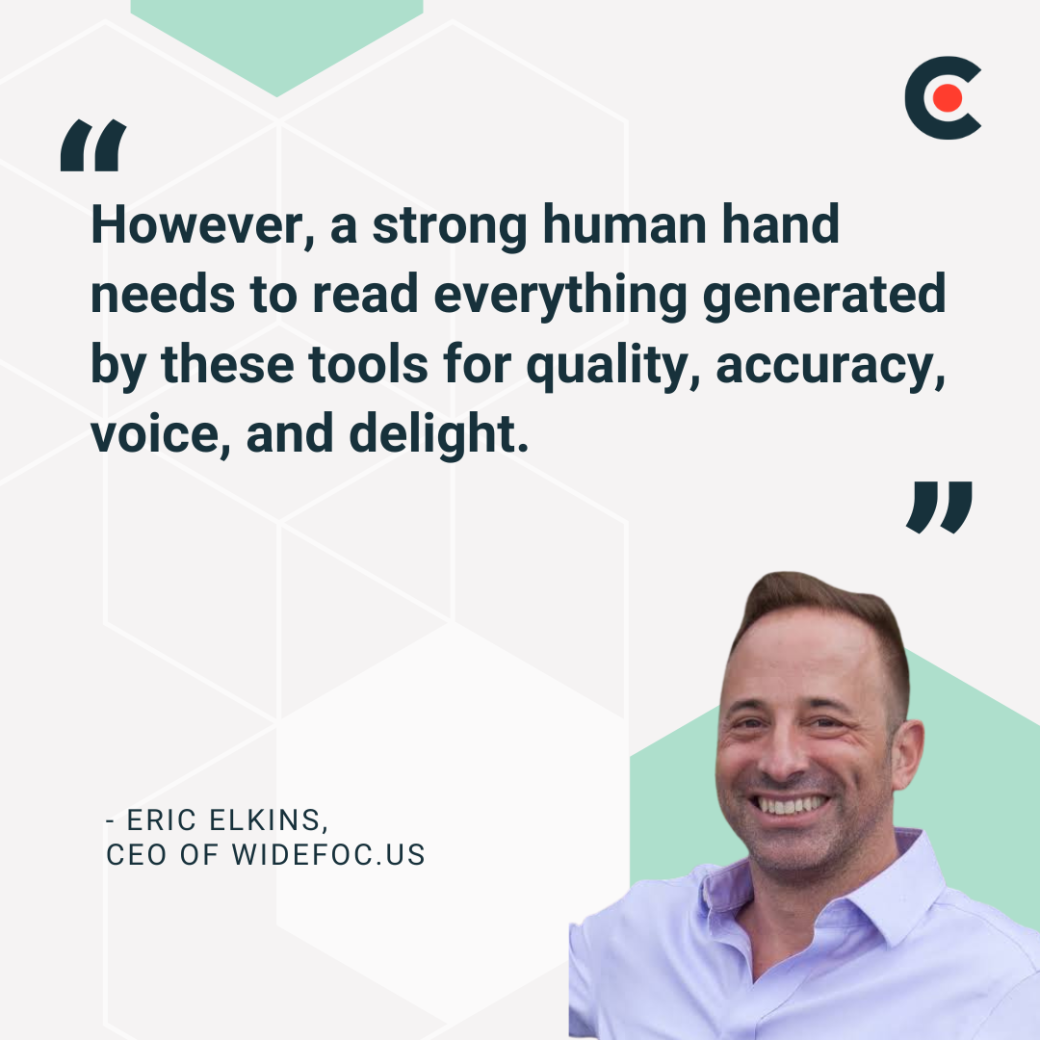
“It's easy to get sucked into the simplicity and speed of content creation,” Elkins observes. “However, a strong human hand needs to read everything generated by these tools for quality, accuracy, voice, and delight.”
Get started by using AI to draft some of your upcoming content, such as Instagram captions or podcast transcripts. But don't forget the human element. That’s what separates great AI content marketing from spam.