How to Use Claude Code if You're Not a Developer
Learn how to use Claude Code to build your own AI agents without a coding background, including setup, first steps, and safety tips backed by Clutch data.
Updated June 9, 2026
AI tools can now write code and perform repetitive tasks typically handled by humans, such as generating documentation, with minimal human prompting. While this can save your team significant time and resources (and, as some believe, has made junior-level entry into the profession more difficult), it also raises the pressing question: When something breaks, who's accountable?
Looking for a Artificial Intelligence agency?
Compare our list of top Artificial Intelligence companies near you
Russell Anthony, CTO of Kingsmen Digital Ventures, shared an answer in Clutch Conversations, our YouTube series featuring C-suite executives on issues shaping their industries. His answer is straightforward: The team that owns the system is always accountable for what gets released, whether the code came from a junior engineer or an AI tool.
There's a lot of debate about what AI is doing to the engineering industry. In a recent survey of 800 software professionals, 45% of respondents say AI could make it easier for junior developers to enter the profession by providing better tools, faster ways to learn, and built-in mentorship. But 37% believe the opposite: that AI could make it harder for newcomers to gain the required experience or find positions at all, as automation eats away at entry-level roles.
Instead of claiming either side is right, Anthony focuses on something organizations can act on immediately. No matter how you categorize AI, you still have to manage it. And his model is straightforward.
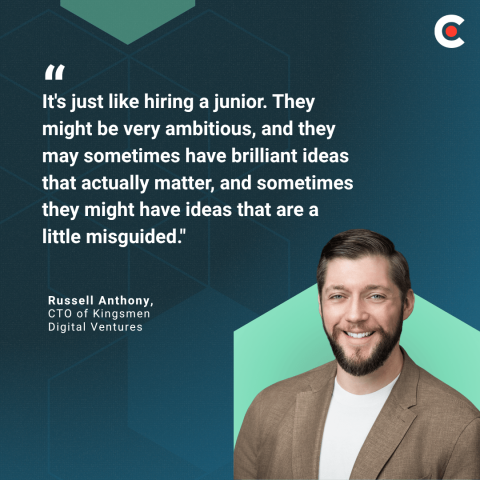
"Managing AI is kind of like managing a junior engineer," he says. "AI, for example, there's automated dependency upgrades you might see pop up on GitHub. I mean, you could even set up OpenClaw to be doing some of this stuff for you and saying, 'Hey, I implemented this because I think it's a good idea.' And it's just like hiring a junior. They might be very ambitious, and they may sometimes have brilliant ideas that actually matter, and sometimes they might have ideas that are a little misguided."
This comparison maps onto real management situations:
Most of this applies to AI, which, like a capable junior contributor, can explain complex concepts, suggest best practices, and help with debugging when senior engineers don't have time. There is a limit to treating AI like a junior, though. Unlike junior devs, AI can't consistently tell you when it's stuck, flag uncertainty, or develop judgment through feedback over time. Remember, it's programmed to produce confident output, even when the task exceeds its competence.
However, that's not a reason to avoid using AI. It's a reason to apply the same review discipline you'd apply to any contributor whose judgment you haven't fully stress-tested.
On April 8, 2025, a driverless Zoox robotaxi braked too late, sideswiping an approaching vehicle at 43 miles per hour on the Las Vegas Strip. In response, the Amazon subsidiary issued a software recall on 270 autonomous vehicles and suspended operations. This incident raised the timely question: Who is responsible when an AI system fails?
The answer depends on whether you have a clear oversight structure before something goes wrong. Because once it does, accountability can become reactive, expensive, and hard to assign. In fact, tech firms deploying AI agents for code reviews without established protocols experienced spikes in error rates, while those that built review structures saw efficiency gains of 30%.
Anthony is unambiguous about where responsibility ultimately sits. "Whether a junior fresh out of college puts up a PR that breaks something or AI does, the team that owns that system is responsible for what happens when it gets released," he says. "Now, you can automate and streamline a lot of that with good test coverage. Really, you should have good automated signals that tell you if something's going to break before it goes to production.”
Despite AI's ability to do tasks that juniors can do — including writing CRUD operations and creating unit tests — you shouldn't treat it as a replacement for junior engineers. By removing juniors, you're removing the human layer that asks questions and catches what AI gets wrong.
You're also affecting hiring pipelines by making it harder for newcomers to learn the skills they need to move up in the industry and continue ensuring AI works as it should. Ultimately, teams that eliminate junior roles in favor of AI-only output run the risk of ending up with engineers who are primarily prompt-senders rather than people who own their decisions and catch mistakes before they become production incidents they can't easily trace or fix.
Besides knowing who's responsible for AI errors, your team also needs test coverage — automated mechanisms to catch problems before they reach production. At AI-assisted development speeds, manual review alone can't keep pace, and the gaps it misses will show up in production.
"You can automate and streamline a lot of that with good test coverage," says Anthony. "Really, you should have good automated signals that tell you if something's going to break before it goes to production. You never want to find out in prod that something was broken because we didn't test it enough."
Research by McKinsey supports this, revealing that the highest-performing AI-driven software organizations design training that mirrors real development work — integrating AI into code reviews, sprint planning, and testing cycles. Successful teams apply AI in live contexts rather than in simulations, and they track outcomes, such as monitoring quality improvements and speed gains, rather than surface-level adoption metrics. By holding your team accountable for impact, you can more easily sustain momentum and adjust when necessary.
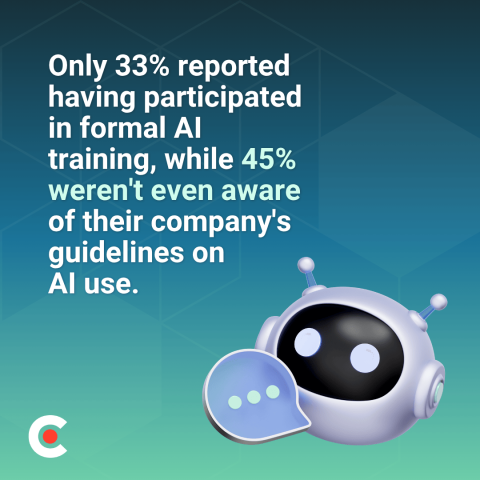
However, the gap between intention and practice is often significant. In a Clutch survey of 250 full-time employees, only 33% reported having participated in formal AI training, while 45% weren't even aware of their company's guidelines on AI use. In engineering contexts, that means a large share of teams are integrating AI into their workflows without a shared understanding of where it can fail or who's responsible when it does.
Overconfidence in the AI output is another risk. The same Clutch survey revealed that 76% of professionals trust AI outputs most of the time, even though the most accurate and specialized large language models (LLMs) on the market still have meaningful error rates. In an engineering context, that level of trust without sufficient proactive oversight can lead to mistakes slipping into production, compromising user experience and exposing systems to security risks.
Fortunately, test coverage addresses the technical side of that problem. It also serves a training function. Engineers who build and maintain robust test suites develop a working understanding of where AI output fails, how often, and under what conditions. That hands-on exposure is what builds calibrated judgment about when to trust AI and when to question it.
Teams also need to close the policy and governance gap to address the human side of these problems. When nearly half of employees don't know their company's AI guidelines and nearly three-quarters of employees are overconfident about AI output, there's no shared baseline for how they should use AI or who does what when something breaks.
By establishing clear policies, you give your team a framework to hold each other accountable, much like how good test coverage holds the codebase accountable.
AI's role in the SDLC is only going to grow. As this happens, teams need to be proactive about owning their decisions. Otherwise, they risk being mere prompt-senders who can't trace the consequences of their actions, leading to a proliferation of downstream issues. "It's very important to stay engaged and to be responsible for the outputs regardless of who's writing the code. It's just a seniority thing that every engineer learns to do," advises Anthony.
Anthony's analogy of AI as a junior engineering developer works because it reframes the question. Instead of asking what AI can do and whether it can replace anyone, he says the real question is whether the team has the discipline to review AI outputs and the ownership culture to stand behind what gets shipped.
Ultimately, as AI takes on more of the SDLC, human qualities won't become less important — they'll be the deciding factor between teams that use AI well and the teams that get burned by it.