
Task Automation: How to Cut Repetitive Work
Task automation saves time, gets work done faster, and reduces errors. Learn how to automate repetitive tasks step-by-step and how to decide what to automate.
Updated August 5, 2026

AI adoption fails more often due to overlooked people problems than to bad models. Here's a practical change management approach built specifically for AI rollouts.
Every business is now adopting AI in one form or another, from customer support to procurement to finance. AI is reshaping how we handle virtually any workflow built on data and repeatable processes. However, there’s usually a gap between testing an AI tool and actually using it to change how people work day-to-day. And change management is what bridges that gap.
AI adoption means new processes, new roles, and new expectations. It also changes who makes which decisions and redefines what “good performance” looks like. So, when you treat an AI rollout like a routine software upgrade, you’re likely to lose people right when the real work begins.
Looking for a Artificial Intelligence agency?
Compare our list of top Artificial Intelligence companies near you
This guide walks you through a practical approach to leading a successful AI shift.
Change management is a structured approach that prepares and supports people affected by new ways of working. In AI adoption, it means new tools and, more importantly, new behaviors. These may include prompting systems, interpreting model outputs, updating procedures, and making decisions with data more than before.
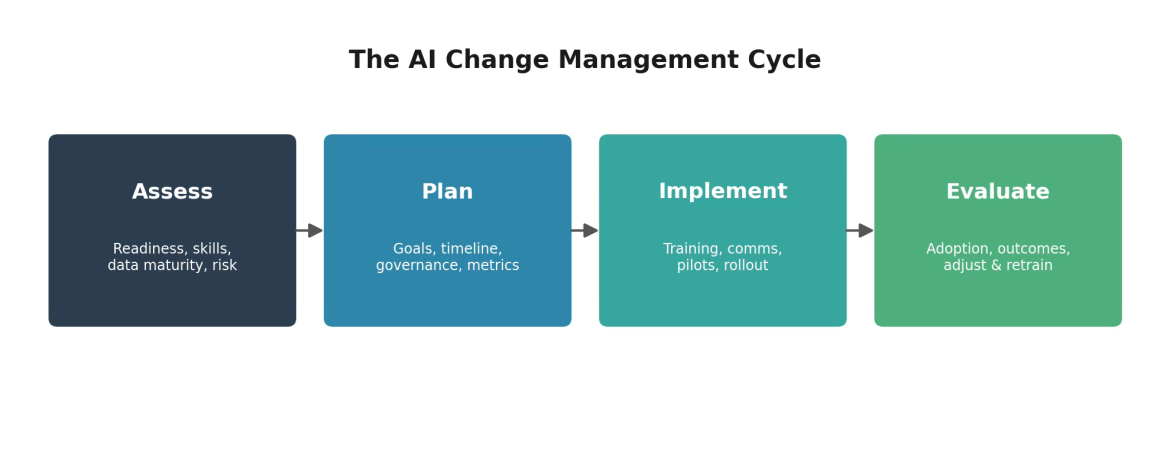
Change management typically moves through four stages:
Why does change management matter more with AI than with a typical system rollout? The stakes are different. You're asking people to trust machine-assisted decisions, accept changes to their jobs, and manage new compliance and ethics risks.
Prosci's research on change management outcomes has found that projects with strong, structured change management are far more likely to meet or exceed their objectives. That gap widens for AI because changes tend to be complex and cross-functional.
Resistance is normal. It’s not necessarily a sign that something has gone wrong. With AI, there’s usually resistance because people fear losing their jobs. They may also get confused about how a tool works or be frustrated by disrupted routines. The underlying question people are asking is simple: "Will this make me obsolete?"
“Start by listening to your people before responding,” advises Greg McRoberts, CMO & Founder of Verde Fulfillment USA. “You may run pulse surveys, hold open Q&As, schedule skip-level meetings, and conduct retrospectives after every pilot. In my experience, I watch for sentiment shifts after major announcements, and look for patterns across teams rather than reacting to the loudest complaints.”
Then respond directly, not defensively. In practice, this usually means:
Most resistance isn't really about the technology. Rather, it's usually about whether people believe their role still matters once the new tool is in place. Bringing that question into the open, instead of avoiding it, is what tends to turn their anxiety into ownership.
AI adoption needs a cross-functional team with real authority behind it, not just a project manager tacked onto an existing IT rollout.
Ideally, you have the following people on your team:
Diverse perspectives matter here more than in a typical software rollout, because AI touches so many different types of work. People from frontline and operational roles, not just IT, are better endorsers of a change. It works better than a boss telling people what to do.
Map your stakeholders, identify who actually makes decisions, and keep your champions close. They'll see problems long before anyone else.
You need a solid change management plan to ensure the success of your AI adoption. It should cover:
Avoid generic templates because a change management plan works best when it bridges the gap between where the organization actually is and where it wants to go. You need realistic timelines and honest resource commitments mapped against the existing culture, rather than the one a slide deck assumes.
Kotter's 8-Step Process is a useful structure for building organization-wide momentum. For AI-specific governance and risk, NIST's AI Risk Management Framework lays out practical guidance for building AI systems.
Nick Mendez, Founding Partner and CEO of Horton & Mendez, sees this play out constantly in legal practices adopting tools like contract management software. "Attorneys don't resist the technology itself. They resist being told to trust it blindly," he says. "Show them, case by case, that it catches what they'd have caught anyway, just faster. That's what turns skepticism into adoption."
A well-structured change management plan not only facilitates a smoother transition but also promotes a culture of adaptability and resilience within the organization.
Your people can't support AI adoption unless they understand it. Communication here is key. It’s one of the fastest ways to minimize resistance, but it has to be repeated and layered rather than delivered as a single memo.
Here are a few things you can do:
Airbnb's internal Data University program is a useful model here. It runs role-based courses that improve data literacy across the company. It pairs accessible training with internal storytelling that makes working with data feel practical rather than abstract. This kind of blended, repeated communication can benefit AI rollouts, too.
Samantha St. Amour, growth partnership manager at Technobark & Technomeow, sees this constantly across franchise networks. "Franchise partners will tune out a corporate mandate in about five seconds," she says. "Treat every location like a stakeholder with a vote, not just an inbox to broadcast updates to."
Effective communication strategies are essential to transparently convey the benefits, expectations, and support available during the AI adoption journey, building trust and engagement among all team members.
Having the right skills will help your people use AI confidently. Training programs for an AI rollout, including AI-powered employee onboarding and training videos, shouldn’t be just a one-time event. It's what converts curiosity into competence.
A layered approach tends to work best:
Keep it practical wherever possible. Instead of slide decks, use simulations, side-by-side workflow comparisons, and sandbox time. According to IBM's Global AI Adoption Index, skills gaps remain one of the top barriers that prevent organizations from scaling AI beyond the pilot stage. That’s why training and reskilling are a core driver of AI adoption success.
Jesse White, General Manager of Balance Point Heating, Cooling & Plumbing, has seen the same pattern with frontline teams. "Techs don't push back because they hate new technology. They push back when nobody explains why it matters to their day," he says. "Tie the training to the routes and calls they already know, instead of a generic module, and adoption stops being a fight."
Comprehensive training and development programs are essential for equipping employees with the necessary skills and confidence to adapt to AI technologies. They will help to ensure a smoother transition and enhanced organizational effectiveness.
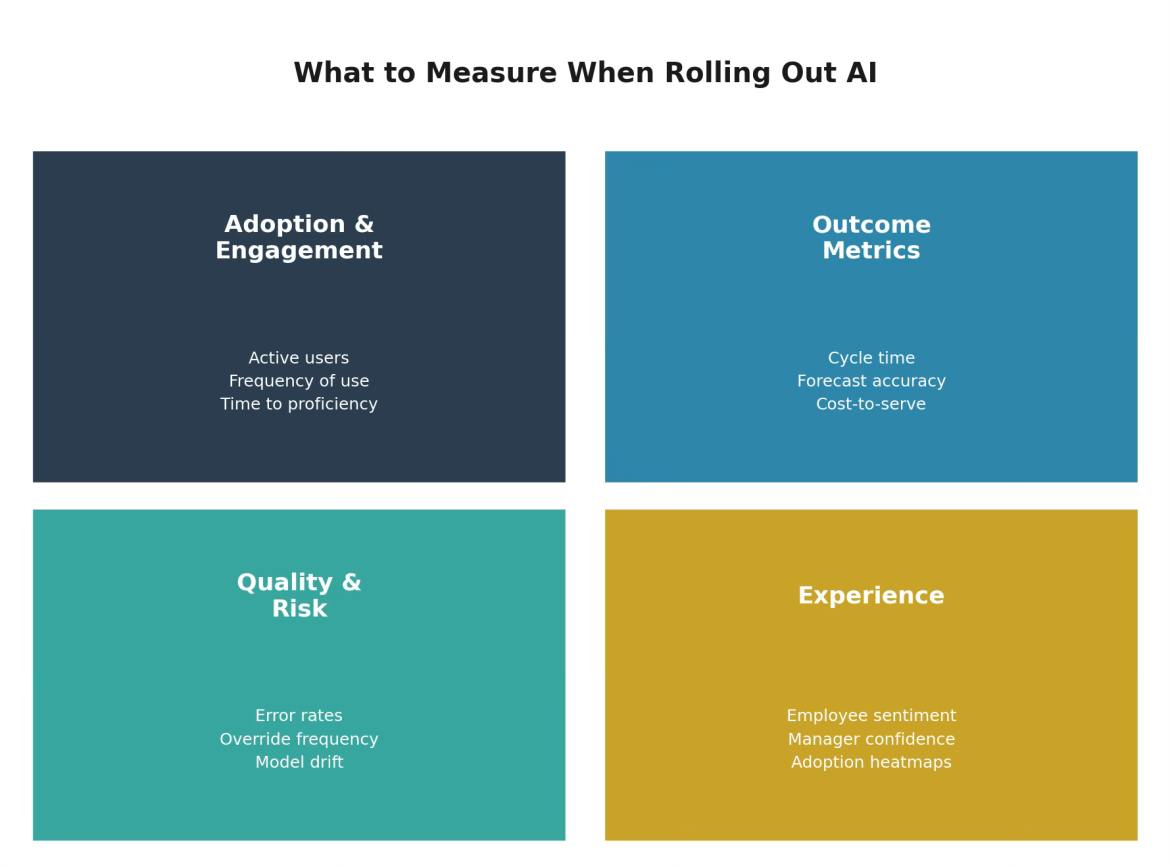
Define what AI adoption success means to you before you launch, then measure in ways that guide your next action rather than just producing a report. In general, you should track these four categories:
Tie these to clear decision rules. If adoption lags, add coaching and simplify the workflow. If models drift, strengthen monitoring and retraining. If sentiment drops, listen and address the specific pain points people raise, rather than issuing a generic reassurance campaign.
According to research from MIT Sloan Management Review and BCG, fewer than 50% of companies investing in AI report meaningful business gains. Those that do tend to be the ones who tie AI explicitly to measurable outcomes and adjust based on what they learn. They don’t treat the rollout as a one-time deployment.
AI adoption is not about rushing to shift or use the newest tool. It’s a process that requires listening to people, properly equipping them, and adapting. Change management makes that process deliberate instead of accidental. Build a cross-functional team with real credibility. Set clear goals, communicate often, train thoroughly, and measure what actually matters. When resistance surfaces, meet it with honesty and partnership rather than a broadcast memo.
The organizations that succeed with AI usually aren't the ones running the most sophisticated models. They're the ones who help people use those models confidently and safely, and in ways that genuinely support the business.