Lead Quality vs. Lead Quantity: Why B2B Teams Are Rethinking Their Funnel in 2026
Bigger buying committees and tighter budgets are forcing B2B teams to rethink lead quality vs. quantity. Here's how top teams rebalance the tradeoff in 2026.
Updated February 19, 2026

Are businesses prioritizing email in their marketing plans? With a 3800% return on investment (ROI), email has significant potential as a revenue generating machine. However, how much time and budget is enough?
Our survey on email marketing trends in 2016 shows a common email marketing perception among enterprises: your company invests enough resources in email marketing.
Looking for a Digital Marketing agency?
Compare our list of top Digital Marketing companies near you
But is this really true? Email marketing experts surveyed for this series say no.
We argue that looking toward 2017, marketing teams need to dedicate more human and financial resources to email.


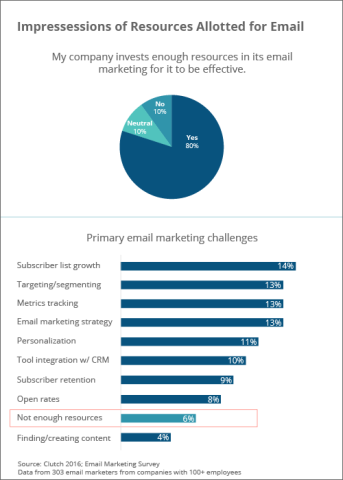
To overcome email marketing’s primary challenges, marketers should prioritize investing in educational tools to improve email skills — like what to include in an email strategy and what content performs best when distributed through email — and to automate time-intensive processes — like targeting and segmenting, personalization, and results tracking.
However, our survey shows that while most email marketers struggle with these core email skills, few see not having enough human and financial resources as a challenge. And, even more significant, few believe that they need to invest more resources in the email process.
Read More: We created an infographic to help you identify the key metrics to track to prove that email is helping your business achieve its goals.
How you approach email marketing — the content you share, the frequency with which you send emails, and the overall goals you want to accomplish — varies case-by-case. Therefore, the amount of time and money required to make email marketing efficient and profitable is not the same for everyone.
However, there are some resources that all companies need if they’re pursuing email marketing:
If we focus in on people — those ever-important human resources — we find that the size of a company’s email marketing team varies based on the size of the company itself.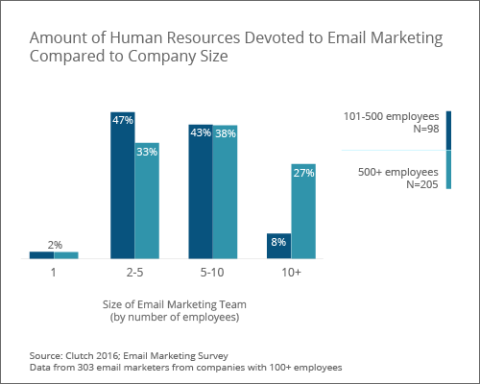
According to Michael Barber, Founder of barber&hewitt, a strategy and planning firm focused on business-to-business (B2B) organizations, larger organizations will have dedicated resources for email and/or marketing automation, while small- and medium-sized organizations will give email responsibilities to a general employee — someone who has some email knowledge but email isn’t his/her key role.
“In medium-sized organizations, we've typically seen more of a holistic type of employee who has email knowledge but functions as a sort of jack of all trades across the marketing team. In these organizations, there typically are one to three individuals who either own the channel or play some sort of role within it.”
— Michael Barber
Be thoughtful about the type and amount of resources you dedicate to email marketing. As you finalize marketing plans for 2017, consider the following:
For more resources on email marketing, see the first two articles in our series:
Contact Sarah Patrick at sarah@clutch.co with questions or feedback.
Subscribe to our bi-weekly email newsletter for data-driven research and resources to help your firm deliver. Curated by the Clutch team.
Data comes from Clutch’s Email Marketing Survey 2016. The study included 303 respondents who describe themselves as either expert, advanced, or intermediate email marketers. They work at companies with more than 100 employees, with 47% representing companies with more than 500 employees. 31% work for business-to-business (B2B) and 69% work for business-to-consumer (B2C) companies.