How App Companies Can Build Trust with Customers
Learn how app companies can build customer trust through better privacy practices, transparent communication, and stronger security to improve retention and...
Updated June 19, 2026

Throughout the life cycle of a product, from ideation to monetization, it's important that product developers stop at each stage to ask questions. Does this idea or concept merit further consideration? What consumer base are we targeting? Will the company make money?
An idea and the desire to bring it to life — this is the starting point for any new product launch. But, once you have an idea, what are your next steps to make it a reality?
In the consumer goods sector, only 35% of the launches were new products, highlighting the challenges many thought leaders face.
Looking for a Mobile App Development agency?
Compare our list of top Mobile App Development companies near you
Three challenges come to mind when thinking about next steps for launching a new product or service:
This article will walk you through each step you need to take to go from idea to successful product launch, including evaluating your product’s value, identifying target markets, and defining your business model.
Before developing a new product, it’s necessary to verify the feasibility of your idea to ensure it’s worth the required time and financial investment to launch.
A starting point for analyzing the viability of your idea involves determining the potential product’s unique selling points (USPs), or the features that differentiate it from existing competition in the market.
Your product is more likely to achieve success in both the mid- and long-term if it has unique characteristics and value.
Therefore, you need to fully understand its usefulness before making any investments. In other words, what’s the main value of the product for end users and business stakeholders?
Here’s how to get started determining value.
First, ask yourself two questions:
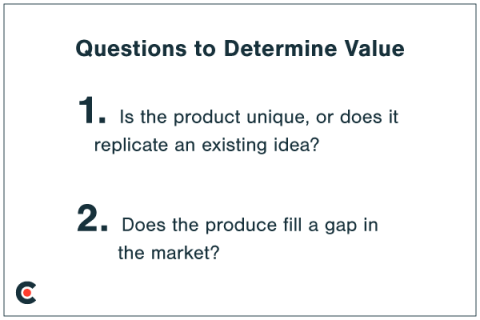
Then, if your answer to these questions is “yes,” think about the following:
Examples of differentiating factors could include higher quality, lower price, better price-quality ratio, newer features or functions, greater ease of use, or higher quality design.
One of the best ways to validate your new product idea is to get feedback from peers, leading industry players, and niche experts with relevant knowledge.
For example, attend networking events, and talk about your product idea with entrepreneurs who have experience creating and launching new products. Ask for professional input, criticism, and advice.
Ten minutes of objective, constructive critique from experts is often worth much more than ten hours of talking to friends and relatives. Experts who are honest will outline potential pitfalls and offer constructive criticism that you may need to hear (even if you don’t want to).
In contrast, friends and relatives are likely to praise your idea, which may make you feel good but won’t help get your product launched.
Equally important is ensuring cross-functional alignment within your own team. Before moving forward, ensure that key stakeholders share a common understanding of the product's vision and goals. Early alignment, maybe through a presentation of product features, prevents costly miscommunication later, helps prioritize the right features, and ensures that every department is working toward the same definition of success.
When teams collaborate across functions, feedback becomes more holistic, combining customer insights, technical feasibility, and business strategy. This integrated perspective strengthens the foundation of your product idea and increases its chances of market success.
After collecting feedback from experts with experience launching a product, reassess your idea to determine if you still want to proceed.
Assuming you’re still excited by your product idea, ask yourself, “What do I want my product to be in five years?”
There are several scenarios to choose from when answering this question:
Your product launch strategy will vary depending on your five-year vision.
Once you’ve clarified your long-term vision, the next step is to prepare strategically for your product launch.
Start with comprehensive market research to understand your target audience, competitors, and the market gaps your product can fill. Use these insights to define your audience segments, craft your messaging, and establish a clear positioning strategy that highlights what makes your product unique and valuable.
Budgeting and resource planning is key. Outline how much you’ll invest in promotion, marketing, distribution, and post-launch support. Allocate resources for essential activities like marketing campaigns, customer onboarding, and performance tracking.
It’s also important to consider how the product will be marketed, so all stakeholders should work to avoid common product marketing mistakes.
If you don’t consider your user from the very beginning of the process of designing a new product, you’re destined to fail after your product launches.
Therefore, it’s important to collect information about your audience in four key areas: the motivation for making a purchase, the reasons why they wouldn’t make a purchase, the challenges that your product can solve, and the use cases that would “wow” them.
The stronger your insight into the type of people and businesses who will seek value from your product, the easier it will be for you to tailor your product to their needs.
One of the most effective methods for gathering initial feedback from your target users is to conduct focus group research.
Focus groups provide an opportunity to gather a group of potential users, share a product prototype, wireframes, or sketches, and observe their reactions. This qualitative data will help you understand how users interact with your product and identify existing pain points.
To use a focus group to test how users interact with a mobile application, you need four groups of users :
Our team at Intersog once had a client who wanted to build a prototype of an information visualization system that provided scatter plot visualizations of U.S. legislative behavior. The goal was to allow users to observe legislative changes over time and draw conclusions.
As a development provider, Intersog initiated focus group research as an opportunity to conduct a free-form discussion with potential users of the tool. Our focus group included four participants and two research facilitators. One of the facilitators controlled how users operated the software, while the other took notes, video-recorded the session, and assisted with the conversational flow.
As a result, not only did we receive feedback on features and usability, but we also gained invaluable insight into the questions that were most important to users regarding legislative initiatives.
We converted those questions into calls to action and functional features and added them to the future application to better meet user demand.
Although learning about a bunch of unknown or potential users sounds daunting, it’s important to remember that you can learn a lot by observing your everyday surroundings, interactions, and circumstances.
Essentially, become a user yourself to better explore their needs and issues.
Consider how Mars Incorporated, a global pet care, chocolate, food, candy, and drink brand, used popular hypotheses and assumptions about human behavior to create an award-winning TV ad campaign.

Hypothesis: When people are hungry, they struggle to think deeply about anything but their hunger and potential sources of food.
Next Steps: Mars Inc. utilized this assumption to craft an ad tagline that resonated with this common user phenomenon.
Result: Successful TV commercials for Snickers candy bars based on their hypothesis: “You're not you when you're hungry.”
Choosing the right time and approach to launch your product can make the difference between an average debut and a breakthrough success. Timing should be guided by market readiness, competitive activity, and internal preparedness.
Once your product is live, the work doesn’t stop. A strong post-launch evaluation process helps you understand how well your strategy performed and where improvements are needed. Track KPIs, collect both qualitative and quantitative data, and more to assess how the product meets customer expectations.
A product idea doesn’t become a business idea until you can describe how you plan to make money from it. This plan for making money, or business model, requires determining how you’ll attract users to buy your product.
One way to put your product ideas together and better define your monetization path is to use the Business Model Canvas. The tool helps you visualize your business model by guiding you through an exercise that touches on nine aspects of creating and launching a new business product.
The nine business model building blocks include the following:
The tool helps you visualize your business model by guiding you through an exercise that touches on nine aspects of creating and launching a new business product.
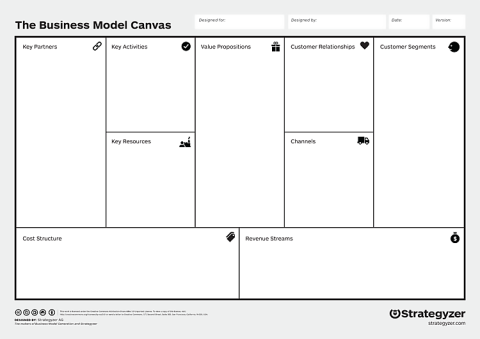
As you experiment with business modeling, you’ll get a more in-depth understanding of your own product and its values, which will help you prepare market initiatives and find the right monetization model.
You can see how Coca-Cola used the Business Model Canvas in the image below.
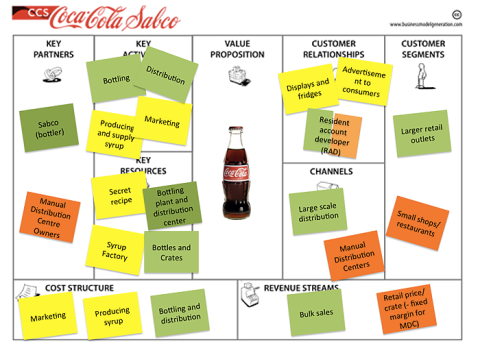
Each sticky note identifies a key component in a successful business plan for Coca-Cola, from creating the main product —a soft drink —to bottling and selling it in bulk.
Successful businesses are able to adapt to volatile market conditions. This guide walks you through the steps necessary to grow your business by creating a new product.
First, take your basic product idea and evaluate it against different scenarios, use cases, what-if simulations, and measurable key performance indicators.
Second, conduct user research to gain a deeper understanding of potential users. Gear your product toward their needs.
Third, create a business plan and calculate potential financial outcomes for each scenario.
Consider all of this and other product launch factors when developing your plan.

Victor is a content writer, turned PR guy, turned head of marketing at Intersog, a U.S. based technology company with R&D Centers in Ukraine and Canada. As a professional B2B and technology marketer, Viktor loves talking and writing about innovation and how it affects our lifestyle.