The Real Cost of Your MVP in 2027
AI made code cheap, but not software that holds up. See how MVP cost drivers have shifted and why human validation and taste are now what you’re really...
Updated April 22, 2026

Take a second to ask yourself: How many times have you heard of companies that built something nobody wanted? Or missed the mark on features your own customers actually need?
That's what happens when teams skip product prototyping. Your development team works for months building the "perfect" product, only to discover critical flaws after launch.
Instead, take the fastest path to product success and start with a prototype. Not just any prototype, but a strategic one that validates your concept before heavy investment.
Looking for a Software Development agency?
Compare our list of top Software Development companies near you
This article will discuss how product prototyping cuts development time, slashes costs, and dramatically improves market fit. Let's get into it.
Product prototyping is the process that creates working models of your concept before full development begins. It sits between ideation and production, serving as your first tangible expression of a business idea.
But prototyping isn't just about building a physical model. It's a strategic process that tests assumptions, validates market fit, and identifies fatal flaws before you commit significant resources.
For executives, prototypes function as risk management tools. They transform abstract ideas into concrete demonstrations that align teams, convince stakeholders, and generate meaningful user feedback.
In short:
Prototyping = Insurance policy against expensive mistakes.
The most successful product companies don't view prototyping as optional. They see it as the foundation of their development process — one that is the difference between educated investments and expensive guesswork.
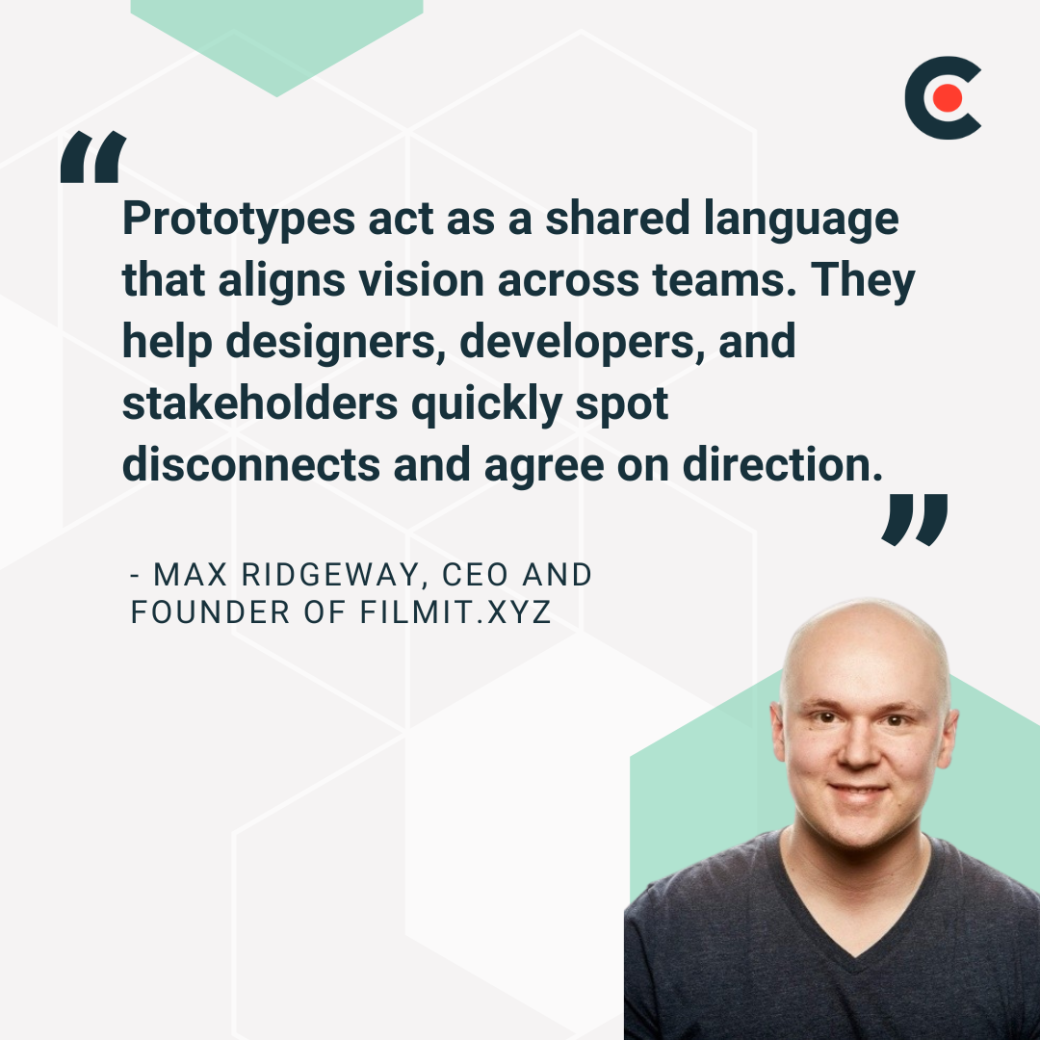
Max Ridgeway, CEO and Founder of Filmit.xyz, shares, "Prototypes act as a shared language that aligns vision across teams. They help designers, developers, and stakeholders quickly spot disconnects and agree on direction."
Smart product development isn't about moving fast — it's about moving in the right direction.
Let's break down exactly how prototyping delivers ROI at every stage of development.
Every product concept contains dozens of assumptions about user needs, technical feasibility, and market demand. Prototyping puts these assumptions to the test before they become expensive mistakes.
Identifying any issues during prototyping, not after development, prevents potential user experience problems and costly redesigns.
By front-loading your discovery process through prototyping, you minimize financial exposure while keeping development timelines intact.
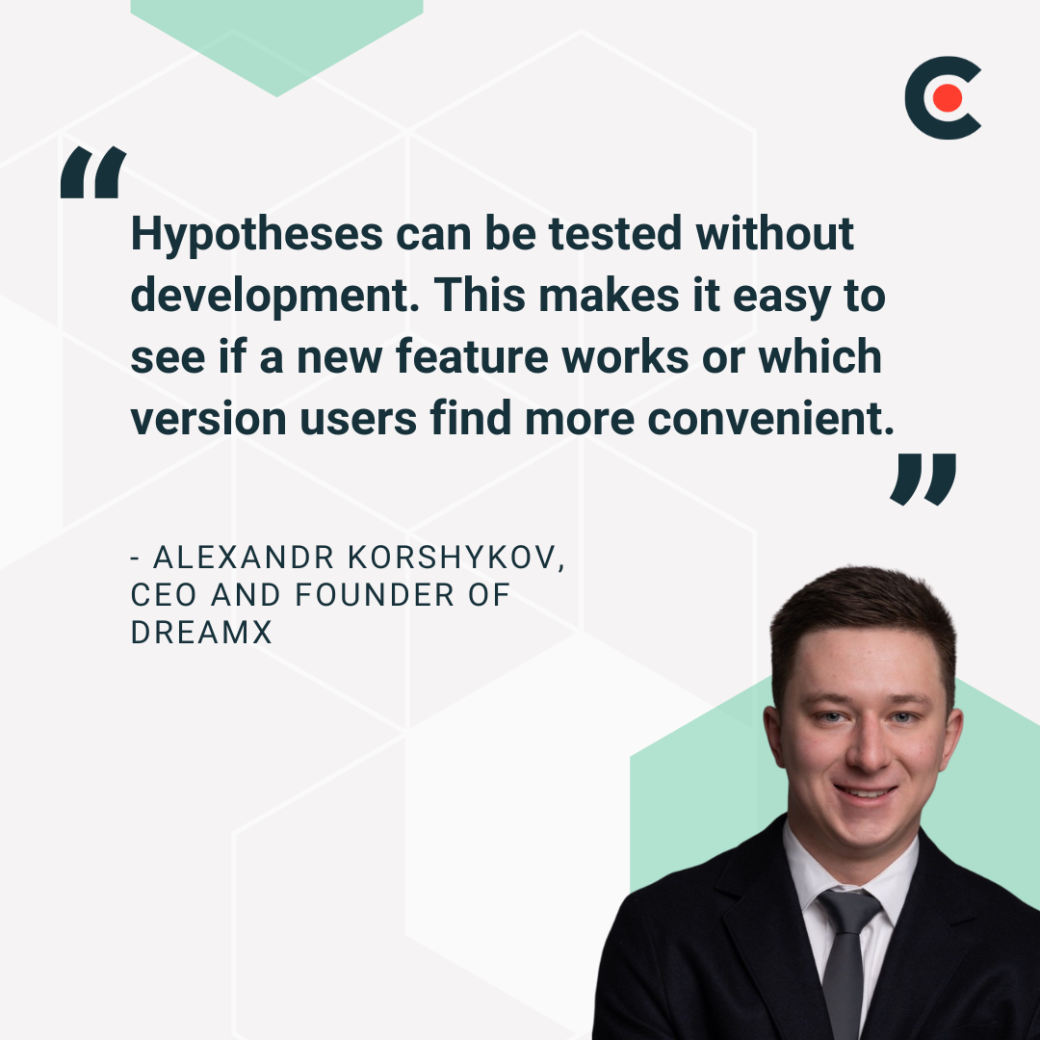
Alexandr Korshykov, CEO and Founder of DreamX, highlights the value of early testing. “Hypotheses can be tested without development,” he says. “This makes it easy to see if a new feature works or which version users find more convenient.”
Market research and focus groups can only tell you so much. Nothing compares to watching actual users interact with a prototype of your product.
In automotive interface design, prototypes frequently reveal disconnects between how designers expect drivers to interact with controls versus actual behavior. For instance, touchscreen interfaces that work perfectly in stationary testing often prove problematic when users attempt to operate them while focusing on the road.
Prototypes give users something concrete to react to, generating insights no survey could capture, such as:
This feedback loop transforms abstract user requirements into specific design improvements that directly impact adoption rates.
Without a prototype, requirements tend to expand unchecked. Engineers add "just one more feature," designers tweak interfaces endlessly, and stakeholders keep shifting priorities, ballooning both budget and timeline.
Instead, product prototypes create natural boundaries around scope. They force stakeholders to prioritize features before engineering investments begin, preventing the expensive cycle of mid-development changes. As a result, “Prototyping with testing also reduces product costs,” says Korshykov.
Products without prototypes typically follow a linear path: design → develop → test → fix → launch. This approach concentrates all feedback at the end of the cycle when changes are most disruptive.
Instead, prototyping products introduces parallel processing. While developers work on core architecture, users test prototypes, marketing validates messaging, and leadership aligns strategy, all simultaneously. This parallel approach significantly accelerates your overall development timeline by eliminating the sequential bottlenecks that traditionally slow product launches.
Some of your best product ideas won't come from brainstorming sessions. They'll emerge when users interact with prototypes in unexpected ways. These user-invented solutions can often become official features in subsequent releases.
To do so, implement a formal system for logging unexpected user behaviors during prototype testing to capture these opportunities for your company. Also, you can set aside dedicated development resources to explore these emergent patterns rather than dismissing them as edge cases.
Product development involves multiple teams with different priorities: Engineering values feasibility, design values usability, marketing values differentiation, and executives value ROI.
Prototypes serve as a universal language that aligns these perspectives. Rather than debating abstract concepts, teams can point to specific elements of the prototype when discussing changes or improvements.
Persuading executives or investors to back your product vision becomes significantly easier when they can see, touch, or experience a prototype.
Enterprise software teams find that interactive prototypes demonstrating core workflows dramatically improve stakeholder comprehension compared to slide decks or requirements documents.
What seems obvious to product teams often isn't to executives until they can experience the actual interaction.
Choosing the right prototype for your current development stage can dramatically improve its effectiveness while optimizing resource allocation. Let's explore the main categories and when to use each one.
Feasibility prototypes answer one critical question: "Can we build this?" They focus on technical validation rather than user experience or aesthetics.
Use feasibility prototypes when:
These prototypes typically stay within engineering teams and rarely reach users or stakeholders in their raw form.
Low-fidelity (lo-fi) product prototypes (wireframes, sketches, basic mockups) focus on core functionality and user flow without getting bogged down in visual details.
E-commerce teams often use paper prototypes to map checkout flows before coding anything. This approach allows them to test multiple payment and confirmation sequences with users at minimal cost, identifying optimal patterns before making technical investments.
These lo-fi prototypes provide a few key benefits:
High-fidelity prototypes closely mimic the final product, with realistic visuals, working interactions, and sometimes partial functionality. They represent the pre-production version of your product.
For example, smartphone manufacturers create high-fidelity prototypes to test key interactions like gesture controls and notification systems.
While more resource-intensive, these prototypes provide the most accurate prediction of market reception and technical performance.
Follow this eight-step process to create prototypes that answer your most critical product questions without unnecessary complexity.
Begin by defining what your prototype needs to validate. Are you testing technical feasibility, user experience, market fit, or all three? Narrowing your scope creates focus and prevents resource waste.
For example, you can exclude engine performance questions from the scope when prototyping vehicle dashboard layouts. This allows you to use simplified electronics that simulate vehicle integration without requiring fully functional systems.
Document your key questions and hypotheses before starting prototype development.
Set clear objectives for what the prototype must demonstrate. Rather than attempting to replicate all intended features, identify the critical few that will validate your core assumptions.
When prototyping subscription-based services, focus on three to five key features that differentiate your offering from competitors. This allows you to validate the user's willingness to pay before building dozens of secondary features that might not impact conversion.
Create a prioritized list of functions your prototype must demonstrate, separated from nice-to-have features that can wait for later development.
Several practical considerations will shape your prototyping approach:
For instance, when selecting prototyping tools, sometimes the best choice isn't the most powerful option but the one your team already knows how to use effectively. This prevents tool-learning overhead from slowing down your prototyping process.
Start with low-investment visualizations that capture the core concept. Whether using pencil and paper or digital tools, focus on mapping user flows and key interactions.
For algorithm-driven products, simple flowcharts often provide more value than interface mockups at this stage.
Here are a few popular wireframing tools:
Choose the tool that allows the fastest iteration for your team's skills. Korshykov shares, "We usually work in Figma, as it’s a tool familiar to designers, developers, and often stakeholders as well.”
Select the appropriate fidelity level based on your validation needs. Match the type of prototype to your current development phase and the specific questions you need answered.
Aerospace companies use different prototype types at different stages: paper models for initial cabin layouts, VR simulations for passenger experience testing, and physical mockups for ergonomic validation.
Each type serves a specific purpose in the development process.
Develop your prototype in small batches, testing after each meaningful addition. This prevents investing in paths that users won't embrace.
Progressive testing is more effective than big-bang evaluation.
Systematically collect and prioritize feedback from users, stakeholders, and technical teams. Look for patterns that suggest fundamental issues rather than individual preferences.
When collecting prototype feedback, distinguish between data points and anecdotes. Ten users struggling with the same interface element represent a pattern, while one stakeholder disliking a color choice might be a preference. Weigh your refinements accordingly.
Document all insights gathered during prototyping. When transferring from prototype to production, identify which elements require redesign for manufacturing scale and which can transfer directly to the final product.
You can implement a formal "prototype retrospective" meeting where you document and assign all key discoveries to the responsible teams for the production phase.
Sometimes internal resources aren't sufficient for effective prototyping. Knowing when and how to engage external partners can accelerate your development process while maintaining quality.
DIY prototype in business works best for software interfaces, simple mechanical products, or when your team has relevant expertise. Professional prototyping becomes valuable when dealing with complex electronics, manufacturing challenges, or when speed outweighs cost concerns.
When selecting a prototyping partner, evaluate their:
The most successful client-partner relationships maintain regular communication cadences, establish clear IP ownership upfront, and create shared dashboards for tracking progress against milestones.
Product prototyping isn't an extra step that slows development — it's the strategic shortcut that prevents costly mistakes down the road. Yet many companies still rush past this critical stage, gambling their entire product investment on untested assumptions.
Before your team writes a single line of code or machines a single component, ask yourself: What could a well-designed prototype teach us today that would make our product better tomorrow?
Your competition is already building theirs. Don't skip it.