Lead Quality vs. Lead Quantity: Why B2B Teams Are Rethinking Their Funnel in 2026
Bigger buying committees and tighter budgets are forcing B2B teams to rethink lead quality vs. quantity. Here's how top teams rebalance the tradeoff in 2026.
Updated June 19, 2026

Product launches are often the culmination of years of hard work. But if you make the wrong marketing choices during rollout, all that effort could go to waste. This guide highlights six common product marketing mistakes and provides guidance on how to avoid them, helping your new product succeed.
There’s nothing quite like launch day. After working for months or years on a product you believe will be valuable, you finally get to introduce it to the public. Now, all that’s left to do is wait to see how the world reacts to what you’ve been developing.
Just like first impressions mean everything between people, they’re also critical to determining how the market reacts to a new product. A poor launch strategy can hinder the effectiveness of a useful tool, while a strong strategy might accelerate its adoption. That’s why the marketing tactics you use before, during, and after launch are so important. They’ll shape how people perceive your new product, ultimately impacting sales, especially when over 30% of products fail when there is no “market need identified.”
Looking for a Digital Marketing agency?
Compare our list of top Digital Marketing companies near you
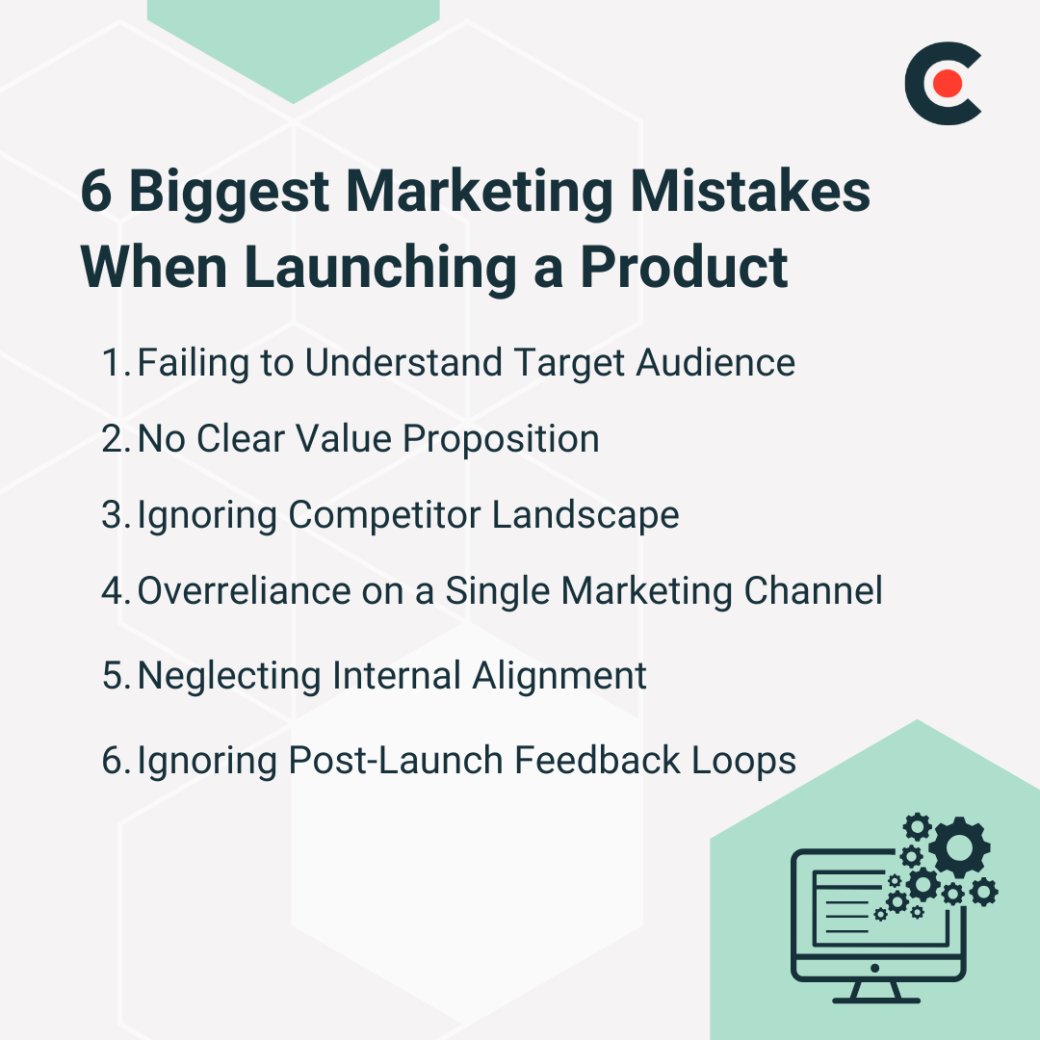
So, how do you create a product launch strategy that accelerates results? You start by avoiding the most common product marketing mistakes. This article explores six issues companies often encounter, highlighting practical solutions you can leverage to improve your new-product rollout.
Even the best products can struggle with adoption when the marketing behind them doesn’t resonate. You can reduce the odds of that happening with your launch by reviewing and correcting the following common product mistakes.
Understanding your target audience is a prerequisite for a successful rollout strategy. You have to know what your audience cares about to create marketing materials that engage them. Without this knowledge, your messaging is likely to miss its mark. This could lead to underperforming campaigns, struggling engagement, and low conversion rates.
Don’t assume you know how your target audience will react to various features just because you’ve engaged them before. Completing new research will help you uncover hidden truths and unexpected attitudes that may shift your approach. Even if the research confirms your initial perspectives, it will enable you to proceed on firmer footing.
Failing to truly understand your target audience can have ripple effects that extend beyond low engagement. Poorly aligned messaging can also damage brand perception, leaving potential customers confused about the product’s value or relevance.
In worst-case scenarios, repeated missteps can erode trust, making it harder to gain traction even when subsequent campaigns are more carefully targeted.
A real-world example is PepsiCo’s 2017 launch of “Crystal Pepsi” in some markets; despite nostalgic appeal, the company misjudged consumer expectations and preferences, leading to low adoption.
Comprehensive audience research could have anticipated the gap between curiosity and sustained interest, enabling adjustments to messaging or positioning before launch.
By creating detailed buyer personas before launch, you can avoid misunderstandings about your audience. These should capture the wants, needs, and perspectives of the customers who will buy your product. Base them on real interviews, surveys, and observed data rather than assumptions.
You may also want to A/B test different parts of your messaging before launch. For example, you can test two versions of the same release announcement, each featuring different calls to action. This will indicate which approach customers respond to best.
The distinction may be subtle, but it's important, as David Ebner, President of Content Workshop, explains: “I believe many companies prioritize features over benefits. They list all of the components of the product, but not the real-world implications of the benefits the product offers the target audience.”
As you go through the process, focus on the benefits that your product offers consumers, more than its features. Doing so will tell customers why they should buy your product, which is more impactful than showing them what it can do.
Another common mistake is not providing your target audience with a compelling reason to care about your product launch. This typically happens when the value proposition is vague or overly broad.
For example, saying that your SaaS platform “helps businesses grow” doesn’t differentiate your product from the many other services that promise the same.
To stand out, you’ll need to get more specific, distinguishing your product’s benefits from those offered by the competition.
For example, you might say that your platform “helps businesses grow by cutting new-client onboarding costs up to 70%.” This gives consumers who feel like they’re spending too much on onboarding a more direct reason to check out your new platform.
To avoid this mistake, refine your value proposition in the pre-launch phase. Tie your product’s benefits to specific pain points your clients experience, such as spending too much on customer service or losing time to repetitive tasks that could be automated.
Jaye Cowle, Founder & CEO at Launch Online, says, “We see the best results when businesses invest in strategic experimentation early, supported by robust performance measurement and a commitment to learning/iteration.”
For the best results, define a value proposition that is:
You may need to iterate over time to reach a launch-ready value proposition.
Next, it’s essential to consider the competitor landscape before launching a new product. Remember, you’re releasing into a market that already has options. To carve out a niche, you’ll need to stress what makes your product uniquely valuable.
Key factors to consider while researching your competitors include:
You can’t carve out a niche unless you know how it compares to what’s already available.
Researching the market you’re launching into isn’t just about comparing your product to others. It’s also important to understand how competitors market themselves, what customers think about different types of messaging, and how your approach will align with theirs.
Experts stress the importance of listening to feedback throughout this process. Or, as Iulia Vasciuc, CEO of ScaledOn, puts it: “The biggest mistake? Falling in love with your own idea and forgetting to listen.”

The critical step is to take the information you gather from competitor content audits and use it to shape your messaging. Look for gaps that your brand can fill. You might also identify what’s working for other companies and look for ways to integrate it into your approach without sacrificing authenticity.
Another common mistake is focusing too much on any single marketing channel. This can result in missing audience segments active on other channels, decreased reach, and reduced conversions.
For example, even if you’re confident that paid social ads will deliver the best results, you should still consider splitting up your marketing budget across email, organic search, and other relevant channels.
This will expand your reach and lay foundations that can pay dividends down the road, as Khalil Kanbar, founder and CEO of Kanbar Digital LLC, explains:
“Companies always focus on marketing channels that provide instant gratification, like social media and paid media. (...) They forget how important SEO is when breaking into a new market with a new product. It can take three to five months before clients see their SEO success come to fruition — so it's always best to start as soon as possible.”
Your goal should be to create a diversified launch strategy, featuring a mix of paid, organic, earned, and owned channels.
A diversified launch strategy will help you reach customers regardless of their location. Then you can track post-launch performance to see which channels are worth doubling down on.
Be sure to keep messages aligned across platforms. This creates a consistent, unified brand image that users will recognize no matter where they encounter your company. However, you’ll still need to make basic adjustments to your content to optimize it for the platforms you target.
For instance, a social post that does well on LinkedIn may need to be revamped for Instagram and TikTok. These sites tend to focus more on imagery than words, so you’d want to find a way to share the same idea you blogged about through a graphic or explainer video.
Launch success is about more than how well you communicate with a target audience through marketing. It’s also impacted by how aligned your team is internally.
Vasciuc describes one unfortunate consequence: “A rarely discussed but critical mistake: no plan for what happens if the launch actually goes well. I’ve seen companies crippled by unexpected success — inventory shortages, website crashes, service bottlenecks.”
If sales, support, leadership, and marketing teams aren’t on the same page, you could face confusion, bottlenecks, and inconsistent customer experiences.
Misalignment can lead to operational inefficiencies that undermine even the most carefully crafted product marketing campaigns. When teams are not coordinated, customer inquiries may go unanswered, sales follow-ups can be delayed, and more can create frustration and erode trust.
To identify and prevent these risks, conduct cross-functional planning sessions well in advance of launch, mapping out each team’s responsibilities and contingency plans for high-demand scenarios.
Holding pre-launch meetings with key stakeholders from every group can help your teams stay on the same page. These meetings are opportunities to share concerns, promote intra-departmental communication, and align the whole staff behind core product launch tactics and messaging.
You could create a Slack channel where employees from all departments can share updates, review internal messaging documents, and ask questions. This is also a good place to store materials such as one-pagers, product launch FAQs, and value propositions.
A real-world example is the launch of the Pokémon Go mobile game in 2016, which led to overwhelming demand, causing server outages and delayed customer support responses. Niantic had to quickly coordinate across engineering, marketing, and support teams to stabilize the experience, highlighting the critical importance of internal readiness for launch success.
Just make sure to listen to the feedback you receive during this process. You don’t want to stress the importance of internal alignment only to overlook employees who try to help. That can lead to workers checking out and missing critical product launch updates.
Finally, make sure your team knows that launch day is more like a starting line than the checkered flag it often feels like. To be successful, you’ll need to listen to post-launch feedback and adapt your approach over time. Otherwise, you could miss valuable opportunities to pivot, expand into new verticals, and refine your messaging.
For example, users on social media might start complaining about an annoying bug that’s making it hard to use your platform. If you aren’t watching these conversations, you may respond late and frustrate your core users.
Or maybe you’ll find that social posts featuring one benefit outperform those highlighting another. This would be a sign to pivot your messaging to prioritize the feature that users are talking about. It’s an opportunity to increase engagement that you wouldn’t be able to take advantage of if you ignored the feedback following a launch.
So, how do you take advantage of these post-launch feedback loops? Many companies start by monitoring social media, forums, and third-party review sites. You can leverage social listening tools to collect data from these sources, analyze what people say, and adapt your approach accordingly.
You can also collect feedback by engaging your audience directly. For example, some companies ask customers to complete surveys, and others use frameworks like NPS to evaluate customer satisfaction rates.
However you collect feedback, responding is also important. It lets customers know that you hear their complaints and are doing what you can to solve them. This can improve your brand’s reputation and help build more loyal customer relationships.
The data you gather from social listening and surveys can then help you refine the product and its messaging to increase sales. You'll also be prepared to make more informed decisions about future campaigns, leveraging feedback to appeal to a broader segment of your target audience.
Modern consumers now see close to 5,000 ads per day. To cut through that noise, you’ll need to avoid these six mistakes and create a rollout strategy that speaks directly to your target audience and establishes your product's unique value proposition.
That's not always easy to do, as Andy Groller, president and CEO of Dragon360, explains: “The biggest miss isn’t messaging clarity; it’s misalignment between what you're saying and what the buyer actually needs to hear to take action. That disconnect leads to wasted budget and slower adoption.”
Ultimately, one of the most costly product marketing mistakes is assuming you can predict exactly how the market will respond to your rollout messaging. No matter how thorough your planning, real-world reactions can differ from expectations. By proactively identifying and addressing common product marketing mistakes—from misaligned messaging to poor audience research—you reduce risks and set your team up to respond effectively. Minimizing these pitfalls ensures you’re better prepared to navigate unexpected challenges and increase the chances of a successful product launch.