
Why Searching for a Specialized Dev Agency Takes Longer Than It Should — And What to Do About It
Looking for a niche software development agency? Learn how to define your requirements, find specialized providers, and vet their experience.
Updated May 29, 2026

Rolling out a new product feature is an exciting milestone—but introducing it to your clients requires more than just a quick announcement. Whether you're enhancing an existing tool or launching something entirely new, the way you present it can significantly impact adoption, engagement, and client satisfaction.
Your newest product feature may be groundbreaking. But your clients won't care if you can't present it right. Most teams spend months perfecting features, then lose the sale in a 30-minute demo.
The reality?
Looking for a Software Development agency?
Compare our list of top Software Development companies near you
You could have the most innovative solution on the market. But it won't matter if your client's team zones out during your presentation. Want to know a key attribute that separates product features that sell from features that flop?
The difference between "We'll think about it" and "When can we implement this?" comes down to the presentation.
In this article, we'll cover practical tips that can transform feature presentations from boring spec sheets into compelling client solutions. Let's get started.
Your audience determines everything from language and depth to focus and presentation length. Understanding your audience’s expectations ahead of time can make the rollout of new product features more effective. For this reason, regular testing and user feedback can be particularly beneficial.
"We implement phased rollouts with beta testing groups who can provide targeted feedback before full deployment,” explains Vishal Bhatia, COO of Dedicated Developers. “Our engineers collaborate directly with client teams on customized onboarding plans that integrate new features into existing processes with minimal disruption."
Strategies like this can help you identify what motivates clients, the challenges they face, and how your new product can help address them. Consider that a CTO wants different information than a CFO, and a startup founder has different concerns than an enterprise VP. Here is how their priorities might differ:
In addition to identifying client priorities, you also need to identify their hidden concerns, which are often the questions they might not ask out loud. Are there Budget constraints? Internal team resistance? Have previous implementations failed during rollout?
Akash Shakya, COO of EB Pearls, shares this insight: "In all our projects, we use idea management within the client portal, and a lot of new product features are being built based on user feedback and new business acquisition." This is a great way to gather client feedback and identify opportunities for improvement.
When you can say "Your team specifically requested this capability," you're not selling anymore. You're delivering features that perfectly fulfill the pressing needs of the customer.
This is where most feature presentations fail. They get stuck in the "what" and forget the "why."
Your new feature might have 15 different functions, but nobody cares. What they care about is how those functions translate into business value.
Take this example:
See the difference? One is a specs. The other is a solution to a million-dollar problem.
The key is drilling down from features to real business impact. Instead of stopping at surface-level benefits, keep pushing until you hit the metric that makes clients lean forward. For instance:
Focusing on the impact of these features makes the presentation more impactful and persuasive.
Conductor, an organic marketing platform, recently introduced powerful new features that enable brands and marketers to track mentions and citations across AI-powered LLMs and search engines, including platforms like ChatGPT and Perplexity. This is a game changer for search engine marketers who are looking to gain a better understanding of how often their brand is being featured in AI-powered search results.
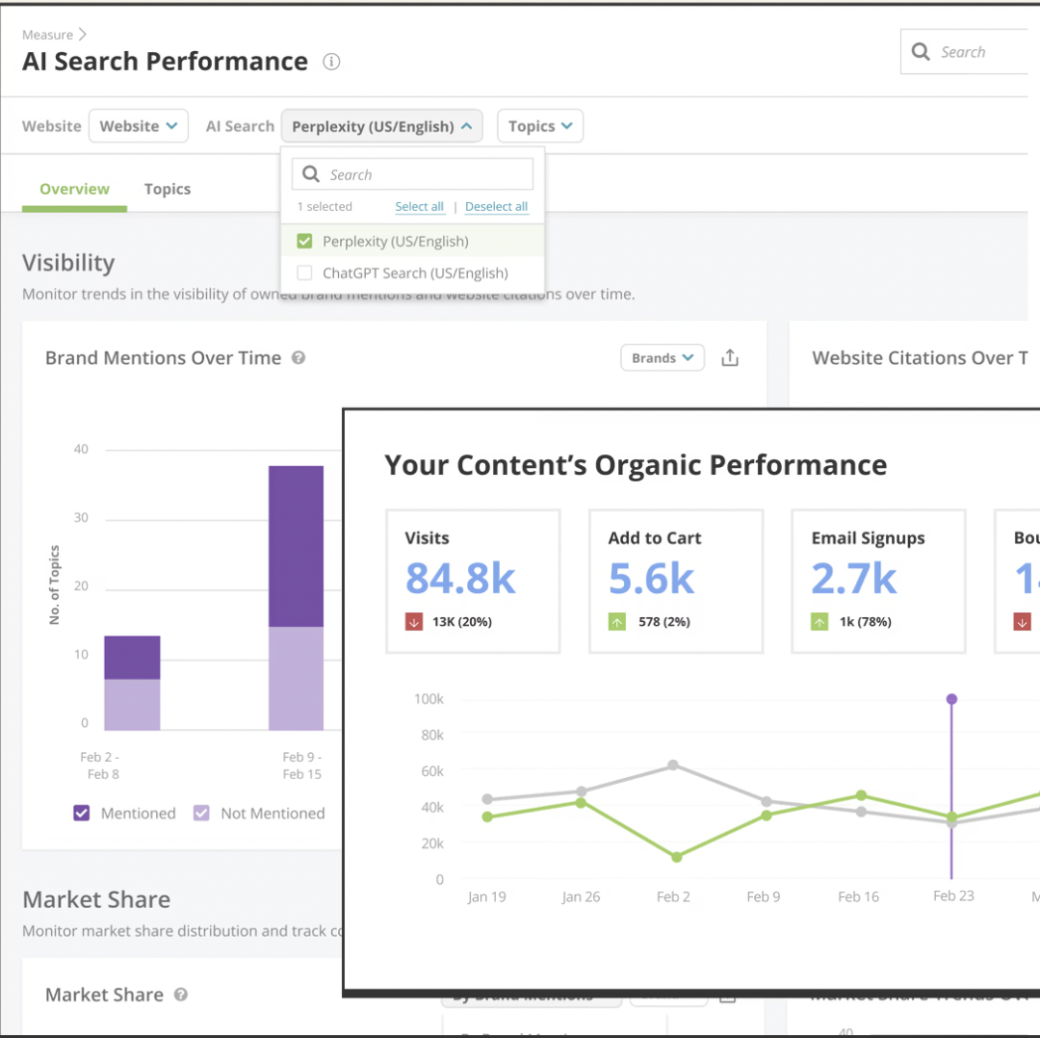
In addition to presenting new features, Conductor is explaining how these features can benefit businesses looking to grow their digital presence as search evolves. Here's how Conductor is positioning this new feature to win clients:
By connecting the dots from technical capability to strategic advantage, Conductor isn't just showcasing a feature—it’s making a compelling case for why it matters to the business outcomes that decision-makers actually care about.
Presenting new features to new or existing clients is often quick, so visuals and demos are a great way to demonstrate how a new offering can directly impact their business.
Start with the end result and show them the magic before explaining the mechanics. If your feature saves 3 hours per week, show a dashboard with "156 hours saved this year."
Then, demonstrate a real scenario. Rather than relaying a perfect-world example, show how your product feature handles messy, real-world situations. Executives have seen too many demos that break the moment you go off-script.
If possible, include interactive demos along the way. Let new users click around so they get a handle on how to use your new feature.
Unrelatable features don't sell, but stories do. "It's not just about launching new features, it's about telling the story around them,” says Cyrus Kiani, founder of TouchZen Media. “We recommend clients not only highlight updates in-app, but we also create supporting content like social videos and announcements."
Why does storytelling transform feature presentations? Because stories bypass the analytical brain and create emotional connections. Stories also make abstract benefits tangible. Instead of processing specs, clients see themselves as the hero overcoming their specific challenges. Plus, stories stick in their mind.
Here's how it could play out in real life:
Sarah, a supply chain director at a Fortune 500 company, was losing $50K weekly to inventory mismatches. Manual reconciliation took her team three hours every morning, but errors still slipped through.
Then, she implemented our real-time sync feature.
Her team now focuses on optimization instead of firefighting.
Notice what happened here? The feature became a supporting character in Sarah's success story. That's how you make it stick.
Customer testimonials and case studies work because they're stories. Even technical documentation works better when wrapped in a narrative.
Client feedback is invaluable for refining both your product and future presentations.
"When a new feature is launched, let users know and invite them to try it and rate it. Make the experience gamified (like the first 100 users trying it and giving feedback would get a chance to get free access for a couple of months),” says Abhijith HK, Founder and CEO of Codewave. “As users try the new feature and experience value; they're likely to use it more and more often (ex:, ChatGPT enabling image generation). You win either way - whether users love it or have critical feedback, you then know what to change to make it right."
This continuous feedback loop helps your team identify which features resonate most with different client segments. It also allows you to customize future demos and prioritize development efforts based on real client needs.
This approach works in presentations, too, by giving clients skin in the game:
End with clear next steps or CTAs. Not "any questions?" but:
All this makes saying yes easier than saying no.
Even the best product features can crash and burn during client demos. But these mistakes are completely preventable. Here are the three main presentation killers to dodge:
Great product feature presentations don't just inform but inspire action. You've got the frameworks in this article. But here's the secret that makes all the difference: passion. If you're not excited about your feature's potential impact, why should others be?
So, your next presentation shouldn't be just about features. Make it about transformation. Show decision-makers exactly how their world improves with your solution.
The executive clients you're presenting to might have sat through hundreds of demos. Most blur together, but yours won't. Because now you know the difference between describing a feature and presenting a vision.
Go and make your next presentation impossible to forget.