
The Real Cost of Your MVP in 2027
AI made code cheap, but not software that holds up. See how MVP cost drivers have shifted and why human validation and taste are now what you’re really...
Updated April 23, 2026

Building out the right software features can transform your business. Companies investing in AI, real-time analytics, and enhanced security are accelerating revenue growth while staying ahead of evolving user expectations.
To keep up with the competition, software products must continuously evolve with new features. These updates provide greater value to users and additional revenue for developers, turning a basic application into a must-have tool. Carefully chosen software features can reduce customer churn, increase average revenue per user, and even open up entirely new market segments.
Whether you're building completely new software, or are looking to optimize your existing software's performance, knowing what product features are trending can help you plan for future growth.
Looking for a Software Development agency?
Compare our list of top Software Development companies near you
In 2025, many businesses are prioritizing product features that will help them evolve to meet user expectations and harness new technologies. "Clients will prioritize product features that drive incremental growth and revenue," explains Katya Vakulenko, Managing Director of Soup Agency. "Anything that helps them scale efficiently, improve ROI, or get in front of new customer segments."

The specific features that are being implemented vary depending on your audience, industry, and more, but one thing is for sure: adding new product features is essential to their strategy.
We interviewed industry-leading developers and executives to determine what features businesses are investing in the most right now, and here's what we found.
Artificial intelligence was once an object of science fiction. Now, cars can drive themselves and computers can talk to us just like humans do.
Taking advantage of these technological achievements is no longer optional, and many businesses are leaning on AI to automate complex tasks, scale operations, and grow their business. Ultimately, this has transformed how work gets done and many business leaders are looking to incorporate AI into their software.
"Products will increasingly incorporate AI for personalized experiences," predicts Ivan Olin, CEO of UPLineSoft. "This could include smart home devices that learn user preferences, AI-driven customer service, and personalized recommendations in e-commerce."
Companies like Netflix and Amazon have long used machine learning models to better predict which of their offerings a given customer may prefer. By surfacing more relevant options, they increase engagement and sales.
Recently, companies have integrated AI in even more innovative ways. Spotify's AI-powered DJ feature takes the traditional recommendation algorithms that have long driven engagement and mixes them with an AI-powered voice to deliver a radio-like experience directly targeted at the user.
Many business software developers have added generative AI to their feature set, enabling their users to automate many of the communication and personalization tasks. Salesforce, for example, has a full suite of AI tools for lead scoring and nurturing. Businesses that use these features gain a massive competitive advantage against competitors performing these tasks manually and with less precision.
In addition to generative AI, the software industry is also seeing a shift toward AI agents. These sophisticated systems can perform complex, multi-step tasks autonomously. AI agents can plan, reason, and execute a series of actions to accomplish a specific goal.
"In 2025, users expect AI agents to act as intelligent copilots — proactively assisting with tasks like content creation, decision-making, and customer support," said Ritesh Dighe, Director of Inceptive Technologies. "Automated workflows are now standard, streamlining repetitive tasks and reducing manual effort through intuitive, no-code interfaces."
These agents are able to perform many of the repetitive and manual tasks typically performed by humans. This allows staff to focus on more important tasks and lets companies stretch their labor budget further.
AI customer service agents are able to handle complex conversations and work seamlessly across multiple systems. For instance, in financial services, AI agents are managing portfolios and conducting risk assessments. Additionally, the healthcare industry uses AI agents for patient triage, appointment scheduling, and even treatment recommendation systems. When combined with computer vision systems, the manufacturing industry can even use these agents to perform visual quality inspections on products.
The age of big data has changed everything about analytics. Data is no longer manually tracked and analyzed. Now, automated systems monitor every aspect of a business at a highly granular level. Real-time analytics ensure that businesses can respond to opportunities and risks as events unfold.
The value of integrating real-time analytics into business software extends across all areas of a company, including:
AI is also a part of modern real-time analytics systems. Identifying patterns, predicting trends, and recommending actions all work to take the businesses that use them from reactive to proactive.
"Predictive insights have evolved from basic analytics to real-time, actionable recommendations powered by machine learning, helping users anticipate outcomes and make smarter decisions," said Dighe. "Together, these features redefine productivity and user experience in modern software."
The power of real-time analytics may be best illustrated by its use in financial trading platforms, where a tiny delay can result in significant losses. These systems are able to analyze thousands of data points per second and execute trades that no human could ever make in time manually. The result is improved trading performance and risk management.
Retail businesses are also big beneficiaries of real-time analytics. Walmart’s software is now able to adjust pricing dynamically, driven by rapidly evolving market data. They also use the technology for managing stock levels and even optimizing store layouts. The result is higher revenue and improved customer satisfaction.
IoT devices fundamentally shift how devices interact with one another and the value they can create from those interactions.
One of the major ways IoT devices improve a product is their ability to gather data. Businesses can track game-changing amounts of information about product usage and customer behavior. This data can then be used to refine and improve the product.
Data connection is just the start. The real appeal of IoT is its ability to drive automation, remote monitoring, and predictive maintenance. With these features, businesses are able to reduce operational costs while at the same time improving the reliability of their systems.
"As the Internet of Things (IoT) continues to expand, products that seamlessly connect with one another to create a cohesive ecosystem will be appealing,” said Olin. “This includes smart appliances that communicate with each other and can be controlled remotely.”
Founded during the first industrial revolution, John Deere continues to innovate in the fourth. The company is using the IoT to great effect already, with ambitions to take it further. The company hopes to develop machines that can communicate with each other and with the internet to automate crop care and provide individual attention to each plant, greatly increasing the yield of the crop.
Another huge area for IoT is smart building systems. In these systems, connected sensors, lighting, HVAC, and security systems all work together to optimize energy usage and improve the comfort of residents.
Once a novelty, augmented reality and virtual reality hardware have matured into fantastic mediums for providing measurable value to businesses. These devices are now integral across multiple industries and use cases.
Retail companies use AR for better product visualization. Education companies are creating learning experiences that are more engaging and immersive. The manufacturing industry uses VR for training and design visualization. All of these applications improve user experiences, increasing engagement and driving growth.
"Features that incorporate AR and VR for immersive experiences will be increasingly popular, particularly in retail, gaming, and education,” notes Olin. “This could manifest in virtual try-ons for fashion or interactive learning environments."
Both AR and VR are revolutionizing how 3D content is created for gaming and other applications. The company Scaniverse develops software to turn scanned pictures into 3D models. Recently, they've integrated the technology into AR glasses and created a VR viewer for users to virtually walk around in the worlds they scan.
VR platforms are creating immersive learning experiences in the educational sector. Medical schools are even using VR training simulators so students can get initial practice without risk to real patients. These applications reduce costs, improve learning outcomes, and increase safety.
The rise of data-collecting devices has, in many ways, been a boon to business. However, it's also resulted in a public that's increasingly concerned about privacy. This has shaped both consumer behavior and regulations. As a result, privacy and security features are major differentiators in the marketplace.
Implementing better security features not only pulls in more customers but improves compliance and brand positioning. When a company demonstrates superior data protection, it can often command premium pricing and build greater customer loyalty.
The opposite is also true: Failure to improve security can lead to reputation-damaging breaches.
Modern security features come in several layers. Encryption and authentication are among the most well-known, but behavioral analysis and threat detection are also major aspects of modern security postures.
"As concerns about data privacy grow, products that emphasize robust security features — such as end-to-end encryption, biometric authentication, and transparent data usage policies — will attract consumers," explains Olin.
It will come as no surprise that financial services companies have invested heavily in advanced security features. From simple features such as multi-factor authentication to more advanced technologies such as behavioral biometrics and AI-powered fraud detection, cutting-edge cybersecurity is vital in an industry that impacts people's financial stability. By adopting these features, companies can reduce losses due to fraud while increasing customer trust.
Privacy and security are also the major value proposition for several communication platforms. Signal and Telegram, in particular, have built their entire business around features such as end-to-end encryption, self-deleting messages, and transparent security practices. Leveraging this value proposition has allowed these platforms to grow to millions of users.
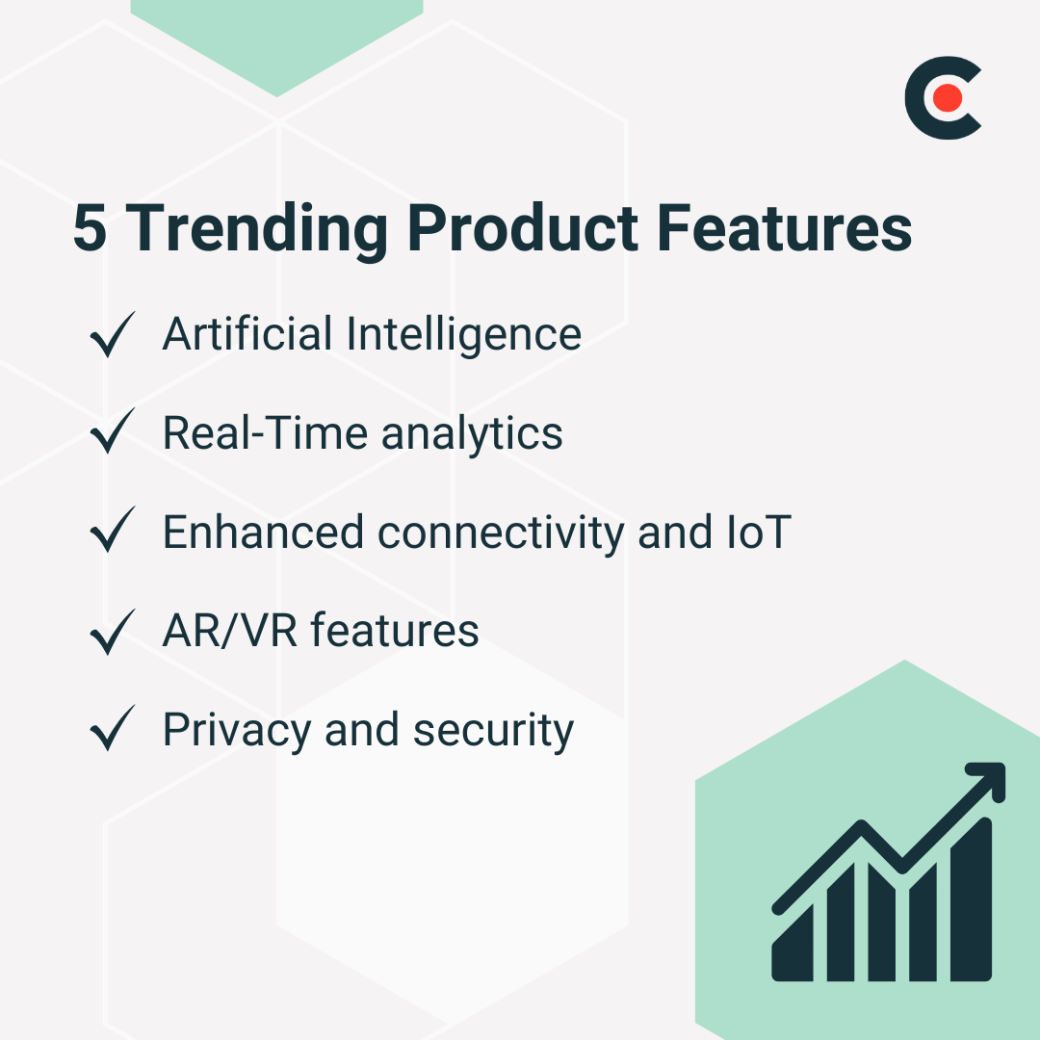
The trending software features of 2025 include AI integration, IoT connectivity, real-time analytics, AR/VR, and enhanced privacy. These trends drive business growth when they're selectively employed to solve genuine problems rather than simply chasing technical novelty.
By strategically matching these software trends to features that meet the real needs of your business and its customers and carefully integrating them into your products, you'll be positioned to move beyond simple marketing appeal to create measurable value.