Lead Quality vs. Lead Quantity: Why B2B Teams Are Rethinking Their Funnel in 2026
Bigger buying committees and tighter budgets are forcing B2B teams to rethink lead quality vs. quantity. Here's how top teams rebalance the tradeoff in 2026.
Updated August 26, 2026

With so many products on the market, getting lost in the shuffle is easy. Standing out takes more than quality — it takes strategy. This post explores how product differentiation can cut through the noise and turn browsers into buyers.
Product differentiation is how a company distinguishes its offering from competitors — through unique features, quality, brand identity, or customer experience — to make it more enticing to a target audience. The classical framework covers three types: vertical (objective differences like price or quality), horizontal (subjective preferences like taste or brand), and mixed (both together). But in 2026, a fourth force is reshaping every category: AI has made most "features" easy to replicate, which means what used to differentiate a product — an AI-powered dashboard, a smart recommendation engine, a chatbot — is now table stakes. What actually differentiates in the AI era is what AI can't fake: real people, real customer stories, and demonstrated brand authenticity.
Every industry is saturated with lookalike products, from lip stains to smartphones to SUVs. Getting lost in the shuffle is easy — and it's about to get harder as AI-generated content further commoditizes both products and marketing. It's not enough to be good. You have to be different in a way that matters. This article covers the three types of product differentiation, what actually differentiates products in the AI era, the techniques that consistently work, and the mistakes to avoid.
Looking for a Digital Marketing agency?
Compare our list of top Digital Marketing companies near you
Product differentiation is how a company distinguishes its offering from competitors to make it more enticing to a target audience. Usually, this is achieved by highlighting the unique features, benefits, or qualities that set the product apart.
Product differentiation gives your audience a reason to choose your product. It affects how your potential customers perceive your product and can even sway their decision in your direction.
How does product differentiation do this?
Product differentiation affects customer perception by:
Product differentiation impacts customer choice by:
Additional Reading: ‘How to Lead a Product Launch: 10 Stages of Launching a Product’
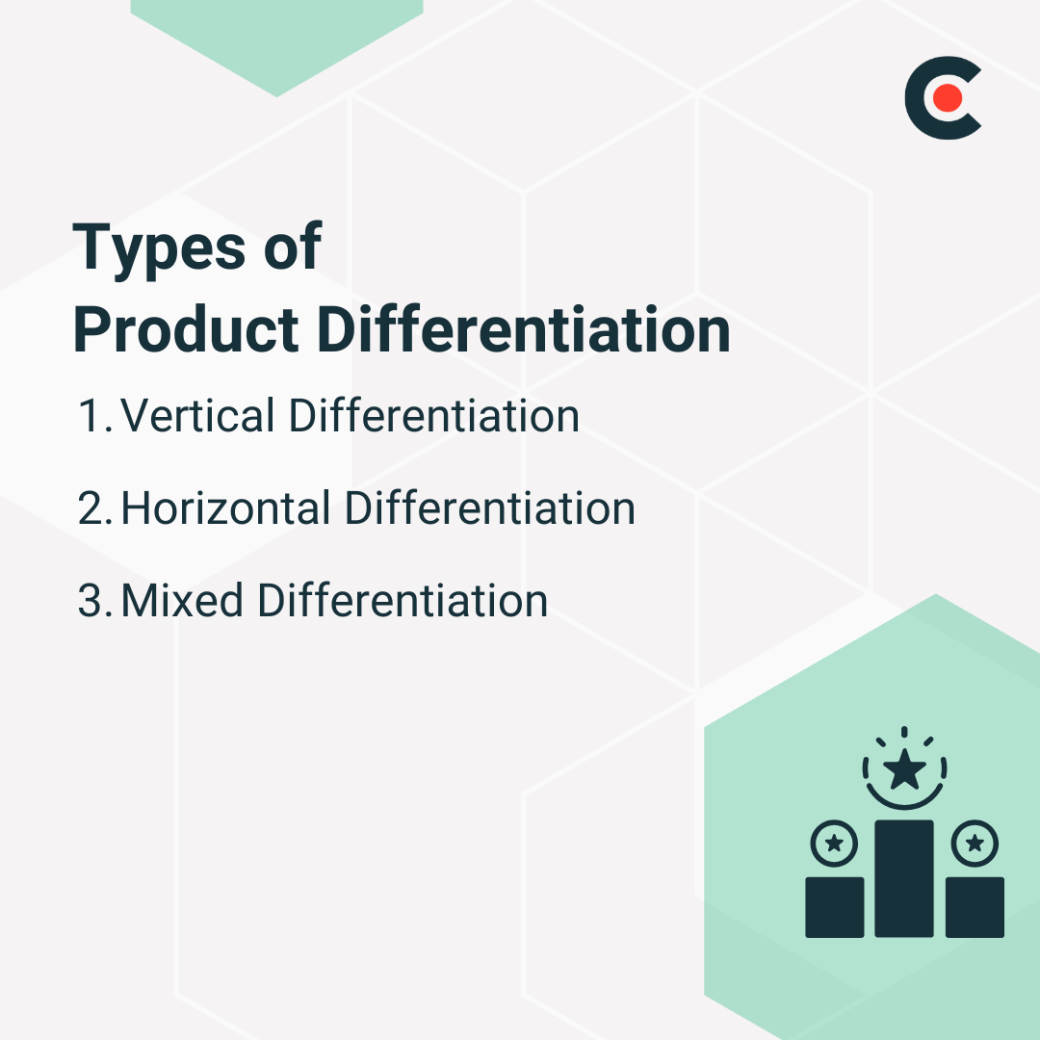
Differentiating products falls into three main categories:
| Type | How buyers decide | When it applies | Example |
| Vertical | Objective ranking (better/worse on a measurable axis) | Categories with clear performance or price difference | Luxury cars vs. economy cars; enterprise SaaS vs free-tier SaaS |
| Horizontal | Subjective preference (like/dislike, taste) | Categories where quality and price are similar | Coca-Cola vs Pepsi; ice cream flavors; graphic design styles |
| Mixed | Both objective and subjective factors weighted together | Most real-world buying decisions | Cars, restaurants, laptops, most SaaS categories |
Depending on the market you provide services in, that will determine the product differentiation category you will fall into.
The classical three-type framework still holds, but 2026 added a modern wrinkle: AI has commoditized many features that used to differentiate products. Every SaaS category now has an "AI-powered" version. Every content platform has AI-generated content options. Every e-commerce brand has AI-driven personalization. What was a differentiator in 2022 became table stakes by 2024 and, in some categories, a negative signal by 2026.
Three shifts to design your differentiation strategy around:
If your product's main claim is "AI-powered," you're saying what your competitors are also saying. The AI capability itself is no longer distinctive — what's distinctive is how you apply it (specific to what customer problem), what data you train it on (proprietary vs. generic), and whether you keep humans visibly in the loop (increasingly a trust signal). Differentiate on the application, the data moat, or the human accountability, not on the AI itself.
As AI raises the floor on production quality and lowers the cost of generic content, the presence of real people — named authors, visible founders, on-camera employees, verified customers — has become one of the strongest differentiation levers. Our June 2026 human branding survey found that 36% cite "seeing real people visibly behind a brand" as the single strongest driver of their loyalty — ahead of price, product quality, or convenience. That's not just a brand insight; it's a product design signal. Products and marketing that make human presence visible outperform those that rely on generic polish, in an AI-saturated market.
The same Clutch survey found that 49% of consumers rank real-customer-story campaigns as the most memorable format of all — outperforming polished, high-production creative. In a market where AI can produce infinite polished content, authentic customer stories become both a differentiator and a durable competitive moat: they're specific, verifiable, and impossible to fabricate without getting caught. Build a customer-story pipeline as part of your differentiation strategy, not as an occasional case study.
Our July 2026 survey of 408 consumers found that 93% of consumers say it matters that a brand's communications feel like they came from a real person, and 55% view a brand less favorably once they can tell AI created the work. That means transparency about AI use — labeling AI-assisted content, keeping human bylines on human-written work, disclosing where automation touches the customer experience — is itself a differentiator in categories saturated with undisclosed AI content. Brands that treat AI disclosure as a brand asset (Dove's public no-AI stance in beauty, for example) turn a compliance question into a competitive advantage.
The practical implication for product teams: don't lead differentiation strategy with your AI stack. Lead with what only you can offer — proprietary data, named people, verified customer outcomes, category-specific expertise — and treat AI as the infrastructure that lets you scale those advantages, not the advantage itself.
Setting your product apart has multiple significant benefits. Here’s a more detailed look at how differentiation can distinguish your product in an oversaturated market:
The advantages of differentiating your product are numerous and substantial.
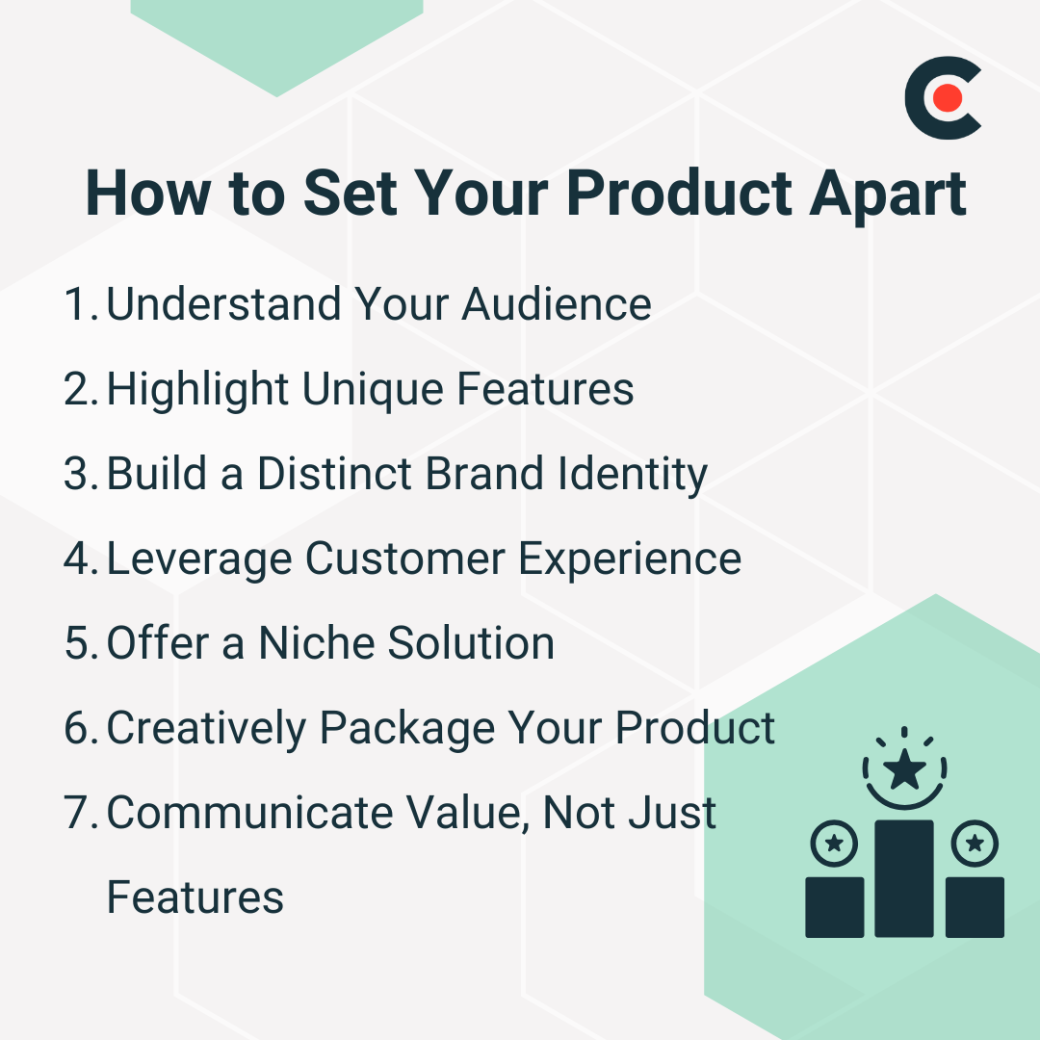
We’ve compiled a selection of techniques you can use to differentiate your product, boost your sales, make your brand recognizable, and capture consumer attention.
Understanding your customers and customizing your marketing to reach them is essential to setting your offering apart. As Andy Groller, President & CEO of Dragon360, points out, “If you get the audience wrong, no amount of launch hype will save you.”

There are several layers to understanding your audience:
Go beyond standard demographics and explore psychographics: lifestyle, values, interests, and purchasing decisions. Develop buyer personas that include your ideal customer’s motivations, pain points, and behavior.
Conduct surveys to collect feedback from your existing customers and potential buyers about their needs, desires, and challenges. Then, research how other companies engage with similar audiences to identify effective techniques.
Social listening is also invaluable. Track online conversations about your company and related topics.
Develop marketing materials that align with your audience’s interests, provide value, and address their concerns. Choose the channels where specific demographics — like new parents, tech-savvy millennials, or retirees — spend their time, and make your ads meaningful to them. Your brand identity should also speak to your customers and set you apart from your competitors.
Consider collaborating with influencers whose following overlaps with your target audience. This could boost your message even further.
Analyze your results by monitoring your campaigns and tracking specific metrics to see what’s working and what’s not. With this knowledge, you can shake up your approach as often as needed. And stay on top of market and industry trends, adapting your methods to maintain product and brand relevance.
To distinguish your product and highlight its unique features, concentrate on communicating its benefits to your customers. Here are a few tips on how best to do this:
Focus on the advantages your product offers customers to differentiate your product and emphasize its unique qualities effectively.
Developing a hardy brand identity is part of product differentiation. Your logo, color palette, typography, and aesthetic should coincide with your product’s distinctive qualities.
Compelling storytelling is also crucial. Connect emotionally with consumers by sharing your brand’s story, including the origin and purpose of your product. Customer testimonials can also be highly effective; showcasing real users’ opinions gives customers a reason to trust you and provides powerful social proof.
Additional Reading: ‘How to Create a Product Launch Marketing Plan’
Customer experience starts long before the first purchase. It begins with how well your product or service answers your audience’s actual needs.
According to Chris Cozzolino, CEO & Co-Founder of Uptown Creation, “The biggest mistake companies make when marketing a new product is focusing too much on features rather than addressing the specific problems their customers face.”
Even the coolest features will fall flat if customers don’t feel seen or understood. Focusing on features alone misses the mark. Customers will more likely stick around — and spread the word — when they feel like the product was designed with them in mind.
You’ve already defined your audience and learned what they need and want. It's time to use that knowledge to create problem-solving experiences at every stage: clear messaging, helpful onboarding, and support that doesn’t make them want to scream into the void. Don't just demonstrate what your product can do; explain how it fits into their lives and solves a real problem.
Focusing on a small, distinct market segment with a specialized product or service can bolster your customer relationships and increase their loyalty. It also allows you to become an expert in your chosen area, which increases customers' trust in you.
You'll likely encounter less competition with a targeted focus, specialized offering, and smaller audience. Niche markets often have fewer competitors, so it’s easier to differentiate your brand and its offerings. Your profits might also increase because you can set premium prices for specialized/rare products and the value they offer.
First impressions matter. Creative packaging means more than just the physical materials containing your product. The combination of attractiveness, messaging, and emotional pull makes someone stop scrolling or shelf-scanning long enough to consider what you’re offering.
This can mean bold design, unusual materials, or one-of-a-kind unboxing for physical items. For services, it’s about how you present the offer. Is it suave and professional? Friendly and fun? Do the visuals and tone match both your brand’s image and what the customer wants to feel?
And packaging doesn’t stop at looks. How you introduce your product across social media, marketing materials, your website, and customer support is part of the "total package."
Christopher Savage, President and founder of Savage Global Marketing, says, "We focus on authentic messaging and multi-channel outreach to capture attention right from the start."
A cohesive, authentic feel across every touchpoint makes your offer stand out long before someone clicks “buy.”
Accentuate your product’s value, not just its features! Explain how your product solves a problem, improves a situation, or enhances the user’s life.
Here’s where the adage “show, don’t tell” comes into play: use visuals, demos, and videos to demonstrate the product’s value in action. Visuals can make or break a product’s appeal and help spotlight its uniqueness.
Don’t stumble when differentiating your product. Steer clear of:
Working collaboratively with different teammates will help your company avoid mistakes in product differentiation.
Product differentiation can mean the difference between prosperity and obsolescence. When you know your audience, call attention to what makes your offering truly different, and build a recognizable brand, you give people a reason to pay attention. Over the past few years, the "truly different" bar has been raised — AI has commoditized most feature-based differentiation, and the durable moats are proprietary data, named people, verified customer stories, and disclosed operational transparency.
Make every choice count. In an oversaturated market, the boldest move is being unmistakably yourself. Even a one-person operation can make an indelible mark.
If you’re ready to stand out for the right reasons, don’t wait to get intentional about your branding. Start with the basics, focusing on authenticity and your UVP.
Product differentiation is how a company distinguishes its offering from competitors to make it more enticing to a target audience. It's the set of unique features, benefits, brand qualities, and customer experiences that give buyers a reason to choose your product instead of a competitor's. Effective differentiation increases perceived value, reduces price competition, builds customer loyalty, and creates a defensible market position. In 2026, differentiation matters more than ever because AI has commoditized many features that used to distinguish products — meaning what actually differentiates now is often what AI can't fake: real people behind the brand, verifiable customer stories, and proprietary data or expertise.
The three classical types are vertical, horizontal, and mixed differentiation. Vertical differentiation is based on objective, measurable factors like price or quality — luxury cars vs. economy cars, or name-brand vs. generic products. Horizontal differentiation is based on subjective preferences like taste or brand when products are similar in quality and price — Coca-Cola vs. Pepsi, or different ice cream flavors. Mixed differentiation combines both — most real-world buying decisions (cars, restaurants, laptops, most SaaS categories) involve buyers weighing objective performance and subjective preference together. Which type applies to your product depends on your category and how buyers actually compare options in it.
AI has changed product differentiation in three ways. First, "AI-powered" is no longer a differentiator on its own — most competitors in most categories now offer AI-enabled versions of their products, making the AI capability itself table stakes rather than a distinguishing feature. Second, real people have become one of the strongest differentiation levers: Clutch's June 2026 survey of 408 consumers found 36% cite "real people visibly behind a brand" as the strongest single driver of their loyalty, and 49% rank real-customer stories as the most memorable campaign format. Third, AI disclosure is itself a differentiation signal — Clutch's July 2026 survey found 93% of consumers say it matters that brand communications feel human, and 55% view a brand less favorably once they detect AI in its work. The practical implication: don't lead with your AI stack. Differentiate on what only you can offer, and treat AI as infrastructure that scales those advantages.