The Real Cost of Your MVP in 2027
AI made code cheap, but not software that holds up. See how MVP cost drivers have shifted and why human validation and taste are now what you’re really...
Updated April 24, 2026

From global brands to small businesses, new products are fundamental to long-term success. Unfortunately, new products fail more often than they succeed. The ones that manage to make a big market impact are powered by product launches that get the word out, generate excitement, and prime consumers to make a purchase. Here's how you can lead a product launch that gets results with insights from experts in their development fields.
Launching new products is critically important for the growth of any business. It keeps current customers engaged with your brand and excited about what your business has to offer. It also helps you expand your market reach and find new consumers who become customers. But it isn't as easy as building and making a new product available. Behind every successful product is a successful product launch.
Ilgin Kezer, Head of Business Development at Cool Digital Solutions, believes businesses introduce new services and goods to differentiate themselves in crowded markets.
Looking for a Software Development agency?
Compare our list of top Software Development companies near you
“Businesses that provide innovative solutions not only enhance their brand, but also promote client loyalty as a result of the brand’s dedication to consumer demands and innovations,” said Kezer.
Kezer follows up by saying that regular product development is essential for any business looking to stay relevant.
This article outlines everything you should know about the product launch process based on commentary from development leaders. We'll discuss common mistakes that can lead to failure, the importance of having a launch strategy, and how to lead your team through the early stages to launch day and beyond.
Looking for expert developers for your new product? Explore our top companies in:
A product launch strategy is a comprehensive plan that guides you through every stage of the product launch process. It's an essential building block of bringing a new product to market because it unifies the many components involved, from design and promotion to the teams and individuals from every department. When you have a solid launch strategy, you ensure that all your efforts are coordinated, your resources are optimally distributed, and everyone involved is working to fulfill the same vision.
At MindSea, Paul Wareham is a product manager who works closely with clients to optimize every aspect of a launch plan.
“We collaborate closely with our clients to configure a personalized launch plan, leveraging our extensive experience in successfully bringing software products to market,” says Wareham. “This involves aligning the product development process with the client’s objectives, market demands, and user needs to ensure a cohesive and effective launch.”
While the specifics of a product launch strategy vary from product to product and brand to brand, all effective strategies include the same basic elements:
To summarize, it's important to have a strategy to clarify each launch stage so that the process is streamlined, well-coordinated, and successful. Doing so will also help you avoid common mistakes that often lead to failed launches.
The grim reality about the roughly 30,000 new products that hit the market every year is that most of them are doomed for failure — about 95% of them, to be precise. From small businesses to the biggest brands, drumming up consumer interest in new products is a significant challenge.
Let's take a look at the biggest reasons new products have such a hard time making an impact:
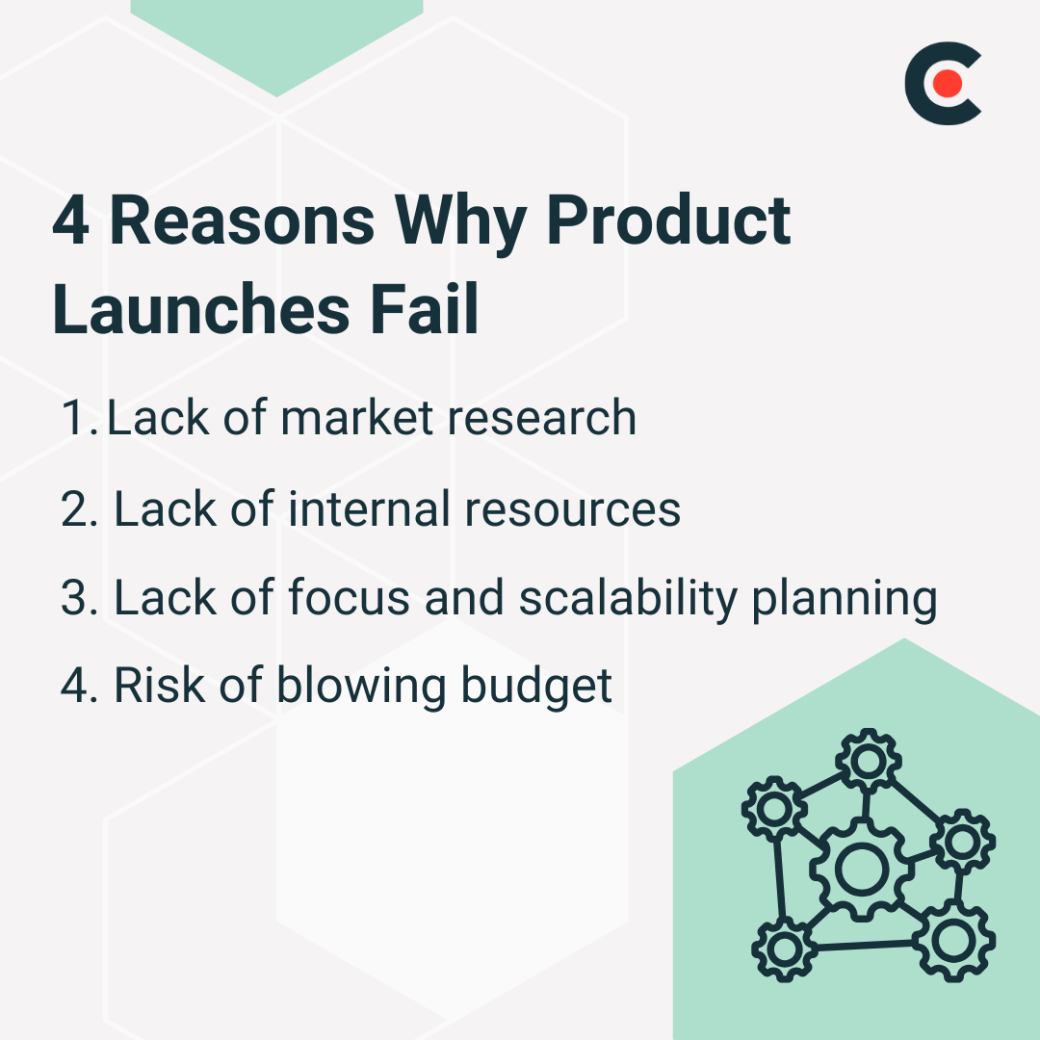
Researching your target market is a crucial step in the product launch process. Under-investing in market research — or worse, skipping it altogether — is a disastrous move and a big reason so many products come and go without notice.
Why is market research so important to a product launch? It reveals important insights into your consumers, the market, and your competition, allowing you to determine the best positioning for your product.
“Inadequate market research is a primary cause of launch failures,” says Kezer. “The product might not satisfy real demand if businesses misinterpret their target market or fail to recognize important trends.”
Timing is everything when it comes to launching a product.
A product launch is a complex endeavor involving many people from several teams and departments across a company, including sales, customer support, product design, marketing, management, and more. The product launch process's multifaceted nature is a positive, as it signals that the many crucial aspects of releasing a new product have been considered.
However, the product launch process often goes awry when there's a lack of sufficient organization between those teams, especially when communication between teams and individuals isn't well coordinated.
Andrew Volgin, Business Development Manager at Magora, agrees that a lack of team communication can prevent real product success.
“Teams without a clear understanding of their Unique Value Proposition (UVP) can lose focus when overwhelmed by user feedback, leading to unnecessary features and wasted resources,” said Volgin.
Disorganized communication can lead to unclear goals, inconsistent messaging, and muddled priorities, which can tank your product launch. It's important to have clear and effective communication channels among and between teams and individuals and with protocols for how those channels should be used.
There are so many tasks, factors, and aspects to consider in the product launch process that companies risk losing focus by throwing too many irons into the fire so that none of them get hot enough. Important updates quickly become needless distractions if there's too much volume, which can lessen the impact of a launch.
Not every team member needs to be looped in on every minor detail or change that occurs.
A lack of focus can also result in important factors getting overlooked. Scalability is often one such factor. Poor scalability planning can threaten the success of a launch when companies find themselves unable to meet rising consumer demand, resulting in poor customer experiences, performance dysfunction, and more.
Resource allocation and budget management are integral to the success of any product launch. From product development to marketing and distribution, blown budgets can spell disaster for otherwise promising products, leading to fulfillment delays, quality issues, and unsatisfactory customer experiences.
The product launch process begins before you've even finalized the product design and continues well after the final product hits the market. Yes, it's important to generate enthusiasm with promotional activities and events that get the word out, but there's a lot to take care of before and after introducing a new product to consumers:
Market research is crucial for successfully introducing a new product to the public. The benefits include:
Its insights should inform every aspect of your product launch plan, from product design to marketing and pricing.
User journey refers to the experience your customers have when using your product and interacting with your brand. Understanding that journey and how product design, marketing, and other factors influence that experience is necessary for planning a successful product launch. One way to gain that understanding is to create user journey maps.
User journey maps visually represent the user experience, illustrating each step of every interaction. Increasingly, user journeys are multichannel, encompassing in-person and digital interactions, such as when a customer uses your company website or mobile app. Journey maps are beneficial because they:
Mapping the user journey is an important step in designing a product that appeals to consumers.
Product wireframes provide a comprehensive look at how your product works. Essentially, wireframes visually represent the structure and flow of a product. They can be drawn by hand or created using software at various points during the product launch process, including before and after initial design and prototyping.
Wireframes are instrumental in building products that meet the needs of consumers, provide pleasurable user experiences, and align with a company's goals. For teams and stakeholders, they help clarify abstract ideas and facilitate feedback that results in improved products. They're also useful for preserving resources and optimizing time, as they can reveal design flaws, inconsistencies, and other issues before product designs are finalized.
Usability is the backbone of product design. It doesn't matter how sterling your brand's reputation is or how flashy a new product looks; if it isn't usable — or using it isn't enjoyable — it isn't going to be successful.
There are many types of usability tests, including surveys, focus groups, lab testing, and many more. In conjunction with wireframing, journey mapping, and market research, testing saves time and money and enables companies to create user-centric products that resonate with consumers.
After the user experience has been mapped and designs have been wireframed and tested, you'll find yourself with data that reveals important insights about your product and suggests how it will perform once it hits the market. That data will include areas where improvements can be made and specific steps to create them. At this stage of the product launch process, it's time to put those insights to use.
Be sure to use the available information to revisit and rethink aspects of your product that usability testing shows consumers didn't respond to. Address any issues that your journey mapping efforts revealed to be problematic or dissatisfying. That sort of due diligence will only help you design the best possible version of your product.
Remember earlier when we said that not planning for growth is a big reason product launches fail? This is where you mitigate against that risk by creating strategies for managing scalability when your product starts selling. Successful scalability planning requires:
By planning for scalability, you ensure your brand can keep up with demand after launching your product.
Before taking your product to market, you need a marketing plan to ensure you reach your target audience and get them excited about your product.
“We work closely with our clients’ marketing teams or agencies to ensure that the marketing strategy is executed in sync with the product launch,” says Wareham. “This alignment ensures that the product not only meets user needs but also reaches the target audience effectively, maximizing the impact of the launch.”
To begin, review your market research, which will tell you all you need to know about developing an effective marketing plan, including:
As you go forward, track marketing performance and update your plans in response to scaling and as new technologies and techniques become available.
Additional Reading: "How to Create a Product Launch Marketing Plan"
At this point, you've perfected your product design based on insights from market research, testing, and journey mapping. You've developed a marketing strategy that's sure to stoke audience excitement, and you have a plan in place for keeping up with demand after release. Now, it's time for the official product launch.
The good news is that most of the hard work is already behind you. There are just a few things to keep in mind on launch day:
Most importantly, launch day is a time for celebration.
Once your product is available, there's more testing you can undertake to identify issues that could interfere with sales and implement strategies to address them. Some of the most effective tests for launch day and the days immediately following include:
Continuing to test your product after launch is key to meeting your customers' needs.
After your product is officially released, the product launch process continues. To ensure ongoing success, you should have a continuous improvement plan in place that involves:
Remember that most consumers buy the same 150 or so products repeatedly, so if you want them to try something new, you need to offer them what they aren't already getting. That means you may need to continue iterating on your product design even after its official release.
The duration of the product launch process varies depending on the product, brand, and other factors, such as a given marketing strategy and market dynamics. However, a good rule of thumb is to plan for 3–9 months.
The product launch process is long and complex, from the original idea and design that brings a new product to life to the promotional tactics and logistics that bring it into consumers' homes.
“Companies launch new products to address unmet customer needs, drive business growth, leverage emerging technologies, expand into new markets or verticals, and enhance operational efficiency,” said Volgin.
It involves deep research to understand the market and target audience, progresses through product testing and planning your marketing strategy, and continues even after product release. It takes planning, coordination, and hard work, but when it comes to success, it's a non-negotiable.