Lead Quality vs. Lead Quantity: Why B2B Teams Are Rethinking Their Funnel in 2026
Bigger buying committees and tighter budgets are forcing B2B teams to rethink lead quality vs. quantity. Here's how top teams rebalance the tradeoff in 2026.
Updated June 17, 2026

While the domestic market may suffice for some small business, there’s opportunity to expand internationally and improve growth potential. This article reviews the most important challenges marketers encounter when scaling strategies for international brands.
Marketing to a global audience means more than translating your existing campaigns — it means keeping a consistent brand while adapting your product, message, channels, and compliance to each market you enter.
Going international can unlock economies of scale, larger audiences, and real brand value, but it carries equally real risks: a product that thrives in one country can fail in another, and a tone-deaf campaign can do lasting damage.
Looking for a Digital Marketing agency?
Compare our list of top Digital Marketing companies near you
This guide walks through what to consider before you expand: choosing the right markets, product-market fit, cultural adaptation, distribution, and the legal and privacy rules that differ from country to country.
Deciding which market to enter is tough, but data makes it easier. Start with your own analytics: in Google Analytics (GA4), if a meaningful share of your traffic already comes from a country you don't sell or market to, that may be an untapped market. The vast majority of the world doesn't speak English, so significant traffic from other regions is a strong signal to consider localizing for those visitors.
Two tools are invaluable for "testing the waters":
Google Trends tracks interest via searches in a country over a given time period. The tool also displays trend information on its dashboard.
As the below screenshot suggests, Google Trends is a fantastic resource to gauge general interest via search terms from around the world.
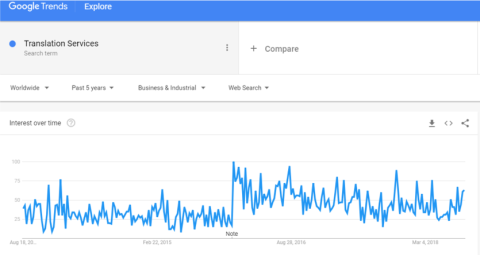
If Google Trends shows a high volume of search terms across a targeted country, this may indicate demand for the product or service you’re selling and thus, an opportunity to adjust your strategy.
Google Ads is great for testing whether a product would sell in another country. Instead of an expensive full rollout, run a small campaign with low daily budgets to gauge results, then use GA4 to review performance. Before launch, you can direct users to a promotional offer or an email sign-up to build a list of potential customers for later.
One modern addition: don't assume your customers search the way — or where — your home market does. Winning a new market often means multilingual SEO — researching the actual keywords locals use (a direct translation of your top keyword may be nobody's search term), and implementing hreflang tags so search engines serve the right language version. And in some markets, Google isn't the destination at all: plan for Baidu in China, Yandex in Russia, and Naver in South Korea, plus region-specific platforms like WeChat, LINE, or WhatsApp where your audience actually spends time.
Product-market fit means aligning your product or service to the right audience. It seems obvious, but a product that works in one country can fail in another — dietary restrictions and preferences, for instance, can make a staple product a non-starter elsewhere. The goal is to isolate the best target market, understand its needs, and deliver a solution that genuinely fits.
Define what a good target market looks like: easy to enter, with a significant potential user base and room to grow. Enter markets where people actually need what you offer — it makes your strategy far more cost-effective. A few techniques to understand a potential customer base:
Online surveys reveal what your current customers want, and that feedback can guide products for a new market. Tools like Mailchimp make surveys easy to launch; modern survey and analytics tools (increasingly AI-assisted) can also help you spot patterns across responses faster.
If your brand is spreading to an international market, consider engaging online focus groups to generate firsthand data around your customers’ preferences.
This is a valuable marketing investment because focus groups give you up-to-date insight into what your audience values.
Culture can't be an afterthought. Both the broad macro and microcultures of a market shape how your message lands.
Macro culture is the overall culture of a country — language, traditions, social structures. Language is often the biggest hurdle: you'll need to communicate in the local language, but true localization goes further than swapping words. Transcreation adapts the whole message — slogans, imagery, color, humor, and even the user experience — so it feels native rather than imported. A tagline that's clever in English can be meaningless or offensive once translated literally.
On the perennial "should I just use machine translation?" question: AI and machine translation (Google Translate, DeepL, and others) have improved dramatically and are genuinely useful for understanding and for first drafts at scale. But for marketing copy — where nuance, tone, and cultural fit drive results — you still want a fluent human or a professional translation and localization agency to review and transcreate. Use AI to move faster, not to skip the cultural judgment.
Microculture is the subculture your audience belongs to, and understanding it is key to a successful global strategy. A classic cautionary tale is Starbucks in Australia: it expanded too aggressively and didn't adapt to a sophisticated local coffee culture that prized high-quality café coffee, and ended up closing most of its Australian stores. Research both the macro and microcultures of a market before you enter it.
Decide how you'll roll out and distribute marketing in each market. There are two broad approaches:
An in-market team localizes your materials and chooses the right channels for the area — for example, leaning on one social platform in one country and a different one elsewhere. Larger organizations often dedicate a team to managing these rollouts. Even if you don't have a full local team, building relationships with local partners, creators, or contractors gives you the native insight that prevents missteps.
Here, marketing is managed from the company's home country — workable for newer or smaller organizations. Channels that can be run remotely include social media management, PPC (e.g., Google Ads), and video/YouTube rollouts.
Whichever you choose, match the channel mix to the market: the platforms that dominate at home may be secondary (or absent) abroad, so build your distribution around where each audience actually is.
What's standard marketing at home can be restricted — or illegal — abroad, so build compliance into your plan from the start. A few areas to research for every market:
When in doubt, get local legal guidance before launching. Compliance isn't just risk avoidance; respecting local norms and laws is part of earning trust in a new market.
New-market entry brings both opportunity and challenge, and marketing plays a role at every stage. Global strategies are notoriously difficult and can take years to become profitable — and the problems multiply if you don't speak to your audience in the right way.
Once you've identified your target markets, confirmed product-market fit, planned for cultural localization, chosen your distribution and channels, and accounted for local legal and privacy rules, you're ready to build a strategy that travels: one consistent brand, adapted thoughtfully for each market it enters.
Global marketing is planning, producing, placing, and promoting a brand across multiple countries — treating the world as a connected market while adapting messaging, products, and channels to local preferences and rules.
Global marketing emphasizes a consistent brand with light local adjustments and universal appeal; international marketing develops more distinct strategies tailored to each individual country. In practice, most successful programs blend the two.
No. Translation converts words; localization (and transcreation) adapts the whole experience — slogans, imagery, color, humor, and UX — so it feels native. AI translation is useful for speed and scale, but marketing copy still needs human cultural judgment.
Assuming what works at home will work everywhere — expanding too fast without adapting the product, message, or channels to local culture, and overlooking legal and data-privacy differences. Starbucks' Australian struggles are a classic example.
Anthony Toronto is a digital analyst at Interpreters and Translators Inc., a language solutions company that helps companies knock out language barriers. When not helping companies grow, Anthony enjoys hiking, sushi, and staring at computer screens.
See full profile