Micro SaaS: How Solo Developers Build Profitable Products
Solo developers now make up 35% of startups. Discover how micro SaaS lets individuals build and launch profitable products without a big team.
Updated August 6, 2026

Is AI-generated code enough, or is it time to bring in real developers? These seven thresholds show you the exact moment when a vibecoded build becomes a liability, before it costs you.
If you spent time around founders in 2026, you probably heard the same question come up repeatedly: vibecode it yourself in Cursor, Replit Agent, or Lovable, or pay a development team for the ‘real’ thing? Too often, the discussion turns into an either-or debate, as if one option is the smarter choice. In reality, both have their place. The real decision isn’t about which approach is better, but about when each one makes the most sense. And that’s where many founders get it wrong.
Ask yourself: “Where do I draw the line?” As a founder, you need to determine the exact point where a particular product isn’t safe to vibe-code. That line is determined depending on what you’re building. Our team has shipped and rescued software long enough to notice a pattern: it's the same seven checkpoints, over and over, for almost everyone. These seven checkpoints don't require picking a side. You need to know what it'll cost you if you cross one without noticing.
Looking for a Software Development agency?
Compare our list of top Software Development companies near you
Among ten founders who were asked whether AI-generated code is “good enough,” you’ll get ten confident yet contradictory answers. This question has no fixed answer. The right question to ask is: what is it good for, and for how long?
According to the 2025 Stack Overflow Developer Survey, 84% of developers use or plan to use AI tools. Down from 40% last year, only 29% can vouch for the output. As per Veracode’s 2025 GenAI Code Security Report, 45% of 100 code samples written by AI models failed standard security checks. This is not a tooling problem. The issue here is that these tools have gotten faster at producing code that looks finished but doesn't actually work.
Instead of asking “AI or agency,” ask which among the seven specific thresholds your product is about to cross. We’ve found these seven cover nearly all cases where a vibe-coded build turns into a liability.
The first line is simple: does it need to work correctly every single time and not just in the demo? A YC-backed SaaS company found out the hard way. The AI-built MVP looked complete, but the “Stripe integration” was nothing but a button, and its “user accounts”, a private database, can be accessed by everyone. It looked done, but it wasn’t “functional.” The difference between looks-finished and is-finished is exactly what Stack Overflow survey respondents flagged as their top frustrations with AI code. As cited by 66% of developers, these are solutions that are “almost right, but not quite.” A prototype is good enough if nobody’s livelihood depends on it yet; if it does, “almost working” isn’t good enough.
These are two different engineering problems that require different solutions: a checkout button that looks like it just works in a demo vs a checkout system that actually handles payments. Once money is involved in a project, the work changes. Refunds, failed charges, partial payouts, and reconciliation are all the unglamorous stuff that AI tools skip unless someone asks for it in a prompt.
This line gets crossed when the app starts withholding information a customer cares about keeping private. The AI-generated code is focused on “does the demo look like it works” and not “who’s allowed to see what.” The unglamorous logic that gets skipped is authentication and permission checks. These get skipped or built halfway unless someone specifically asks for them and double-checks that they were actually done. That’s not a big deal in a prototype with a few test users. But once the customer’s real information is in there and a breach exposes the gap, the founder is explaining it to customers instead of fixing it quietly.
The fourth line is crossed as soon as an AI shortcut becomes a compliance problem rather than a coding problem. Frameworks like SOC 2, HIPAA, and GDPR are not concerned with whether the product looks finished. Instead, they require organizations to prove it on request. AI tooling is good at creating artifacts that appear to be evidence, such as logs, access rules, and policies. The issue is that it is not reliable in guaranteeing that such paperwork is as true as its claims. Risking a bug is one thing if a founder relies on an AI-generated shortcut, but a failed audit months after the code was written is a whole ordeal.
The fifth line gets crossed when the app has more users than it was built for. A spike in users can’t break a vibe-coded project, but the unchecked feature on the last one can. More often, it is the quick fixes and unchecked additions that accumulate over time. Fast in month one, exhausting by month six. Growth doesn’t create those problems; it reveals them.
It's when more than one person needs to work on the code, especially once the original developer is gone, that the sixth line gets crossed. Every new contributor needs to learn what the previous developer already knows. The gap widens when there was never any real plan written down, only a quick prompt and the AI’s suggestion. Vibecoded projects get exposed here since the “architecture” often exists only in a chat history. If a second engineer is onboarded six months in, they will get handed a code with no map and no author willing to explain how it works.
The seventh line is the one that actually kills most vibecoded products, and it rarely shows up until well after launch. Code that works when it’s brand new isn’t the same as code that’s easy to update over a year later. A survey by Stack Overflow found that 45% of developers say fixing bugs in AI-written code takes longer than fixing bugs in code written by a person. That extra time and difficulty compound every time you add a new feature onto code that wasn’t built to grow. The cost doesn’t show up as a single bad day. Shipping gradually gets slower, and founders usually blame their team for it before realizing the real problem is the code itself.
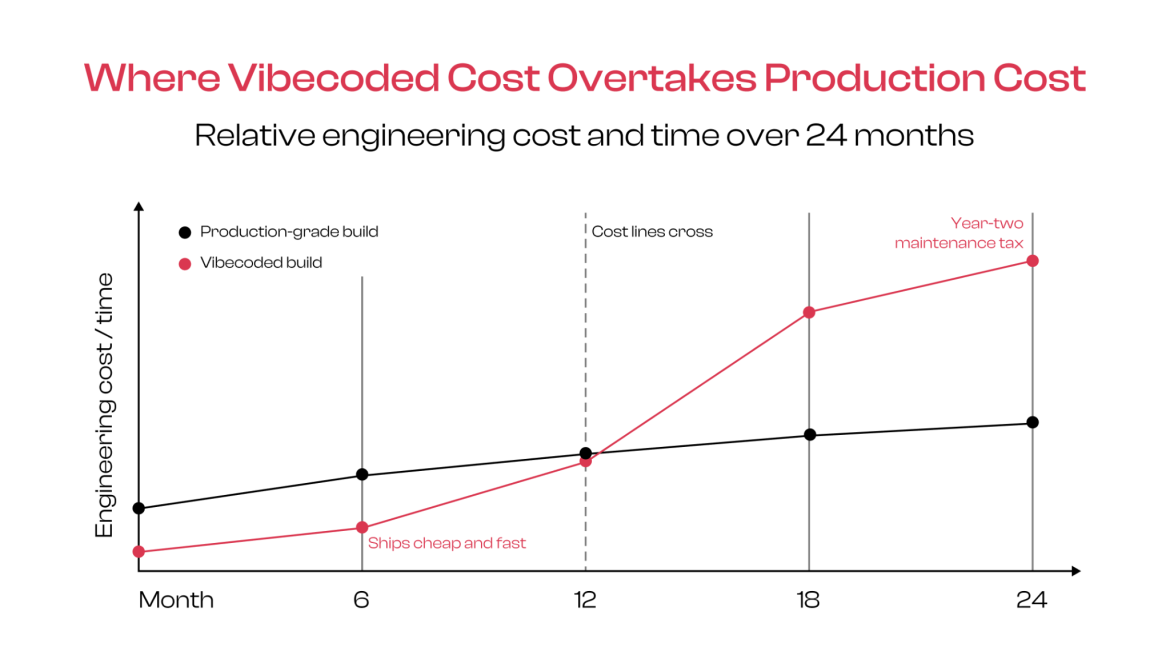
The real cost of a vibe-coded project is illustrated above. In the first couple of months, a vibe-coded build looks cheaper. Then, feature requests start hitting code that wasn’t built to handle change. Each new fix starts taking longer than the last.
Just as when the founder starts feeling proud of how fast they shipped, the costs start climbing. A production build costs more upfront, but pays back later. This is the trade-off that people leave out when they claim one approach is always the right choice.
Vibecoding is not always the issue; it is the timing of using it. In 2026, founders who build the fastest aren’t the ones who go full-on AI or work with an agency. They are the ones who try vibe-prototyping first to find product-market fit, then bring in real developers right as one of the seven lines is about to be crossed, not after something is broken.
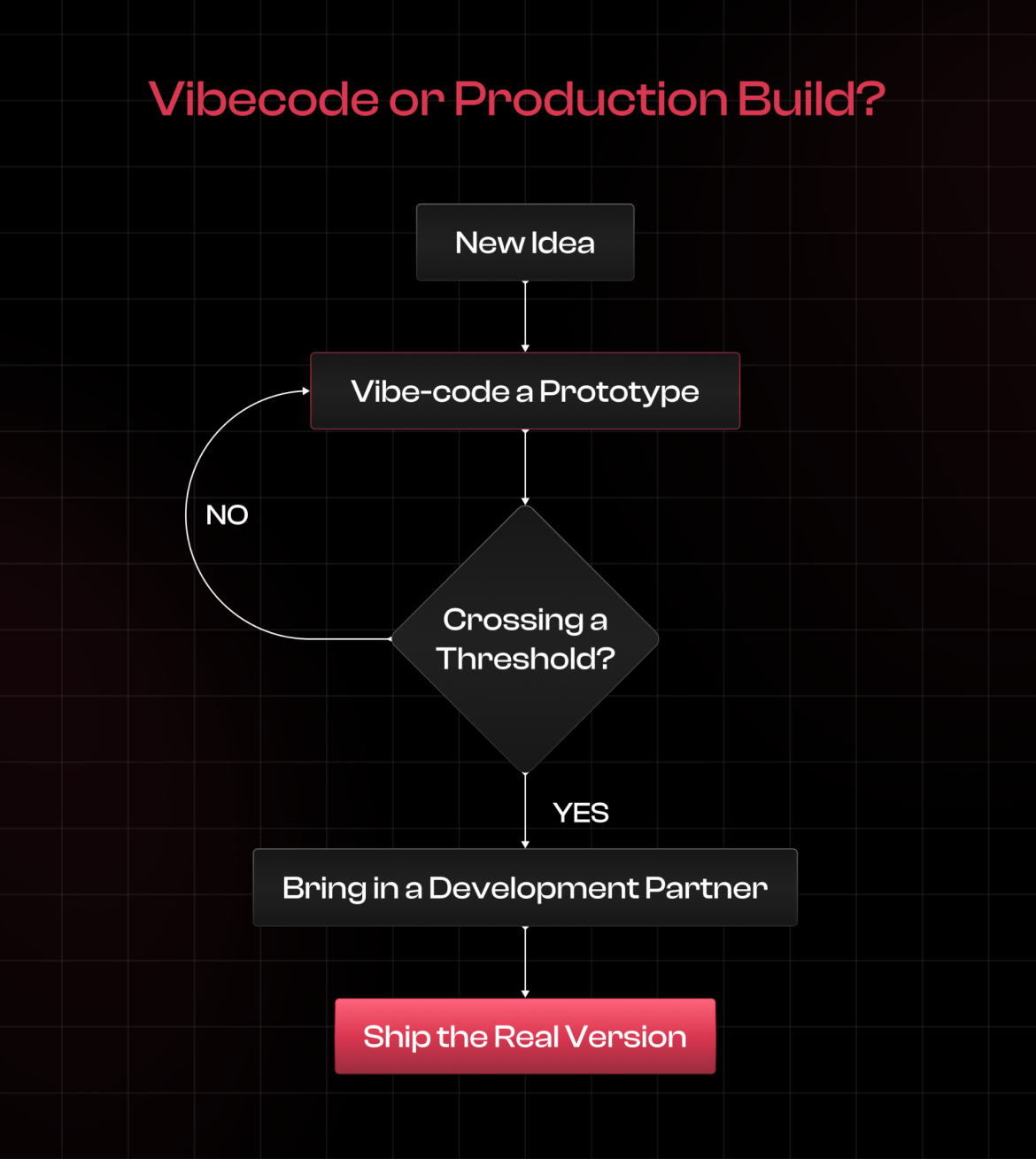
The YC rescue case is a useful illustration of what this handoff looks like when it’s done on purpose rather than as an emergency fix. An agency had quoted the founder about $150,000 and four to six months to build it right away. A focused rebuild, instead, cost about $40,000 and took six weeks because the developers weren’t starting from scratch. They already had a proven idea, knew exactly what was missing, and could scope the work around those gaps instead of guessing. That’s the real value of vibecoding done right: it’s a fast, cheap way to prove an idea is worth investing in properly. But it’s not a replacement for real development once people are actually depending on the product. And bringing real developers at that point isn’t “fixing a mistake.” It’s simply the second half of a job that was always meant to have two parts.
In every founder Slack channel and pitch deck through 2026, the “AI vs agency” framing will always surface. The reality is that vibecoding is genuinely great for building fast and testing ideas. The cons of this approach lie in its weak spots: trust, data, compliance, and long-term maintenance. Of all those, the founders tend to overlook compliance and team continuity. These two stay hidden until an auditor, an investor, or a resignation forces the question. By then, the decisions that caused the problem were already made.
Out of all seven lines, it is vital to know which one you’re closest to crossing more than which tool you’re using to build. It tells you these three important things: what to build now, what to keep an eye on next, and when to bring in help. In retrospect, “looks-finished” and “is-finished” are two sides of the same coin that define your second year instead of your first.