Micro SaaS: How Solo Developers Build Profitable Products
Solo developers now make up 35% of startups. Discover how micro SaaS lets individuals build and launch profitable products without a big team.
Updated September 18, 2026

When hiring a Salesforce developer, it is no longer enough to confirm a candidate’s knowledge of Apex or Lightning Web Components. You must also understand how they approach decision-making on the platform. A good hiring process will determine whether the person can choose between configuration and code, work within security and integration constraints, and develop solutions that remain sustainable after deployment.
When hiring a Salesforce developer, things can go wrong long before an interview is conducted. This is rarely due to a lack of technical terms in a job description, but rather to the company's failure to specify the Salesforce area for which it seeks an expert. Declarative automation, Apex, Lightning Web Components, integration, data modeling, security, industry-specific offerings, and AI functionalities can all be part of a Salesforce project. Salesforce certifies individuals in various roles, such as administrators, developers, architects, consultants, and designers, among other professionals, rather than certifying generic Salesforce professionals.
The message here for recruiters is that the right person for the job need not have the most Salesforce technologies under their belt, but rather experience that matches the decisions to be made.
Looking for a Software Development agency?
Compare our list of top Software Development companies near you
Administrator, developer, architect, and consultant roles overlap, but they solve different problems. The administrator will have to configure the platform, manage access, and enhance processes and automation. A developer is necessary when requirements go beyond the scope of standard configuration options. The domain of architecture operates at a much higher system level, where integration, data, security, scalability, and platform design itself become significant factors. A consultant is closer to discovery; they transform a business problem into requirements and determine how to solve it.
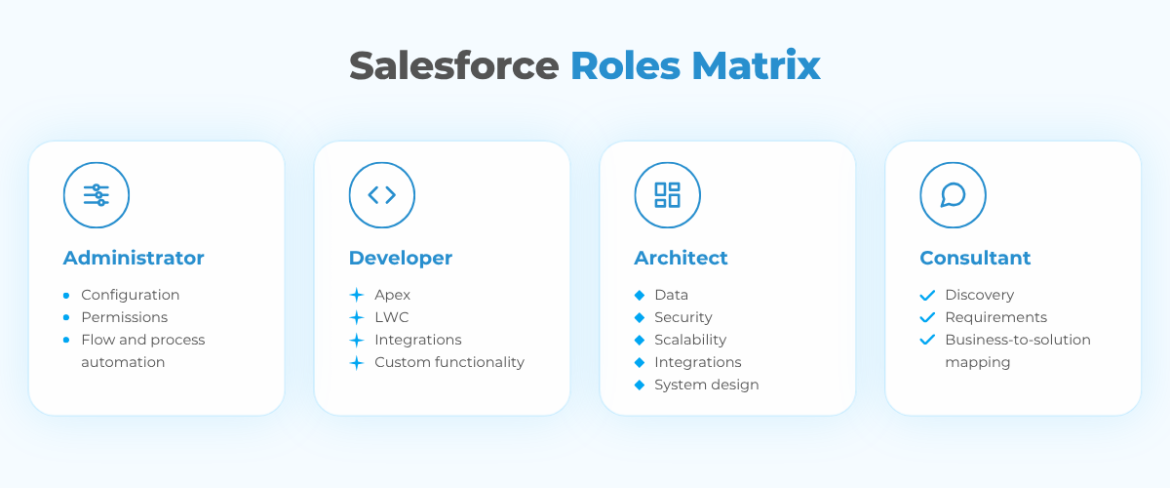
In a small team, these roles become even less defined. A developer may perform the architect’s job, and an experienced administrator can build automation. The problem is not the overlap, but planning a role that expects one person to do all Salesforce work equally well. Cloud and product experience require the same attention.
Experience with Sales Cloud cannot simply be equated to that of Marketing Cloud, Commerce Cloud, sophisticated Experience Cloud, or even Agentforce. It becomes imperative, then, to ask not “How many years of experience does this candidate have in Salesforce?” but “How relevant is the candidate’s past experience to the realities of our situation?”
Experience in years is a poor replacement for a clearly defined scope of work. Two positions that ask for 5 years of Salesforce development experience could require entirely different skill sets. One position might focus on Experience Cloud with integration capabilities, while another could have completely different technical requirements. The same resume can be highly relevant to one and poorly matched to the other.
A better job description will articulate what needs to change three to six months after hiring. This job description will identify which Salesforce solutions will be used, how much of the expected work will be declarative versus programmatic, which technical decisions the new hire can make independently, and which architectural decisions require approval. It will also avoid one major hiring distortion: converting any desirable skill into a required skill. In a custom app development environment, Apex and LWC might be very important but far less critical when the bulk of the work involves Flow and configuration.
Salesforce Well-Architected guidelines provide a very similar differentiation in terms of the system. Good architecture is not just about having a lot of customized functionality; the design complexity and the choice between standardized and customized solutions are also important considerations. The hiring criteria should assess the candidate’s judgment capabilities rather than reward customization skills.
Salesforce certifications are good signals for recruitment purposes, especially when the HR team lacks sufficient experience with the platform. They show that the candidate has been exposed to a specific set of knowledge about the platform, which is why Salesforce has different certification paths.
They don’t prove that a person can diagnose a confusing business problem. Even when applying the appropriate terms, a candidate can be confused about what is involved in Flow, Apex, an integration layer, or even in redesigning another business process. This contrasts with a veteran developer who may hold few certifications compared with the complex systems they have developed. That’s when project experience becomes much more revealing than counting credentials.
Have candidates choose one system implementation and explain how the decision was made, rather than simply describing the technology. What kind of problem did the project start with? What other options were considered? Why was one of those discarded? What went wrong in testing? What would they change right now? Those follow-up questions are important because it’s easy to create a project summary, but difficult to replicate the reasoning behind it.
The evaluation of a Salesforce candidate should necessarily employ a work-sample approach rather than rely on obscure facts about the platform itself. The work-sample technique is based on the same principle: candidates perform tasks that they would have to perform in their work. In Salesforce recruitment, this can involve analyzing an existing Flow, identifying risks in Apex code, resolving integration problems, or providing a plan for deploying small changes.
Such a test should not turn into volunteer project work. Usually, 60 to 90 minutes of task performance, followed by a discussion, will yield more information than a lengthy take-home project. An adequate Salesforce assessment grading rubric should rate:
These factors are important because there are limitations to Salesforce development beyond just functionality. In the Salesforce Well-Architected framework, solutions are measured across three core principles: Trusted, Easy, and Adaptable. Security guidelines also define permissions, sharing, field-level access, and data security as architectural questions rather than optional improvements to be considered.
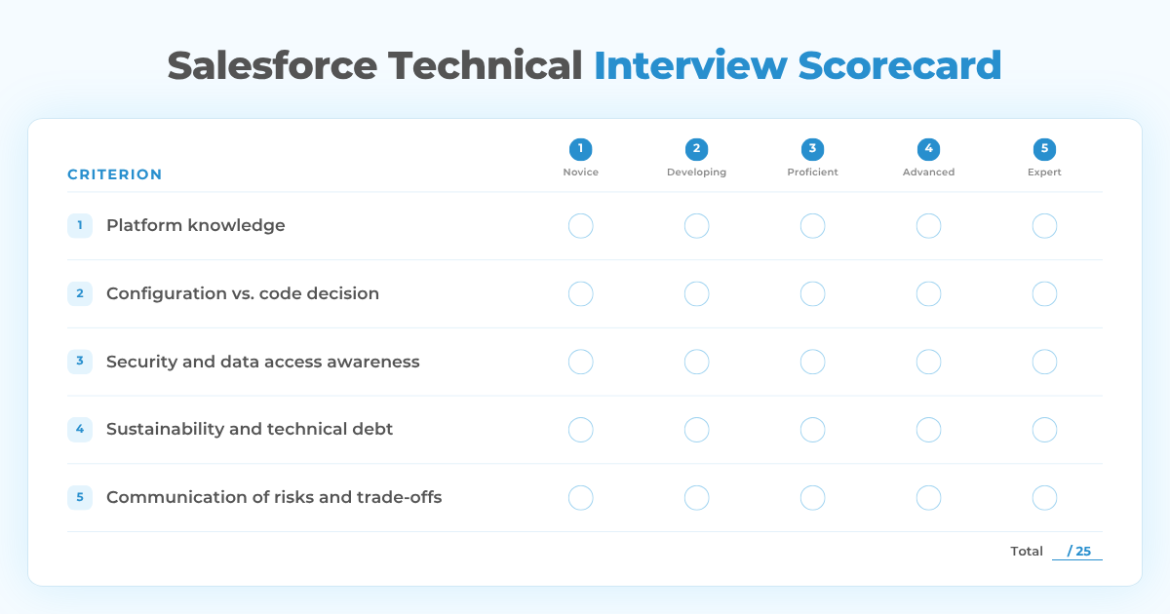
In many instances, a candidate who is cognizant of such restrictions while solving a mini-assignment is far better than someone who gives a fast answer.
Salesforce developers rarely receive perfectly specified tasks. They interact with administrators, architects, testers, vendors, business users, and managers who articulate their requirements in extremely varied fashions. The developer has to identify information gaps, point out false assumptions, inform others about the platform's limitations, and sometimes advise against implementing certain requirements altogether. It is for this reason that communication must not be considered a mere soft skill; it impacts the quality of the system directly.
Salesforce customization work with ESMS Global provides an illustrative example. ESMS Global supports clinical trial emergency response operations across roughly 40 countries and in 80 languages. The work involved complex workflows, integrations, automation, and custom development, but the technical challenge was only part of it. Our team also had to translate actual operating procedures and user feedback into a Salesforce environment that reduced workarounds and supported faster adoption.
This distinction is important in regard to recruiting. A developer operating in such an environment will not be able to take the ticket and follow instructions exactly. They will need to know the reason for such a workflow, any limitations in its implementation, and what the user wants to achieve. To assess this, present the interviewee with a scenario involving security or scalability issues arising from a stakeholder request and note how they respond. A good candidate will test their assumptions first and then move on to discuss technology. They can decline to do something without being an obstructionist.
The presence of a capability gap in using Salesforce does not necessarily mean you need to hire a new employee. Full-time hiring should be considered if you have a strategy for such a position, and if there is a need for in-house expertise. The upside is reliability; the downside is that there will not be a single person you can hire to satisfy all future specialized requirements. Independent contractors are well-suited to defined deliverables and specialist work where scope and ownership are well defined.
Salesforce staff augmentation addresses a different issue. Our team uses this model when Salesforce teams already have internal product ownership but need temporary access to specialized expertise in development, integration, migration, or architecture. Our specialists join the existing delivery structure and expand its capacity without taking control of the client’s Salesforce roadmap.
However, when no one within the organization can set priorities, make technical decisions, and take ownership of the work performed, adding more developers to the problem can actually increase the risk of delivery failure.
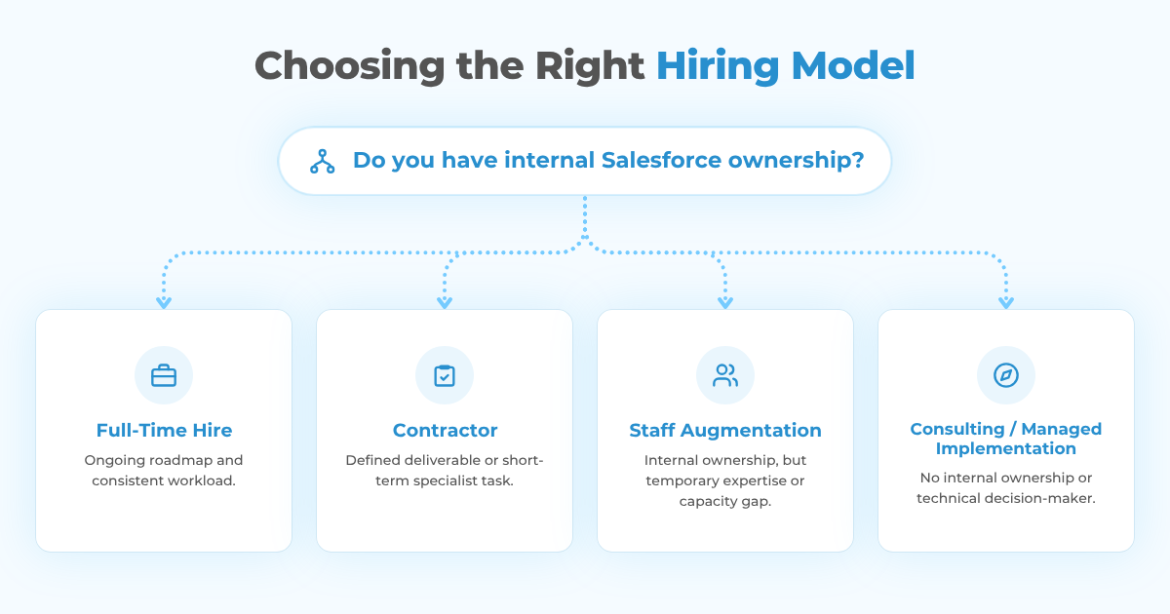
Consulting or managed implementations can be a better answer where what is missing is not labor but ownership.
Agentforce adds an additional layer to the Salesforce recruitment process, creating an intersection between AI functionality and established Salesforce platform development. Salesforce enables you to invoke Agentforce agents using Apex and Flow and to integrate them with applications and systems outside Salesforce. The possibilities for automation increase, but they also raise issues of permissions, data accessibility, reliability, governance, and the agent's environment.
The skill requirement, therefore, does not simply become “Agentforce experience.”
The developer who works with AI-driven Salesforce systems needs to understand when deterministic automation is a better fit, what types of data the agent can use, which actions need to be governed, what failure management is needed, and how to monitor the deployment process. These requirements connect agentic systems directly to data governance and increase the value of architectural judgments, even in developer roles.
The most efficient Salesforce recruitment process is one that will not attempt to make recruiters into developers. Recruiters and hiring managers must have a sufficient framework to distinguish evidence from terms. Begin by identifying the required technologies, then distinguish between critical and nice-to-have skills.
Treat certifications as only one type of evidence, not as a recruiting criterion. Do a structured project interview and some hands-on tests. Evaluate the candidate’s understanding of security, maintenance, business requirements, and the consequences of technical decisions.
Most errors in Salesforce recruitment do not result from selecting candidates with insufficient knowledge of the syntax. Instead, they stem from a misalignment between the decisions required by the project and those made by the candidate. That is the ability that the recruitment process needs to identify.