
Micro SaaS: How Solo Developers Build Profitable Products
Solo developers now make up 35% of startups. Discover how micro SaaS lets individuals build and launch profitable products without a big team.
Updated October 12, 2026

AI has made writing code faster and cheaper than ever, but building software that holds up is a different story. This article follows how the biggest cost drivers in software have shifted over the last few decades and why human validation and taste are now what you're really paying for when you build an MVP.
Years before I was Director of Operations and then Director of Product Discovery at Designli, I started my tech career as a freelance programmer. I got my first true technology job right around the time the shift to the cloud was in full force and had finally reached the corporate world that resisted it for years. It was already clear there was a new way of doing things, one that had inverted how solutions were provisioned and built.
That experience taught me something I keep coming back to: the price of software is shaped by a handful of cost drivers. These are the variables in a pricing equation that have the biggest effect on the final number. Every solution and every client is different, but a few core factors always carry disproportionate weight. And those factors change every decade or so.
Looking for a Software Development agency?
Compare our list of top Software Development companies near you
For a long time, hardware was the main cost driver. Where the servers physically lived, whether you bought them or depreciated them, whether they counted as a capital expense or an operational one: all of that was part of a CTO's matrix for calculating the cost of a solution.
This applied whether the software was off-the-shelf, such as SAP or Oracle EBS, or custom-built in C#, Java, or Ruby. Infrastructure was at least as important as development hours, and together they overshadowed every other cost of ownership.
Then, cloud providers started charging for infrastructure by the hour. Servers stopped being an upfront CapEx you had to commit to before you even started, and became a variable OpEx you could scale up or down as you needed it. Spinning up a server took one click.
Hardware didn't become an afterthought, but its weight in the overall cost of a solution dropped dramatically. A resource that was fixed and finite became dynamic and à la carte, and the cost per unit went down, too.
About ten years later, something similar happened to the other big cost driver: engineering hours.
Software engineers have been disrupting ourselves since the beginning. The history of our craft is a chain of changing cost drivers, and after the hardware era came what I call the "writing code era." During this stretch, engineering time dominated every other category. It was THE factor that decided what a solution would cost.
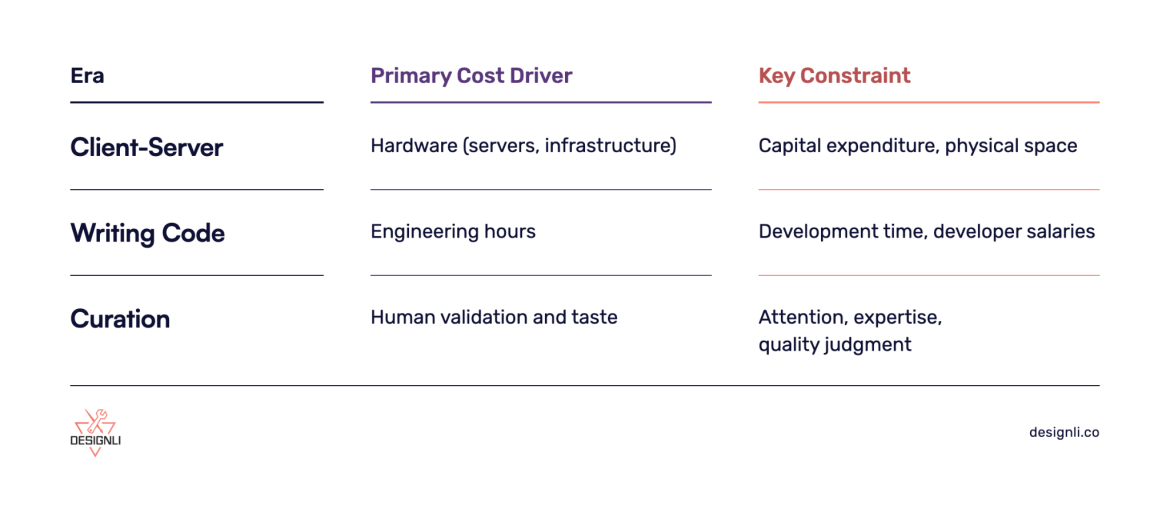
Now we have AI tools that can boost an engineer's output by 10x. Work that used to take months takes weeks, so the engineer's time as a share of the total cost drops significantly.
One of the hard rules in business is that your process is only as fast as its slowest bottleneck. AI sped up code creation, but that acceleration works differently from past shifts. Some of the bottlenecks it left behind are more important than ever, to the point that they're the new cost drivers.
Almost a year into a world where "writing code is a solved problem," I expected to see perfect, bug-free, feature-rich software. What I see instead is an enormous amount of low-quality software, and software that used to be close to bulletproof, like Amazon's marketplace, going down more often than in any period I can remember.
Low-effort work has always existed: SEO-optimized "grandma's secret" recipes, greeting card copy, email templates, etc. In software, you could build an API by hitting TAB through IntelliSense in Visual Studio and gluing together copy-pasted Stack Overflow answers. Generative AI made it possible to produce slop at an industrial scale without even trying.
I think slop is easier to define by its process than by its output. My definition: AI slop is anything created in a process that didn't have a good, careful human curator.
Something doesn't become slop just because AI generated it. What makes the result valuable is a human carefully validating it. You could have an essay written entirely by generative AI, with every line checked by a person, and I wouldn't call it slop.
Everything we produce has a thousand small decisions baked into it. When AI generates something, even from the most detailed prompt, it makes hundreds of decisions. Some are right, some miss the mark, and some are straight-up hallucinations. Vectara's hallucination leaderboard found that several of the best-known frontier models, including GPT-5 and Claude Sonnet 4.5, hallucinate more than 10% of the time on its summarization benchmark.
So the difference between slop and value comes down to whether a human reads every line and understands and corrects every decision in it. With the cost of generation close to zero, that desloping process is the scarce resource.
Over the last 12 months, the bottlenecks have been redistributed. Writing code used to be the biggest one by orders of magnitude. Now that it's shrunk, parts of the process that never felt like bottlenecks are the ones slowing everything down: the tasks that turn a firehose of code and decisions into something worth shipping. You can only move as fast as humans can verify.
That shifts the conversation from engineering hours as a resource to attention and taste as a resource. To avoid shipping slop, someone who knows what good looks like has to check:
These are mostly verification tasks rather than execution tasks. You could call them "curation tasks," and they're best done by someone with real expertise in each area.
AI brings another change: leaner teams. By amplifying each contributor's skill set and allowing them to cover multiple roles, AI makes smaller teams possible. Builds that used to require developers, DevOps, QA, etc., can now be done by just one developer and one PO. Besides saving on payroll, we also cut down on communication friction and loss of context that occur in larger teams, where people are working on multiple projects.
It's tempting to think this boost in skill sets and velocity lets a non-technical person do the heavy lifting and build a platform themselves. For some use cases, with very simple, very standard solutions, this might be true.
But you still don't have the thousands of hours of experience required to anticipate edge cases, secure data, and build for long-term scalability.
This is where a firm like Designli adds value. Producing lines of code is the easy part now. What we bring is the experience, process, and taste required to build a platform that doesn't break the second it has more than 30 users. A lean team has plenty of upside, but only when it's steered by people who understand what "good" looks like.
Taste is a concrete thing. We use the term to refer to a set of real activities in a product's lifecycle: user empathy, real-world experience, architectural thinking, technical debt evaluation, and edge-case prevention.
It's also worth noting that AI costs are heavily subsidized right now. We're not paying the real price behind these models. As Forbes reported, the major AI providers are pricing inference below the cost of serving it to win market share, and some have already started moving enterprise customers toward usage-based billing.
For now, AI is cheap enough that it isn't a major cost driver. That's temporary. When the subsidies dry up, the real cost of running these models will take up a bigger share of the total pricing equation, and teams that burn through tokens without discipline will feel it first.
One of the defining factors in the price of any project is how much you have to build, whether by hand or with AI. And it's always easier, and far more predictable, to remove features than to add them.
Most MVPs are overbuilt. Even before agentic coding, when every extra feature cost six figures and pushed back time to market, founders still insisted on nice-to-haves that didn't move the needle. Now that generating code costs a fraction of what it used to, discipline over what makes it into the product matters even more.
If we hold that line and define an MVP as the minimum that delivers value without overwhelming users with more features than they can reasonably validate in a month, a dedicated Designli team can ship a true MVP in 60 days:
| Timeframe | Phase | Focus |
| Days 1-30 | Build & Friends & Family Launch | Core features and friends & family release |
| Days 31-60 | Feedback & Iterate | Adjust based on real feedback, and refine core value |
It might sound arbitrary, but think about it in reverse. As a rule of thumb, if it can't be built in 30 days, it's probably overbuilt. Your mileage will vary depending on what you're building.
AI engineering has been a disruptive change and an incredible boost for code creation. It doesn't mean the end of professional software development. It changes the rules. You no longer need to fund a massive engineering operation, but expert human curation matters more than ever.
Committed founders will always feel the pull to muscle through and do it themselves. For someone who isn't an expert, that comes with an invisible price: an unfocused product that breaks in real-world scenarios and edge cases. AI can't substitute for hard-earned experience when it comes to architecture, databases, scaling, or security.
If you're comparing software development partners, look past the hourly rate and ask who's doing the curation. Just as important, product discipline keeps your MVP from turning into a hodgepodge of features. What you get is a focused product, designed to scale and easy to market.
The broken product is only part of the hidden cost of going solo. The bigger part is the months you lose figuring out what doesn't work.