
Why Searching for a Specialized Dev Agency Takes Longer Than It Should — And What to Do About It
Looking for a niche software development agency? Learn how to define your requirements, find specialized providers, and vet their experience.
Updated May 29, 2026

Shortening the development lead times helps businesses meet market demands and enjoy a competitive advantage. Some ways to do this are streamlining the planning phase, improving collaboration, automating repetitive tasks, prioritizing tasks, implementing version control, using Agile techniques, and outsourcing non-core tasks.
Every extra day in development could mean lost revenue and missed opportunities. Getting a new product to market as soon as possible can help businesses gain a competitive advantage, adjust to changing customer demands quickly, and even save money. Often, the longer it takes for a software product to go to market, the more expensive the project is due to the additional labor required to launch the product.
But why do development timelines often stretch beyond initial estimates? Unexpected bottlenecks, resource constraints, shifting requirements, and inefficient workflows are usually the culprits.
Looking for a Software Development agency?
Compare our list of top Software Development companies near you
Shortening development lead times means eliminating these factors. However, it doesn't only mean moving faster but working smarter. The end result is faster time to market and quicker responsiveness to change. The guide covers a few tips for achieving shorter development lead times.
8 Tips for Shortening Development Lead Times
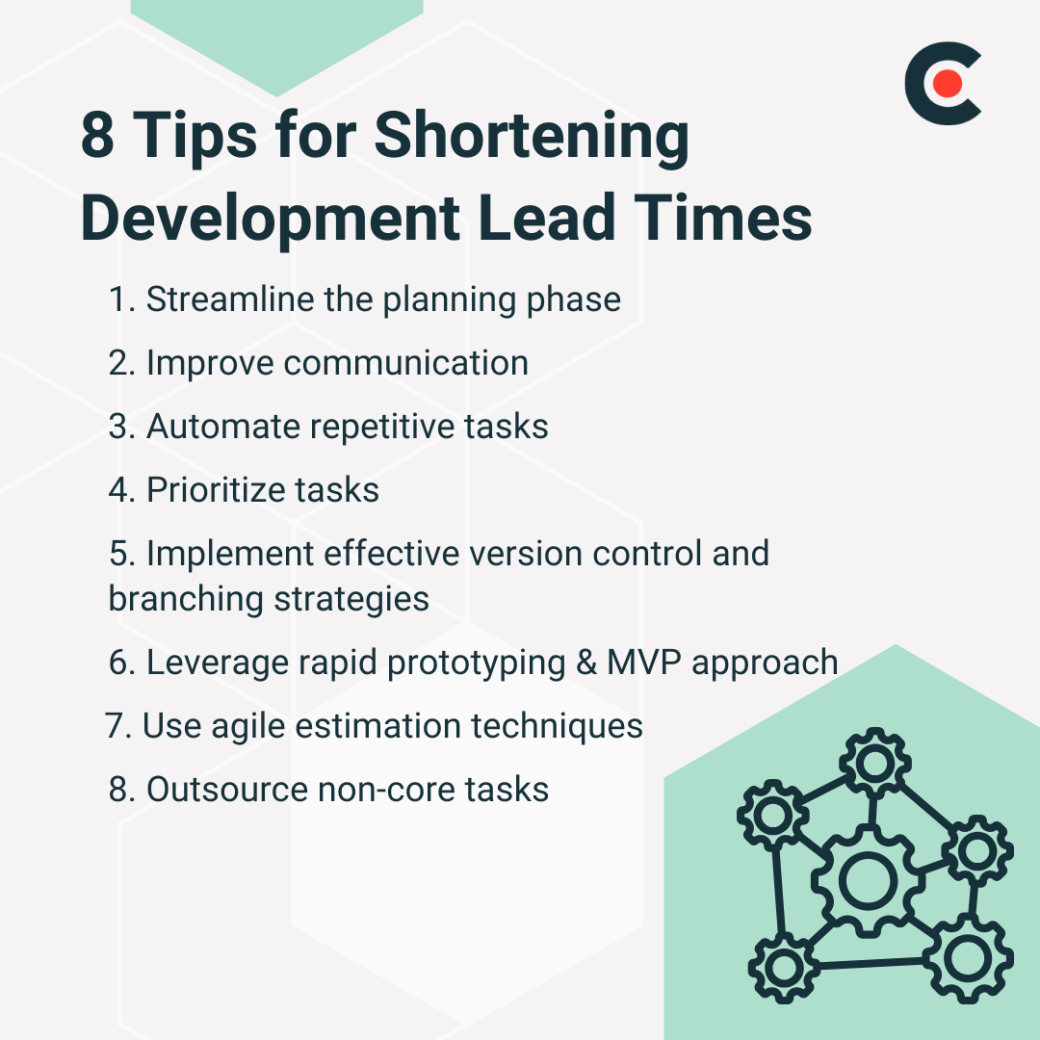
You need to get development right from the start to keep the times from going over the deadline. If you haven't set clear directions during the planning phase, your team could get stuck in endless revisions and last-minute pivots that inevitably extend lead times.
"One of the biggest bottlenecks in development is unclear or shifting requirements,” said Alex Nordlinger, the CEO at Materialize. “To avoid this, we invest heavily in the discovery phase, making sure user stories, wireframes, and technical scope are well-defined before development begins.”

Unclear requirements are a no-no. Start by briefing every team member on the project scope and key deliverables to ensure that everyone is on the same page. Use agile or lean methodologies to adapt to changes and provide continuous feedback for faster decision-making.
It also helps to break down large tasks into smaller, more manageable chunks. These should be well-defined units so your teams can easily understand each task. This way, everyone is on the same page throughout development.
Teams that don't communicate well during the development process end up with a ton of misunderstandings and misaligned goals. The result is more revisions and additional delays.
However, communication shouldn't just be strong between individual teams. Cross-functional collaboration between designers, developers, business stakeholders, and QA testers is necessary.
You can improve communication by holding short daily meetings to brief everyone on what's going on and flag potential roadblocks. Regular updates are also important to promote team accountability. At Materialize, "Developers work from well-defined tickets with detailed requirements and acceptance criteria, reducing ambiguity and rework," explained Nordlinger. "Regular stand-ups keep everyone aligned, helping to identify blockers early, while automated testing and CI/CD [Continuous Integration and Continuous Deployment] pipelines ensure that updates are deployed efficiently." With strong communications and workflows in place, development teams can ensure that the project stays on track and avoid unnecessary delays.
There are also quite a few real-time communication tools teams can use. Slack and Microsoft Teams are usually the common choice since most people are familiar with them.
Manual processes slow down development and increase the chances of errors. Instead, development teams can automate repetitive tasks to improve effciency and speed.
CI/CD pipelines can help in this process. Automated CI/CD pipelines keep deployments smooth, and QA is ongoing throughout development to catch issues before they escalate," said Nordlinger. They can automate the build, test, and deployment process. Every time there's a code change, the system tests and deploys it to production automatically.
Teams can use automated code formatting and linting tools like ESLint and Prettier to enforce consistent code quality and reduce the need for manual reviews. Developers can then focus on problem-solving rather than formatting, which would have otherwise consumed a lot of development time.
The MoSCoW Method is a helpful approach that helps reduce development lead times by allowing teams to get task prioritization right. It categorizes tasks into:
Teams must focus on the must-haves first, while the could-haves should take the last priority. The method helps defer low-priority tasks so that the most valuable parts of the project get delivered on time. Since less critical enhancements are pushed to the later phases, teams can launch their product faster without getting bogged down by non-essential features.
Nordlinger explains how his team implements this approach, "During the discovery phase, we work closely with the client to hone in on the core MVP functionality — the absolute necessities needed to launch a successful product."
He further expands, "We listen carefully to their goals and help them distinguish between must-haves and enhancements that can come later. This ensures we're not overloading the initial build with high-effort, low-impact features that could slow down development without adding real value. Our approach is all about maximizing efficiency while minimizing risk."
The method also helps weed out the wont-haves. These features or tasks are not needed at the time or altogether for that particular project. When you remove these tasks from your to-do list from the beginning, there's no risk of wasting time on them.
When version control is messy, things go out of hand. It can create conflicts and result in costly rework. Instead, teams that use structured workflows and smooth collaboration can minimize disruptions.
Everyone on the team should also follow a well-defined version control strategy. "If changes arise mid-cycle, we handle them through structured change requests to prevent scope creep from derailing timelines," Nordilinger shares. Teams should commit often in small increments to simplify integrations and make debugging more efficient.
The first step in managing branching strategies is to to use Git workflows like GitFlow or trunk-based development, which provides a consistent structure for branching, merging, and releasing. These workflows encourage developers to work on their code independently and merge changes into the main branch regularly. Last-minute integrations don't become a headache this way.
Things can go south if you try to build a fully polished product from day one. Instead, teams should adopt a Minimum Viable Product (MVP) approach. It helps them validate ideas and iterate the product quickly.
One way to achieve this is by rapid prototyping. Basically, you build a basic version of your product and test it with users. You can refine it using real-world user feedback instead of a guesswork approach.
Nordlinger explains how to do it, "We don't steer clients away from ambitious ideas, but we do guide them toward iteration over perfection — getting the product into users' hands quickly and refining it based on real feedback rather than assumptions. This not only keeps time and cost investments manageable upfront but also sets the foundation for a product that can evolve and scale effectively over time."
It's best to engage stakeholders early in the development process so that you're not wasting any effort on features that probably won't add value. Speaking of features, go with the core ones first. These are the "must-haves" from the MoSCoW Method.
Poor estimates for project timelines result in missed deadlines and rushed work. Instead, Agile estimation techniques like Planning Poker or T-shirt sizing allow teams to break down features and tasks into manageable chunks and assign time estimates accordingly.
Nordlinger explains that his team takes "a Kanban-style approach, allowing us to address issues as they come in without waiting for a full sprint cycle. This hybrid model helps us maintain momentum, reduce bottlenecks, and adapt quickly to changes without sacrificing structure."
When doing so, you should also account for retrospectives. In simple words, take notes from your past iterations to improve accuracy in future planning. It will make your timeline predictions more accurate since you're not just guessing but using actual data from past experiences.
When teams try to do everything themselves, the development lead times increase. You can save this time by outsourcing non-core tasks, such as design and infrastructure.
Let's take UI and UX design as an example. While you could do it in-house, it's an extra thing on your to-do list that an external professional could likely do better and faster. As they take care of the UX/UI design, your development team can focus on the core tasks. External help also brings in fresh perspectives, which can hone your product.
Once again, shorter development lead times help products reach markets faster, which means you can stay competitive in tough markets. You can also adjust to meet market demands more easily and satisfy your customers.
However, lead time optimization isn't a one-time, temporary process. Continuous improvement helps refine the development process, further improving your product and keeping your team on top of new user expectations. You should also revise your version control and iteration strategies to keep development lead times short for future projects.
While you're at it, refresh your team's knowledge about Agile techniques. Provide the necessary resources and training to keep them updated on industry best practices for shorter development lead times, and you'll be all set to produce top-quality products in record time.