Recently, the rapid growth in development services reflects a mounting pressure on businesses to embrace technology in order to stay competitive.
Recent data shows a significant uptick in demand for cloud platforms, AI capabilities, and development expertise, signaling that organizations are no longer treating tech adoption as optional, but as a critical factor for long-term success and resilience.
As industries undergo widespread digital transformation, companies are investing heavily in modern tools and platforms to streamline operations, enhance customer experiences, and drive innovation.
Looking for a Software Development agency?
Compare our list of top Software Development companies near you
More Businesses Are Relying on Cloud Infrastructure
Public cloud spending is expected to hit $723.4 billion in 2025. That's a 21.5% jump year over year, indicating that businesses are moving away from traditional on-premise IT toward cloud-first or cloud-native strategies.
Generally, cloud platforms offer scalability, flexibility, and global reach, which are critical for staying competitive in fast-moving markets.
Think about what the cloud can deliver with cloud infrastructure: Do you need 100 servers for Black Friday? Done. Need to scale back to 60 servers on Tuesday? Also done. No hardware purchases or depreciation schedules — just resources when you need them.
But the real game-changer isn't the technology itself. It's what it enables.
A startup in Singapore can now compete with established players in Silicon Valley. Cloud platforms give them the same infrastructure that Amazon uses.
While large companies with huge data centers used to have a significant competitive advantage, smaller organizations are able to compete. With cloud infrastructure, a team of only a few developers can now build and deploy global applications. This democratization of infrastructure changes everything:
- Startups launch globally from day one. No regional rollouts or phased deployments. They go everywhere, immediately.
- Government agencies modernize faster. Legacy systems that took years to build get replaced in months.
- Mid-market companies suddenly play in enterprise leagues. The playing field is completely rebuilt.
The companies thriving right now have made cloud infrastructure their foundation, not their future project. They're already building while others debate migration strategies.
The Need for Software Services Will Continue To Grow
Global software development services are projected to grow from $570 billion in 2025 to $1.04 trillion by 2030, reflecting a compound annual growth rate (CAGR) of 12.9%. Meanwhile, overall software spending is expected to reach $1.23 trillion in 2025, a 14% increase from 2024.

This rapid growth reflects a world where software is at the core of every business. Across industries, businesses are looking to provide digital experiences for customers or need to automate operations. Consider your local bank, who may need to build a mobile app to provide online banking options. At the same time, retailers need point-of-sale (PoS) systems and must be able to accept digital payments.
Custom digital experiences are driving this growth even more. Customers and companies don't want another generic, cookie-cutter solution. They're looking for software that solves their specific problems.
To build the solutions they're looking for, many companies are looking to hire software development services, often across the world. Many companies have hired remote or hybrid development partners in order to access a global talent pool.
You're no longer limited to developers within driving distance. That senior engineer in Poland? She's as accessible as someone in your city. The full-stack team in India? They work while your local team sleeps, helping you complete projects even faster.
This growth reshapes the global economy in ways most executives haven't fully grasped yet.
Emerging economies have transformed into software powerhouses. For instance, Eastern Europe hosts thousands of world-class development teams, and they often charge lower rates than those in the US. Meanwhile, Latin America shares your time zones and delivers enterprise-grade solutions.
To compete for talent, many companies are offering remote-first policies, stock options for engineers rival executive packages, and retention bonuses have become standard, not special.
Moreover, businesses aren’t just competing with companies in their industry anymore. You're competing with every company that needs software.
AI Is Growing at Record Pace
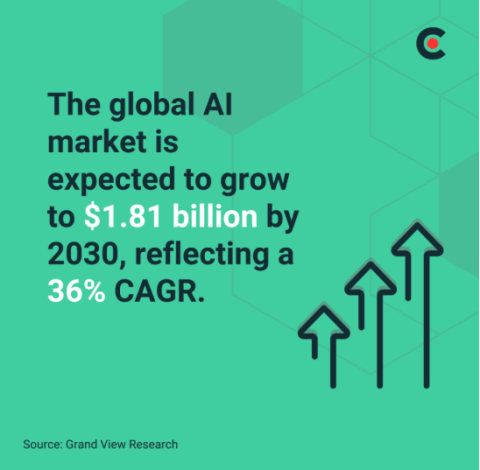
The AI market will grow from $279.22 billion in 2024 to $1.81 trillion by 2030. That's a 35.9% compound annual growth rate. That's faster than the internet or any technology adoption in history. And it's already changing how work gets done.
GitHub Copilot already writes 46% of code for developers who use it. A recent Clutch survey found 53% of developers believe large language models already code better than most humans.
But generative AI goes beyond code completion. It creates content that used to require agencies and analyzes data that used to require consultants.
AI-native startups are now building their entire business model around it. There are no legacy processes to update, just pure AI-driven operations from day one. These companies move at speeds traditional businesses can't match:
- Product development cycles shrink from months to weeks. AI handles the repetitive tasks while humans focus on strategy.
- Customer service becomes proactive, not reactive. AI predicts issues before customers report them.
- Market analysis happens in real-time. No more quarterly reports when AI monitors everything continuously.
The impact ripples through everything: job roles transform overnight, data entry disappears, and creative work shifts from production to curation. Your employees may need new skills and evolved workflows.
Innovation cycles compress from years to months. What took a team of 10 engineers six months, two developers with AI may accomplish in weeks. As first-mover advantages evaporate faster, speed becomes everything.
Yet, despite this rapid growth, companies must remain mindful of the ethical considerations surrounding AI, including issues of bias, transparency, accountability, and the potential impact on jobs, privacy, and society at large.
What This Means for Businesses
The convergence of cloud, software services, and AI creates unprecedented opportunities, but companies that don’t keep up with modern software trends risk falling behind. To keep up, many need to shift their priorities and how they operate. Business leaders must:
- Invest in developer enablement
- Modernize legacy systems
- Adopt AI and cloud strategically
- Foster a culture of continuous innovation
Invest in Developer Enablement
Stop treating developers like cost centers. In fact, developers now determine your company's growth trajectory, and everything else follows. Here's how you can help:
- Budget for modern tools, cloud environments, and AI assistants.
- Remove bureaucratic approvals that slow deployment.
- Let them choose their tech stack within reasonable boundaries.
For instance, Netflix gives developers production access on day one. Spotify lets teams choose their own tech stacks. Amazon practices "You build it, you run it."
These aren't perks but competitive necessities. Your developers should spend time solving business problems, not fighting internal bureaucracy.
Modernize Legacy Systems
Do you still have that mainframe from 1997? It's not "vintage" but a liability.
Legacy systems can slow you down, or worse, prevent you from moving forward at all. While you spend time and money maintaining outdated infrastructure, your competitors are building new capabilities. While you patch old code, they ship new features.
To update, start with the systems that directly impact customer experience, whether that's payment processing or customer data platforms. These create immediate value when modernized.
Remember that you don't have to replace everything at once. Gradual migration beats haphazard transformations. You can start small and replace the legacy system piece by piece.
Adopt AI and Cloud Strategically
AI and cloud aren't mere checkboxes on your digital transformation roadmap. In fact, they're the foundational decisions that determine your competitive position.
But adding them only because everyone else is doing it wastes resources. Instead, start with your specific business priorities:
- Customer churn too high? AI predicts at-risk accounts.
- Development too slow? Cloud environments accelerate deployment.
- Support costs crushing margins? Automated chat handles routine queries.
Avoid the "AI everywhere" trap. Not every process benefits from artificial intelligence. First, test, measure, refine — then scale what works for your organization.
Foster a Culture of Continuous Innovation
Innovation is a mindset. You need to provide psychological safety for experimentation across your organization. Often, failed experiments teach more than successful repetitions. So build a culture that rewards learning, not just outcomes.
You also need to break down silos between IT and business units. Most of the time, the best ideas come from people closest to the problems. The marketing department best knows what customers want. Operations knows what's broken, and IT knows what's possible. When you connect them, the best possible solution arises.
Embrace the Transformation for Growth
The ongoing software revolution is the current reality reshaping every industry. Your path forward is to embrace it and lead the change. Invest in the right technologies, talent, and transformations, and build the future your industry needs.
About the Author
Hannah Hicklen
Content Marketing Manager at Clutch
Hannah Hicklen is a content marketing manager who focuses on creating newsworthy content around tech services, such as software and web development, AI, and cybersecurity. With a background in SEO and editorial content, she now specializes in creating multi-channel marketing strategies that drive engagement, build brand authority, and generate high-quality leads. Hannah leverages data-driven insights and industry trends to craft compelling narratives that resonate with technical and non-technical audiences alike.
See full profile