
Why Searching for a Specialized Dev Agency Takes Longer Than It Should — And What to Do About It
Looking for a niche software development agency? Learn how to define your requirements, find specialized providers, and vet their experience.
Updated January 14, 2026

Software development outsourcing has changed from a cost-saving tactic to an efficiency strategy. Knowing the best practices and methods for outsourcing can make companies significantly more flexible and competitive.
Software development is constantly evolving as customer expectations, competitive pressures, and emerging technologies change at an accelerated rate. Today, keeping pace with these changes is difficult even for large enterprises, but the challenge is becoming even greater for small and mid-sized teams.
One solution that many companies are embracing is outsourcing to bring in top talent. Outsourcing has progressed from a cost-cutting tactic to a strategic approach that allows companies to innovate and modernize at fast speeds. Software development outsourcing can unlock the expertise and experience needed for companies to accelerate their digital transformation and invest in new technology more effectively.
Looking for a Software Development agency?
Compare our list of top Software Development companies near you
With advancements in AI, automation, and digital experiences occurring almost daily, innovation has never been more important. Innovation in software development boosts user satisfaction, leads to solutions for new tech issues, and gives companies a competitive advantage. However, companies that refuse to look beyond their internal staff put themselves at a great disadvantage.
In a recent survey of 400 small business owners, Clutch found that 26% of business leaders say limited internal technical experience is their biggest challenge to meeting tech goals. As new technologies emerge, it becomes more and more difficult and costly to keep internal teams up to date. On top of this, internal staff must stretch their roles to encompass both strategy and execution of products that use these complex technologies.
Many may see outsourcing as an attempt to cut down on internal staff and save money. However, companies that use outsourcing as a strategy for innovation are able to expand their capabilities. More companies are embracing outsourcing for innovation, with 21% of businesses adopting a hybrid outsourcing model that combines internal and external teams, while only 13% rely entirely on outsourced partners.
Sergei Dubograev, senior vice president of development at Clutch, sees outsourcing as an essential practice for companies looking to innovate in this day and age. “Customer expectations are accelerating faster than most small businesses can retool internally,” Dubograev says. “Strategic partners give teams immediate access to specialized technology and expertise they were never designed to build in-house, turning innovation from a long-term ambition into real execution. Outsourcing done right is how companies keep pace with faster, better-equipped competitors.”

Companies that take advantage of hybrid outsourcing models continue to maintain ownership of their strategy over the project while using outsourced experts who bring specialized skills, modern tools, and emerging technologies.
Before deciding whether outsourcing is suitable for your company, it’s important to know the advantages. Here are five strategic reasons to take advantage of outsourced partnerships for projects involving new technologies.
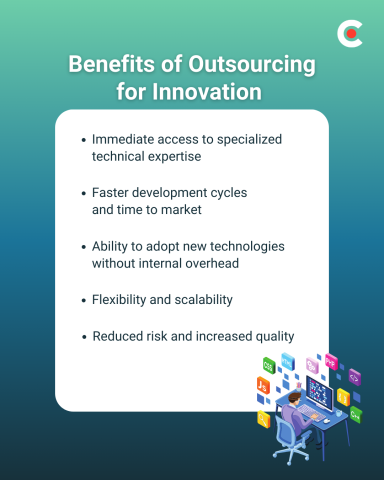
New technologies are constantly popping up, making it nearly impossible for companies to keep their in-house staff up to date with the skill sets they need to remain competitive. Hiring talent on a short-term basis allows companies to avoid the time and expense of recruiting, onboarding, and training full-time employees, particularly for large projects that may not require ongoing support after launch.
Outsourcing roles to experienced specialists can deliver immediate impact and allow teams to move faster on initiatives such as AI, cloud infrastructure, integrations, and cybersecurity.
Speed is another benefit of outsourcing, which can be the difference between staying competitive and losing market share. Teams that capitalize on the specialized knowledge and experience of experts often operate at a higher velocity. These experts can quickly adapt to workflows and established processes while maintaining high-quality execution and delivery.
Outsourcing, when done right, allows internal and external teams to work in parallel. Internal teams can focus solely on developing strategy and vision while outsourced experts handle the building and testing of new products and services. The result is faster development cycles and time to market.
When new technologies emerge, companies that don’t outsource specialized roles must invest in upgrading their infrastructure, diverting resources to training, and updating their tool kits to meet demand. Making major adaptations can lead to friction that slows processes and creates bottlenecks.
Partnering with external teams helps companies sidestep these issues as many specialized providers bring their own tool kits, infrastructure, and experience. For example, an outsourced team may implement its own AI features, migrate to cloud-native architecture, and automate internal processes to maximize efficiency.
By removing the time needed to recruit, hire, onboard, and train employees, outsourcing helps companies scale quickly. Teams can quickly fill technical skill gaps for brief periods when challenges present themselves. Likewise, when those needs are met, teams can scale down to save on costs and maintain efficiency.
One way to guarantee organizations maintain control of the project and get their needs met is to take advantage of a hybrid model. Recently, Clutch found that 21% of organizations have taken a hybrid approach, which allows them the best of both worlds. Their internal team can oversee the process while providing necessary product knowledge, while external vendors tackle the execution.
When companies innovate, there are always inherent risks. However, outsourcing complex tasks to those with extensive experience and understanding of new technologies reduces the risk and simultaneously boosts quality overall. Outsourced partners typically follow best practices, meet quality assurance standards, and use proven methodologies to deliver the best results. By outsourcing, companies are able to bring in senior-level expertise instantly, which reduces the chances of mistakes, rework, and delays.
Additional Reading, “How to Grow Your Software Development Team Without Sacrificing Efficiency.”
When internal teams get bogged down by learning how to apply new technologies, innovation suffers. Here are several ways outsourcing complex technical roles to external partners strengthens innovation.
When companies outsource complex tasks to external vendors, they free up in-house resources to focus on strategic decision-making. Internal staff understand the company’s long-term business objectives, product vision, and customer needs, making it essential to give them the space to determine the best way forward. When in-house employees split their time between plotting out the big picture and technical execution, it dilutes their impact.
Innovation roadmaps are plans that outline how companies will develop new ideas and turn them into products and processes. Some of these innovations may have the potential to reshape entire business models. However, with limited internal staff members and technical expertise, these ideas never make it past the drawing board.
Companies can use outsourcing to bring some of these ideas to the front of the development queue rather than waiting months or years to work them into their roadmap. Through outsourcing, the company can roll out new products, features, and updates faster. This results in faster learning and more experimentation while reducing the risk of over-investment by committing too many resources to these unproven ideas.
The speed of modern technological advancement makes it nearly impossible to stay at the forefront of trends consistently. AI frameworks, cloud platforms, cybersecurity protocols, and development tools are constantly advancing, and companies that can’t adapt risk losing their competitive edge.
Recruiting and retraining internal hires to keep up with these changes can be a significant financial investment and take time. However, outsourcing allows companies to adapt faster and roll out solutions quickly. Companies that take advantage of the knowledge and technical expertise of third-party professionals on a short-term basis keep pace with new trends without breaking their budget.
The most challenging aspect of innovation is taking new ideas from abstract concepts to finished products. Outsourcing significantly eases this process by bringing in professionals with the experience and expertise to develop working prototypes and production-ready features. These external partners not only develop software, but also bring workflows, best practices, and solutions that shorten timelines and increase efficiency.
Selecting the best outsourcing model is key to achieving delivery goals and maximizing innovation. There are several effective approaches to outsourcing that companies can choose from, including:
Choosing the right model for your company comes down to assessing your company’s goals, resources, and innovation needs. Short-term projects may benefit from models such as staff augmentation, where fast scaling is possible. Hybrid structures, on the other hand, are best for extensive innovation projects.
Additional reading, “How Hybrid Outsourcing Helps Companies Succeed.”
To get the most out of outsourcing that drives innovation, it’s essential to use an approach that delivers results. Simply hiring external employees with no plan past saving money won’t help you take advantage of the full potential that outsourcing offers.
First, companies should have a clear plan in place before bringing on outside talent. This should include having specific objectives and KPIs for innovation-focused projects. Without these, it’s impossible to gauge success and learn where to make adjustments.
Communication must be a priority, too. While internal and external teams may work in parallel, they must have frameworks in place to guarantee feedback, meetings, and regular check-ins. Strong communication reduces friction between teams and keeps projects on track without the risk of redundancies or rework. Communication also guarantees both sides are aligned in terms of product vision, quality standards, and timelines.
An essential approach when determining which partner you’ll work with is to look for those with experience in emerging tech rather than those familiar with older software systems. Teams working with AI, cloud platforms, and machine learning automation bring the newest, most efficient approaches with them and unlock the most upside.
Finally, use a hybrid structure to get the most out of outsourcing. Full outsourcing, where a company outsources whole departments or projects, can lead to dependency or a loss of control. By keeping the internal team in charge of strategic oversight and the external team focused on execution, the company can meet delivery timelines faster while maintaining top quality.
Outsourcing provides several crucial benefits for companies hoping to boost innovation and maintain a competitive edge. However, there are key obstacles to watch out for when outsourcing development.
While outsourcing is a cost-effective practice, companies shouldn’t base their decisions solely on costs. Lower rates can be enticing, but it often means the company will pay more in another area, such as quality or communication.
It’s also important to maintain internal ownership of innovation projects. When internal staff don’t control the strategy, the external partners may come to their own conclusions. This can lead to rework and delays. Likewise, when internal teams give the outsourced partners too much control, it can lead to dependency or misalignment.
Another area to focus on is the cultural fit and collaboration processes. External teams that use different communication styles or have different expectations compared to internal teams can cause friction and development issues. Additionally, isolating outsourced teams can reduce the potential for innovation. Companies must integrate external teams into the broader product strategy to make sure there is seamless communication and collaboration.
While some may see outsourcing as a cost-saving tactic, it has become an essential practice for companies that want to stay up to date with the most recent technological trends. Outsourcing is a strategic path toward innovation, modernization, and a competitive advantage for companies. Taking advantage of the right external partners and outsourcing models results in faster adoption of new tech, more innovative products, and the ability to meet increasingly demanding customer expectations.
As technology continues to evolve, companies that choose to take advantage of external specialists will put themselves in a better position to succeed.