
Website ROI: How to Measure, Calculate, and Improve Your Return
Website ROI measures the value your site generates relative to what you spend. Learn how to calculate it, track the right KPIs, and improve your return.
Updated January 7, 2026

Hybrid outsourcing has become a popular way for companies to bring in experts while keeping costs low and staying in charge of strategy. See how this approach allows businesses to fill skill gaps, scale, and accelerate project timelines.
Many companies have either kept business activities completely in-house or outsourced large portions of their operations to external vendors. While there are benefits to each, they also both present downsides. Fully outsourced operations can lead to dependence or loss of control over the long term. Fully in-house operations, on the other hand, can mean missing out on low-cost expertise. However, more and more companies are combining the two methods for a new approach: hybrid outsourcing.
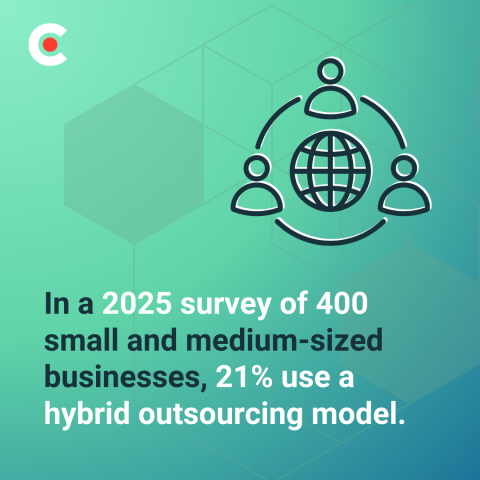
In fact, in a 2025 survey of 400 small and medium-sized businesses, 21% use a hybrid outsourcing model.
Hybrid outsourcing balances both internal and external teams, so the company maintains strategic control and guides the outsourced experts toward efficient execution. Ultimately, this combines the strengths of keeping things in-house and fully outsourcing, as it accelerates projects, fills skill gaps, and allows companies to scale faster. Here’s everything you need to know.
Hybrid outsourcing is a business model that allows companies to expand their workforce when needed to stay competitive. It blends in-house staff with outsourced specialists to maintain control of operations while bringing in experts to give projects a cost-effective edge.
A company that uses hybrid outsourcing will have its own employees handle core functions. Outsourced experts and contractors then join in to support high-impact, overflow, or specialized tasks. This setup proves to be financially efficient as the company doesn’t need to hire full-time employees for short-term or project-based roles.
Hybrid outsourcing is a balance between full outsourcing and keeping all operations in-house. Companies that use full outsourcing will offload entire business functions or departments to third-party vendors, which then take on full responsibility for the operations and processes. The benefit of this is fewer work demands on in-house staff and lower overall costs. On the other hand, using only internal staffing to complete projects can keep operations controlled, but it limits flexibility and slows timelines.
There are several hybrid setups that businesses use, including:
The underlying principle that makes hybrid outsourcing work is the idea of shared responsibility. The company provides a framework for the vision, outcome, and quality standards, while the third-party vendor handles execution and delivery.
Additional reading, “Outsourcing: The Key to Continued Growth In Times of Economic Uncertainty.”
Hybrid outsourcing is becoming increasingly popular as it allows businesses to integrate external top talent with their in-house staff at reduced costs. With new technologies popping up every day, it’s unrealistic for companies to continuously hire full-time employees to keep up. Hybrid outsourcing allows them to bring in experts when needed.
Companies also need to innovate faster, responding to new trends and customer feedback. Recruiting, hiring, and onboarding new staff can take months, but outsourcing allows companies to get support immediately. With this model, they can scale up or down quickly to meet demands and workloads.
Hybrid outsourcing has also become more popular than full outsourcing because it allows companies to maintain internal control while keeping the low costs of bringing in support. Hybrid outsourcing allows internal teams to oversee operations and make sure that the external vendor is meeting objectives and quality expectations. The costs of these external vendors are much lower than what it costs to bring new employees into the fold full-time.
The appeal of hybrid outsourcing is increasing because of the numerous benefits it provides. These six advantages are compelling reasons to consider integrating a hybrid outsourcing model into your company.

One of the most important ways hybrid outsourcing helps companies improve is that it brings in experts to fill skill gaps. New technology in areas such as AI, DevOps, cloud, cybersecurity, and UX requires in-depth expertise and experience that can take years to develop internally. However, bringing in third-party experts allows your business to access these advanced skill sets immediately.
Hiring short-term specialists also allows you to avoid long recruitment and onboarding processes, which take up resources and delay timelines. Taking advantage of hybrid outsourcing guarantees your business has the right talent when it's needed most.
The ability to hire specialists on a short-term basis means parallel workflows and faster execution. Internal teams only need to focus on strategy, setting direction, and passing tasks. They pass this information on to the outsourced experts, who handle development, testing, and implementation. This task separation reduces bottlenecks and shortens timelines. When both sides work together, it results in faster product development, migrations, and feature releases.
Because businesses don’t need to offer experts and specialists long-term contracts, they can maximize flexibility and adapt to changing conditions. When workloads increase, seasonal demand peaks, roadmaps shift, or new priorities emerge, the business can pivot by adding or reducing outsourced staff. These quick changes also allow companies to circumvent the cost of recruitment, onboarding, and maintaining full-time staff for temporary needs.
When internal staff need to develop the overall roadmap and execute tasks to make it happen, it can stretch teams thin and result in slower progress. By bringing on experts for a limited time, internal teams can focus solely on the strategy, product vision, and customer experience without being burdened by operational demands. Meanwhile, outsourced teams handle technical tasks, experimentation, or innovation projects. The division of labor improves efficiency and focus for both teams.
A major benefit to choosing a hybrid model over full outsourcing is the ability to maintain control over core operations. Full outsourcing models mean passing along all responsibilities. Hybrid outsourcing keeps decisions relating to project strategy, architecture decisions, and long-term vision internal. This guarantees continuity, quality, and internal knowledge retention. Businesses using hybrid outsourcing models avoid the risk of losing strategic control over operations while still benefiting from the expertise of external specialists.
Even when hired for short-term contracts, third-party experts bring proven frameworks, best practices, and invaluable experience that can catapult projects to success. This expertise pairs with internal oversight to strengthen workflows and guarantee results. Similarly, it reduces the likelihood of costly mistakes and revisions. Overall, hybrid outsourcing delivers higher-quality results with reduced risk.
Hybrid outsourcing is a highly adaptable model that gives businesses flexibility and scalability while maintaining internal control. Companies can use it for a variety of scenarios, including:
Combining internal and external teams lets companies take advantage of specialized experts while keeping consistency across projects. It also allows them to pivot quickly to respond to new demands and trends when needed.
There are different ways to take advantage of hybrid outsourcing. Creating the most effective model for your business requires taking the time to complete four steps. This process allows you to establish a model that is both scalable and efficient.
Hybrid outsourcing models depend on teams and individuals who know exactly what their roles and responsibilities are. Clear delineation of accountability reduces confusion and redundancy. Make sure the internal staff handles determining the strategy, vision, and key decisions involved with the project. Outsourced experts must follow the plan and execute based on their experience and specialized skills. Come up with shared KPIs and clear communication channels to stay on track and keep everyone aligned.
One of the most important steps for building an optimal hybrid outsourced model is to determine where you need help. Just because a vendor has extensive experience and expertise doesn’t mean you need them. Look for vendors that fill internal gaps instead of duplicating existing roles. These vendors should also integrate smoothly with internal processes, tools, communication methods, and company culture.
Communication is the foundation of any team’s success, but it’s especially important when it comes to hybrid outsourcing models. Guaranteeing that both sides are on the same page and collaborating efficiently limits misunderstandings and keeps operations running smoothly. Establishing strong collaboration and communication requires regular stand-ups, shared tools, and transparent workflows. Some best practices for blending internal and external teams include:
Each company’s needs and operations differ. Work with both sides to determine which approach best allows everyone to work as one cohesive unit.
While it’s good practice to have internal staff control the overall strategy, they need data to make the best decisions. Because of this, channels should be in place to allow information to flow both ways. The technical expertise and experience of outsourced experts can provide the in-house team with insights that can shape their decisions for the better. Keeping documentation up to date, following code standards, and adhering to internal oversight processes help maintain consistency and keep data accessible.
There are many advantages for companies that choose to use a hybrid outsourcing model. However, it’s not a perfect system, and there are potential challenges. To give your company the best chance of success, it’s important to understand the potential difficulties and take a proactive approach.
One of the most common issues with hybrid outsourcing is misalignment between the internal and external teams. This can happen for multiple reasons. The internal staff may come up with goals and strategies that are misinterpreted by the vendor, leading to incorrect execution. When teams aren’t on the same page, it can lead to rework, frustration, and missed deadlines.
To resolve misalignment issues, both sides must completely understand the dynamics of their partnership. When internal and external teams work together, there must be clear governance where both sides know who makes decisions and who executes, as well as who is responsible for what.
A second issue to be aware of is when the company relies on the external vendor too much. This happens over time when the company begins to depend on the outsourced partner for information relevant to the project or to make more critical decisions. If the outsourced specialists become integral to the company, it can result in long-term dependency. This may lead to increased prices from the vendor or cause disruptions if either party decides to go in a different direction.
The fix to this issue is to maintain strategic ownership internally. While it’s important to take the outsourced specialists’ expertise into consideration, the external partner’s main objective should be to support the execution of the strategy. Keeping key decision-making in-house means maintaining long-term control of the project.
Integration issues are problems that can occur early on in the partnership and can be easily prevented. These issues arise when internal and external teams use different tools, workflows, and processes, causing confusion during handoffs and meetings. Adopting shared communication tools and agile methodologies that both sides are familiar with from the beginning can stop this problem before it starts. Joint planning and kick-off meetings also make sure both teams are in sync.
A final challenge to be aware of is communication gaps. When one side misunderstands the other side’s availability, responsibilities, or expectations, it can lead to delays. Keeping structure through meetings, check-ins, and reviews allows both sides opportunities to sync up and give feedback. When communication is reliable, both sides function better and can resolve issues faster.
Hybrid outsourcing allows companies to maintain control of their operations while cashing in on the flexibility, expertise, and efficiency outsourcing provides. It allows businesses to scale quickly, innovate faster, and strengthen their capabilities without overextending internal teams or raising costs by bringing in new full-time staff members. Businesses in need of experts who can deliver an immediate impact on their operations should look to hybrid outsourcing models to support their continued growth and innovation.