
How Talent Acquisition Has Evolved for Modern Startups
Discover innovations that shape the talent acquisition processes for modern startups. Leverage these insights to build effective teams and streamline hiring...
Updated June 18, 2026

Speed-to-hire may feel like a competitive advantage, but replacement costs, productivity gaps, and re-hiring cycles show up on the balance sheet. Here's why pre-vetted remote talent is the fix most businesses aren't using yet.
U.S. companies are sitting on the biggest untapped hiring advantage in history: access to a global pool of skilled, remote-ready professionals who can fill critical roles faster than traditional hiring.
It’s fair to say that most businesses aren’t taking advantage of it. Instead, they keep running in loops, in the same compressed, under-screened hiring process they’ve used since the beginning. The problem is hiring without vetting a profile, which is a costly mistake.
Looking for a Human Resources agency?
Compare our list of top Human Resources companies near you
According to the BambooHR State of Hiring 2026 report, pressure to reduce time-to-fill is at an all-time high.
While HR Dive 2026 Hiring Outlook found that half of employers said that applicants’ lack of relevant experience is their biggest hiring challenge.
On average, a U.S. company takes 36 days to fill a role. Given the pressure, many compress to 2 weeks or 49 days in some areas. While LinkedIn data shows that by the time you place an offer to hire a talent, the ideal candidate is already gone in just 10 days.
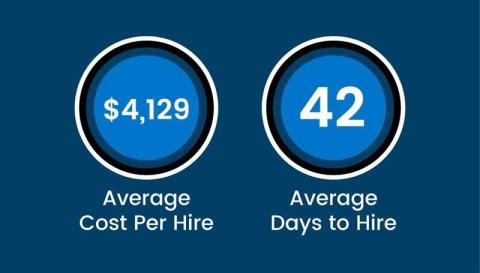
According to SHRM, a bad hire can cost you up to 30% of that employee’s first-year earnings. A $60,000 remote role, that's $18,000. For a $90,000 senior hire, it's $27,000, before you can even begin to count the second round of recruiting costs.
The total exposure breaks down across three budget lines that are rarely added together:
These costs don’t announce themselves. They accumulate silently across departments, times, and budget lines, which is exactly why most companies only notice them when the damage is already done.
A few questions worth running internally before your next hire:
If you don’t know these numbers, then it’s informative on its own. Most organizations fly blind on the downstream cost of fast, unstructured hiring. Which is exactly why the cycle repeats quarter after quarter.
You need to understand why this problem is getting worse and what is happening in the candidate pool.
The Indeed Hiring Lab’s 2026 U.S. Jobs & Hiring Trends Report identifies a persistent skills-to-openings mismatch as one of the defining challenges.
Every empty seat reflects productivity, opportunity, or the talent itself that slips through the cracks. Job openings are stabilizing, but the gap between what the role requires and what candidates can deliver remains a blank yet to be filled.
Research from the Josh Bersin Company makes this even sharper: in 2024, only 17% of applicants reached the interview stage. The vast majority of candidates who reached the pipeline were filtered out, yet the skills gap persists.
“Traditional recruiting isn't working.” — Josh Bersin Company, Talent Acquisition Revolution Report, 2025
So if you rely on a resume review and two video calls, it isn’t a screening for competence. There’s a clear difference between the candidate who interviews well and the one who performs well. Neither is always the same person.
It's not a reason to slow down the hiring, but to add a verification layer before you do.
Remote work does not create the mis-hire problems. They actually give you an accessible solution in the form of pre-vetted talent from around the globe.
Why should you limit yourself to a local candidate pool when you can select from a significantly larger and more competitive talent base?
Workplaces with remote-friendly policies experience 26% lower turnover than traditional setups, according to WeWorkRemotely’s 2025 report. Retention potential is real.
The variable that determines whether the right candidate was captured is based on the fact whether the candidate was properly vetted before they reached your table.
Pre-vetting is not only a background check. Pre-vetting remote talent is a strong combination of the global talent pool who come forward with the confidence that comes from knowing the hard screening work was done upstream.
You choose between candidates who have already proven they can do the work.
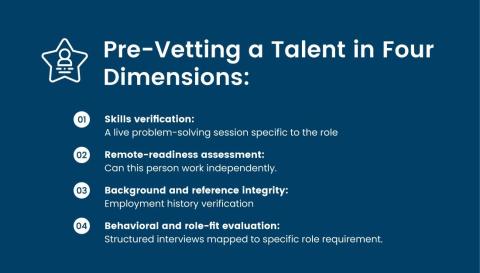
A rigorous pre-vetting covers four dimensions before a candidate even reaches your desk.
It can be verified with an actual task-based assessment. You can give a timed writing sample or a data analysis exercise. You will evaluate a live problem-solving session specific to the role that will determine the competence.
Think about:
Such qualities are assessable and highly predictive of remote performance, yet most fast-hiring processes skip them entirely.
Employment history is verified. At least two structured reference calls are expected. For specialized roles, credential verification is necessary. The goal is to eliminate any confusion or misrepresentation before it costs a full onboarding cycle.
In remote hiring, structured behavioral interviews are mapped to meet the role-specific requirements. This is where you can differentiate between a good and a bad hire.
Once these four layers are completed, your interview time drops from 10+ hours to 2-3 hours per hire. The remote staffing company serves as the first filter, handling pre-vetting, and you just have to shortlist the candidate from the pre-vetted talent list.
Businesses getting the most out of remote talent are focusing on a safe, reliable hiring process.
The misconception is that pre-vetted talent requires more of your time. The screening happens before you’re involved. Your role is to make the decision.
That’s it.
You spend less time on interviews that are like a black hole, and more time choosing between candidates who have already proven they can do the work.
If remote talent, done right, is an advantage, you can build your business on it.